Owner’s manual
 Error Codes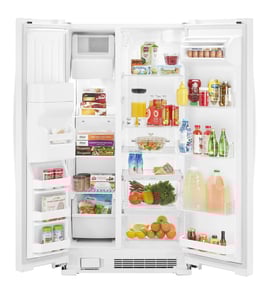




How wide is a 25.6 cubic foot refrigerator?
A 25.6 cubic foot refrigerator is typically about 36 inches wide. For the GE GSH25JSRFSS side-by-side refrigerator, the exact cabinet and door/handle width can vary by configuration, so we recommend confirming the published dimensions in the GSH25JSRFSS owner’s manual.
What “about 36 inches wide” usually means
Most 25 to 26 cu. ft. refrigerators are designed to fit standard 36-inch kitchen openings, but the measured width can change depending on trim and handles.
Common width factors include:
- Handles installed vs. removed
- Door style (side-by-side vs. French door)
- Hinge and door geometry (how far doors swing)
- Case width (cabinet) vs. overall width (doors/handles)
- Clearance needs for airflow and door opening
Quick sizing guide (typical ranges)
Use this as a planning baseline, then verify the exact spec for your unit.
| Measurement you’re checking | Typical value for 25.6 cu. ft. class | Why it differs |
|---|---|---|
| Cabinet (case) width | ~35 3/4 in. to 36 in. | Model-to-model cabinet design |
| Overall width (doors/handles) | ~36 in. to a bit over 36 in. | Handle style and door thickness |
| Recommended opening | 36 in. nominal | Allows fit plus small clearances |
Why it matters for installation
A refrigerator that is even 1/4 inch wider than expected can rub cabinets, prevent doors from opening fully, or make it hard to slide the unit into place. We also recommend allowing the clearances listed for airflow and service access.
If you are measuring for a replacement
- Measure the opening width at the front and back
- Check for countertop overhang or side panels
- Confirm door swing clearance at 90°
- Plan for water line routing if you have an icemaker/dispenser
- Verify the exact dimensions for your model in the GSH25JSRFSS owner’s manual
Last updated: January 2026
What is the average lifespan of a GE refrigerator?
GE refrigerators typically last 10 to 16 years. For your GE GSH25JSRFSS side-by-side refrigerator, that same 10 to 16-year lifespan range is the practical expectation when the doors seal well, temperatures stay stable, and routine cleaning is kept up (see the maintenance guidance in the GSH25JSRFSS owner’s manual).
What affects lifespan the most
A refrigerator’s life is usually determined by how hard the sealed system and airflow components have to work day to day.
- Keeping condenser areas clean so heat can dissipate properly
- Avoiding frequent, long door openings (reduces compressor run time)
- Maintaining good door gasket sealing to prevent warm-air leaks
- Replacing clogged water filters on schedule (helps dispenser and icemaker flow)
- Preventing heavy frost buildup by addressing defrost issues early
Typical lifespan by major system (what usually wears first)
These are common service-life patterns across GE side-by-side models like GSH25JSRFSS.
| Component/system | Typical outcome over time | What you may notice |
|---|---|---|
| Compressor and sealed system | Often lasts the longest | Warmer temps, long run times |
| Fans and airflow parts | Medium-life wear items | Noisy operation, uneven cooling |
| Defrost system | Medium-life wear items | Frost buildup, warm fridge section |
| Water/ice system | Higher maintenance area | Slow water, small cubes, no ice |
Maintenance that helps you reach the high end of the range
We recommend these habits for GE GSH25JSRFSS owners:
- Vacuum dust from the rear/lower area periodically (improves efficiency)
- Keep vents inside the refrigerator and freezer unblocked
- Clean door gaskets and confirm the doors close squarely
- Replace the water filter about every 6 months, or sooner if flow drops (use the refrigerator water filter MWFP)
- If you notice slow water or ice issues, check for restriction causes before they stress the system
Why it matters
A refrigerator that runs longer and harder than it should (due to dirty condenser areas, air leaks, or restricted water flow) tends to have more temperature swings and more wear on key components. Consistent airflow and clean heat exchange are the simplest ways to protect long-term reliability.
Last updated: January 2026
What is the most common problem with a GE refrigerator?
For the GE GSH25JSRFSS side-by-side refrigerator, the most common service issues we see are cooling problems (warm fridge or freezer) and ice maker or water dispenser problems. These usually trace back to airflow restrictions (dirty condenser coils), fan failures, defrost system faults, or a clogged water filter.
Most common symptoms and what they usually point to
- Refrigerator not cold enough: dirty condenser coils, weak condenser airflow, or temperature sensing issues
- Freezer cold but fridge warm: airflow/damper issue or evaporator fan problem
- Frost buildup on freezer back wall: defrost heater/thermostat problem
- Ice maker not making ice or slow ice: water supply issue, clogged filter, or ice maker component failure
- Low water flow at dispenser: clogged filter or water valve issue
For model-specific operating and troubleshooting steps, use the GSH25JSRFSS owner’s manual.
Quick checks you can do first (no parts swapping)
- Confirm temperatures: set controls to a mid setting and allow 12 hours between adjustments.
- Check airflow: do not block vents with food packages.
- Clean the condenser area: dust buildup can cause long run times and poor cooling.
- Listen for fans: you should typically hear airflow when the unit is running.
- Check water flow: if dispenser flow is weak, the filter is a top suspect.
Common parts involved (when symptoms match)
| Symptom | Likely system | Example compatible part for this model |
|---|---|---|
| Low water flow, slow ice | Filtration | Refrigerator water filter MWFP |
| Frost buildup, warm temps | Defrost system | Refrigerator defrost heater WR51X10055 |
| Warm fridge/freezer, poor airflow | Evaporator airflow | Dc evaporator motor WR60X10185 |
| No water to dispenser/ice maker | Water supply control | Refrigerator water valve WR57X33326 |
Why it matters
Cooling and ice maker complaints often start as simple maintenance issues (like restricted airflow or a clogged filter) but can lead to food spoilage, excessive run time, and heavier wear on components if ignored.
Last updated: January 2026
How to reset GE side by side refrigerator not cooling?
For GE model GSH25JSRFSS, the most reliable “reset” for a not-cooling condition is a power reset: unplug the refrigerator (or switch the breaker off) for 1 full minute, then restore power and allow up to 24 hours for temperatures to stabilize. See the GSH25JSRFSS owner's manual.
Quick reset steps (safe first)
- Set the refrigerator control to 5 and the freezer control to 5.
- Keep doors closed as much as possible.
- Unplug the refrigerator for 60 seconds.
- Plug it back in.
- Wait 12 hours before changing control settings again.
- Allow up to 24 hours for full cool-down after a reset.
If it still is not cooling after the reset
A reset will not fix a failed cooling component. On GSH25JSRFSS, the next best step is to confirm airflow and that the unit is actually running.
What to check right away
- Door seals are closing fully; nothing is holding doors open
- Air vents are not blocked by food in either compartment
- You hear the evaporator fan running in the freezer when the door switch is pressed
- The condenser area is not packed with dust
- The freezer temperature is dropping (a thermometer helps)
Parts that commonly affect “not cooling” symptoms
| Symptom | Likely area | Example compatible part |
|---|---|---|
| Temperatures seem erratic or display does not match actual temps | Temperature feedback issue | Refrigerator temperature sensor WR55X10025 |
| Frost buildup on freezer back wall, weak airflow | Defrost system problem | Refrigerator defrost heater WR51X10055 |
Why it matters
A power reset clears minor control glitches and restarts normal cycling. If cooling does not resume, checking airflow and key cooling controls helps you pinpoint the failure faster and avoid replacing the wrong part.
Last updated: January 2026