 Installation guide
 Owner’s manual
 Error Codes


How to check Kenmore dryer model number?
For Kenmore dryer model 11079822801, we check the model number on the model and serial number label attached to the dryer cabinet. On most dryers, you will find it inside the door opening on the cabinet frame, or on the back of the dryer near the top.
Where to look on a Kenmore dryer
Check these common label locations first:
- Inside the dryer door opening on the cabinet frame (most common)
- On the back panel near the top edge
- Along the door opening edge where the door closes
- On the cabinet side panel near the top (less common)
If you are using the dryer user instructions, the manual also notes that the model and serial number are found on the product label. See the 11079822801 owner's manual.
What to write down (and why)
Record these items exactly as shown on the label:
- Model number (for example: 11079822801)
- Serial number
- Purchase date (if available)
Why it matters
The model number is how we match the correct Kenmore dryer parts list, wiring diagram references, and troubleshooting steps. Even small differences in a model number can change which timer, door switch, or gas burner parts fit.
Quick ID checklist
| Item on label | What it’s used for |
|---|---|
| Model number | Correct part fit and diagrams |
| Serial number | Production series and service history |
| Purchase date | Warranty and maintenance tracking |
If the label is hard to read
- Wipe the label gently with a damp cloth and dry it
- Use a flashlight at an angle to reduce glare
- Take a close-up photo and zoom in
- If the label is missing, check your original paperwork and the 11079822801 installation guide for model identification references
Last updated: February 2026
What is an F1 code on a Kenmore dryer?
An F1 code on a Kenmore dryer typically points to a control problem, most often the electronic control board detecting an internal fault or a stuck key input. On model 11079822801, start by resetting power, then check wiring connections and the console controls per the 11079822801 owner’s manual.
Quick checks we recommend first
- Unplug the dryer (or switch off the breaker) for 5 minutes, then restore power and try a cycle.
- If the code returns immediately, press each console button once to check for a stuck key.
- Confirm the dryer is on a dedicated 120V, 15 or 20 amp grounded outlet (no extension cords).
- If the dryer runs but behaves oddly, clean the lint screen and verify airflow to prevent overheating-related shutdowns.
- If you recently moved the dryer, re-check installation basics in the 11079822801 installation guide.
What usually causes the F1 code
In most Kenmore 110-series dryers, F1 is triggered by one of these conditions:
- Failed electronic control board (internal sensing fault)
- Stuck or shorted console key (user interface issue)
- Loose or oxidized wire harness connection at the control
- Power supply issues (intermittent voltage, poor grounding)
What to do next (diagnosis path)
| What you see | Most likely issue | What we do next |
|---|---|---|
| F1 comes back right after reset | Control board or stuck key | Inspect console keys and control connections |
| F1 appears mid-cycle | Intermittent control or power issue | Check outlet, cord, grounding, harness fit |
| Dryer won’t start and shows F1 | Control not processing inputs | Verify door closes, then test control circuit |
Why it matters
When the control can’t reliably read inputs or internal signals, the dryer may stop mid-cycle, not start, or run unpredictably. Addressing an F1 code quickly helps prevent repeated shutdowns and protects components like the drive motor and heating system from abnormal operation.
Last updated: February 2026
How to hard reset a Kenmore dryer?
To hard reset your Kenmore dryer model 11079822801, disconnect power by unplugging the dryer (or switching the breaker off) for 1 to 5 minutes, then restore power and restart a cycle. This clears many control glitches and gets the dryer ready for normal operation.
Hard reset steps (safe, works for most Kenmore dryers)
- Turn the cycle selector to Off.
- Unplug the dryer (or turn Off the circuit breaker).
- Wait 1 to 5 minutes.
- Restore power.
- Close the door, select a cycle, and press PUSH TO START (as described in the 11079822801 owner's manual).
If the dryer still will not start after a reset
Use this quick checklist from common start-up requirements:
- Confirm the dryer is plugged into a grounded 3-prong outlet.
- Check the house fuse/circuit breaker (reset if tripped).
- Make sure the dryer door is fully closed.
- Verify the vent is not crushed or kinked.
- If it is a gas dryer, confirm the gas shutoff valve is open.
| Symptom after reset | Most likely area to check | Common next step |
|---|---|---|
| No response at all | Power supply, door circuit | Check breaker; test door switch |
| Runs but no heat (gas) | Gas supply, ignition system | Confirm shutoff valve; inspect igniter/coils |
| Starts then stops quickly | Overheat/airflow issue | Clean lint screen; check venting |
Parts that commonly cause “won’t start” symptoms
If power and door closure are good, these parts are frequent culprits:
- Dryer door switch WP3406107 (dryer thinks the door is open)
- Dryer timer WPW10185997 (cycle power not being sent correctly)
- Dryer high-limit thermostat W11050897 (overheat protection can interrupt operation)
Why it matters
A hard reset clears temporary electronic or control-state issues, but it will not fix a mechanical failure (like a bad door switch) or a safety condition (like restricted airflow). Checking power, door closure, and venting prevents repeat shutdowns and protects drying performance.
Last updated: February 2026
What size is a Kenmore Model 11079822801 dryer?
Most Kenmore model 11079822801 dryers are full-size units that measure about 27 inches wide, 27 to 29 inches deep, and 43 to 44 inches tall. For installation planning, allow at least 5-1/2 inches of clearance behind the dryer for the exhaust vent elbow (a common requirement for this model). See the 11079822801 installation guide for the exact fit and clearance details.
Typical dimensions and what to plan for
These are the measurements we use most often for Kenmore 110-style full-size dryers when you are measuring a laundry space.
- Width: ~27 in.
- Height: ~43 to 44 in.
- Depth (cabinet): ~27 to 29 in.
- Rear clearance for venting: minimum 5-1/2 in. behind the dryer (for vent with elbow)
- Floor requirements: sturdy, level floor; maximum slope of 1 inch under the entire dryer
Quick measurement checklist (before you buy parts or install)
Measure your space and compare it to the dryer plus clearances.
- Measure the opening width (wall to wall)
- Measure depth to the back wall and note any baseboards
- Measure height to shelves or cabinets above
- Confirm you have room for the door swing
- Plan the vent path; the straightest route dries best
Common sizing reference table
| What you are measuring | Typical for 11079822801 | What to include |
|---|---|---|
| Laundry opening width | 27 in. dryer | Add side wiggle room for leveling and airflow |
| Depth to back wall | 27 to 29 in. dryer | Add 5-1/2 in. minimum for vent elbow clearance |
| Height under cabinets | 43 to 44 in. dryer | Add room to open/close the control console area |
Why it matters
Correct sizing prevents crushed venting, poor airflow, and long dry times. On gas dryers, proper exhaust setup is also a key safety and performance requirement. For vent length limits and elbow allowances, use the 11079822801 installation guide.
Last updated: February 2026
How do I know if my Kenmore dryer thermal fuse is blown?
On Kenmore dryer model 11079822801, a blown thermal fuse typically shows up as a dryer that will not run at all, or a dryer that tumbles but has no heat (especially if only one side of the power supply is working). The sure way to confirm is a continuity test with the dryer unplugged; no continuity means the fuse is blown. See the 11079822801 owner's manual for model-specific troubleshooting checks.
Quick symptoms to look for
- Dryer does not start (no motor run, no drum movement)
- Drum turns but there is no heat (common when a fuse or power leg issue is present)
- Cycle runs unusually long because heat is cutting out
- Burning smell or very hot cabinet (stop using the dryer and correct airflow issues)
How we test a thermal fuse (safe, accurate method)
- Unplug the dryer (or switch off the breaker).
- Access the thermal fuse area (commonly on the blower housing or exhaust duct on many Kenmore 110-style dryers).
- Pull the wires off the fuse terminals.
- Set a multimeter to continuity or ohms.
- Touch a probe to each terminal.
Result guide
| Meter result | What it means | What to do next |
|---|---|---|
| Beep or near 0 ohms | Fuse is good | Check door switch, timer, motor circuit, and power supply |
| No beep or OL/infinite | Fuse is blown | Replace the fuse and fix the airflow restriction that caused overheating |
Checks to do before replacing parts
The troubleshooting section in the manual notes that a dryer can run with no heat if a household fuse is blown or a breaker is tripped (some dryers use two fuses/breakers). Use these checks first:
- Confirm the dryer is plugged into the correct outlet and power is on
- Check both sides of the electrical supply (reset both breakers if applicable)
- Make sure the door fully closes and the start control is engaged
- Verify venting is clear and not crushed behind the dryer
Why it matters
A thermal fuse is a one-time safety device. If it blows, it usually means the dryer overheated due to restricted airflow (lint buildup, blocked vent, or a failing blower wheel). Replacing the fuse without fixing airflow often leads to repeat failures.
Last updated: February 2026
How to replace a Kenmore dryer thermistor?
On Kenmore dryer model 11079822801, the thermistor is typically mounted on the blower housing or exhaust duct inside the cabinet. Replace it by disconnecting power, accessing the blower area, moving the wire connector to the new sensor, and reassembling the dryer; confirm access panels and screw locations in the 11079822801 owner's manual.
Before you start (safety and prep)
- Unplug the dryer (or switch off the breaker) before servicing.
- If you have a gas dryer, close the gas shutoff valve before opening the cabinet.
- Let the dryer cool completely.
- Take a photo of the wiring before you disconnect anything.
- Clean the lint screen and remove lint buildup while the dryer is open.
Replacement steps (typical for this Kenmore-style dryer)
- Disconnect power.
- Remove the rear panel (or the lower access panel, depending on your configuration).
- Locate the blower housing or exhaust duct; the thermistor is usually a small sensor with a 2-wire connector.
- Pull off the wire connector from the thermistor terminals.
- Remove the mounting screw(s) and take out the thermistor.
- Install the new thermistor in the same position and tighten the screw(s).
- Reconnect the wire connector firmly.
- Reinstall panels, restore power (and gas if applicable), then run a timed heat cycle to verify normal heating and cycling.
What to check if drying is still inconsistent
- Venting restriction (long dry times, overheating, or cycling issues)
- Lint buildup at the blower wheel or duct
- Temperature control parts that work with the thermistor, such as the dryer high-limit thermostat W11050897
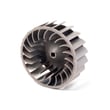
- Airflow problems from a damaged dryer blower wheel WP697772
Quick symptom guide
| Symptom | Common cause | What we do next |
|---|---|---|
| Runs but no heat | Ignition/heating circuit issue | Check igniter and gas valve coils on gas models; check thermostats |
| Heat shuts off too soon | Airflow restriction or sensor issue | Inspect venting, then test/replace thermistor |
| Long dry times | Poor airflow or lint blockage | Clean vent path and blower housing |
Why it matters
The thermistor helps the dryer regulate exhaust temperature. When it drifts out of range, the dryer can under-dry, overheat, or cycle heat incorrectly, which also increases wear on components and can worsen lint-related airflow problems.
Last updated: February 2026








