Installation guide
 Owner’s manual
 Error Codes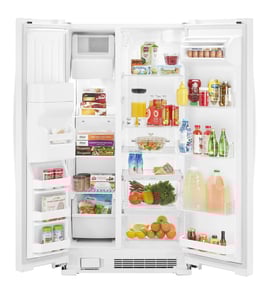



How many cubic feet is a KitchenAid KSRG22FKSS18 refrigerator?
The KitchenAid KSRG22FKSS18 side-by-side refrigerator is about 25.3 cubic feet total capacity. Use this number for comparing models and planning food storage; exact usable space can vary slightly based on shelves, bins, and ice maker configuration.
Quick capacity details
- Total capacity: 25.3 cu. ft.
- Capacity is a model-level spec, not a setting you can adjust
- Usable space changes with:
- Ice maker bucket installed
- Door bins and can racks installed
- Shelf positions and accessories
- Airflow clearance around vents
Where to confirm the spec for your exact configuration
The most reliable place to confirm capacity and feature configuration for your unit is the KSRG22FKSS18 owner's manual.
Why it matters
Capacity helps you compare side-by-side refrigerators and estimate storage, but day-to-day performance depends more on correct temperatures (typically 37°F fresh food, 0°F freezer), good airflow, and door seal condition.
Related specs at a glance
| Spec | What it tells you | Why you care |
|---|---|---|
| Cubic feet (cu. ft.) | Total interior volume | Storage planning and model comparisons |
| Shelf/bin layout | How space is divided | Real-world usable space |
| Ice maker/dispenser | Space taken by ice system | Can reduce usable freezer volume |
Last updated: February 2026
How do I reset my KitchenAid refrigerator not cooling?
If your KitchenAid KSRG22FKSS18 refrigerator isn’t cooling, the most effective “reset” is a power reset: turn the unit off, remove power briefly, then restore power and confirm the controls are on. After power is restored, allow up to 24 hours for temperatures to stabilize (especially after a new install or long outage). See the owner's manual for the exact control type and ON/OFF steps for your model.
Power reset steps (safe, quick)
- Unplug the refrigerator from a grounded 3-prong outlet.
- Wait 2 to 5 minutes.
- Plug it back in (or reset the tripped breaker).
- Make sure the temperature controls are turned on.
- Set both refrigerator and freezer controls to the mid-setting.
- Keep doors closed as much as possible while it recovers.
What to check right after the reset
- Outlet power: Plug in a lamp to confirm the outlet works.
- Controls and settings: Mid-settings are the normal starting point; colder settings will not cool faster.
- Airflow: Make sure interior air vents are not blocked by food packages.
- Time: Wait at least 24 hours after turning the refrigerator on before judging cooling performance.
Control types and what “reset” looks like
| Control style | What you do | What to expect |
|---|---|---|
| Slide controls | Move freezer and refrigerator sliders to mid-setting | Wait 24 hours between adjustments |
| Electronic controls | Confirm controls are ON; return settings to mid-setting | Indicator lights show current settings |
| Digital controls | Confirm unit is ON; use recommended default settings | Temperatures stabilize over several hours |
Why it matters
A power reset clears minor control glitches, but most “not cooling” complaints come from power issues, controls being off, blocked vents, or not allowing enough time after startup. Starting at the mid-setting and waiting the full 24 hours prevents over-adjusting and chasing temperature swings.
Last updated: February 2026
How big is the KitchenAid KSRG22FKSS18?
The exact overall size (height, width, depth) and total capacity for the KitchenAid KSRG22FKSS18 are listed in the product specifications section of the owner's manual. Most KitchenAid side-by-side refrigerators of this style are about 33 to 36 inches wide and roughly 65 to 71 inches tall.
What “big” usually means (and what to measure)
To make sure the KSRG22FKSS18 fits your space, we recommend checking these measurements:
- Overall width (cabinet and doors)
- Overall height (floor to top hinge cover)
- Overall depth (doors closed, and doors open 90 degrees)
- Clearance needs (sides, top, and back for airflow)
- Door swing space (so bins and drawers can open fully)
Quick planning guide (typical side-by-side ranges)
Use these common ranges to plan, then confirm the exact numbers in your manual.
| Measurement | Typical range for side-by-side refrigerators | Why it matters |
|---|---|---|
| Width | 33 to 36 in. | Cabinet opening and door clearance |
| Height | 65 to 71 in. | Overhead cabinets and trim |
| Depth | 30 to 35 in. | Walkway space and door swing |
Why it matters
A refrigerator that is even 1 inch too wide or too deep can prevent proper installation, reduce airflow (which hurts cooling efficiency), or keep the doors from opening far enough to remove shelves and bins.
Related tip for installation
If you are moving the refrigerator in or adjusting clearances, follow the leveling and placement steps in the installation guide so the doors seal correctly and the unit runs efficiently.
Last updated: February 2026
What causes a side-by-side refrigerator to stop cooling?
If your KitchenAid KSRG22FKSS18 side-by-side refrigerator stops cooling, the most common causes are loss of power, controls set incorrectly, doors left open, or airflow blocked by food. After a new installation, it can also take a full 24 hours to cool completely (see the owner's manual).
Quick checks we recommend first
- Confirm the power cord is fully plugged into a grounded 3-prong outlet.
- Test the outlet by plugging in a lamp.
- Check the household fuse or reset the circuit breaker.
- Make sure the refrigerator controls are turned on and set correctly.
- If it was just installed or moved, allow 24 hours for full cooling.
- Make sure doors are closing fully and not being held open by bins or packages.
Airflow and loading issues that mimic “no cooling”
Cold air has to circulate between compartments. If vents are blocked or the unit is overpacked, temperatures rise even though the compressor is running.
| What you notice | Likely cause | What to do |
|---|---|---|
| Warm fridge and freezer after a big grocery load | Large load added | Wait several hours; avoid overpacking |
| Temps creep up, especially during the day | Doors opened often or left open | Minimize openings; verify doors seal and close |
| One area warm, another cold | Blocked vents | Clear space around interior vents |
When it points to a part or repair issue
If power and settings are correct and temperatures still will not recover, common repair-related causes include a failed evaporator fan, defrost system trouble, or a control problem.
- Loud buzzing or no ice production can also relate to water/ice system operation.
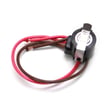
- Frost buildup on the freezer back wall often points to a defrost issue; the refrigerator defrost bi-metal thermostat WPW10225581 is one part used in the defrost circuit.
- Poor airflow in the freezer can involve the evaporator fan area; see how to fix your evaporator cooling fan.
Why it matters
Running warm can spoil food quickly and can make the compressor run longer than normal. Catching simple issues (power, controls, doors, airflow) early prevents unnecessary part replacement and downtime.
Last updated: February 2026
What is the most common problem with KitchenAid refrigerators?
The most common KitchenAid refrigerator problems are ice maker and water dispenser issues, followed closely by cooling and temperature-control complaints. On your KitchenAid KSRG22FKSS18 side-by-side refrigerator, these symptoms often trace back to water filtration, airflow (evaporator fan), or defrost system performance; the owner's manual outlines the model’s normal operation and care.
Most common symptoms we see
- Ice maker not making ice or making small/hollow cubes
- Water dispenser flow is slow or stops
- Refrigerator section too warm or freezer too warm
- Frost buildup on the back wall of the freezer
- Water leaking inside the fresh food section or pooling under the unit
- Unusual fan noise or intermittent buzzing
Quick checks that solve many calls
Start with the basics before replacing parts:
- Confirm the temperature settings are at normal targets (typically 37°F fresh food, 0°F freezer).
- Clean condenser coils and make sure the toe grille area is not blocked.
- Make sure doors seal fully and close on their own.
- If water flow is weak, replace the filter and purge air from the dispenser.
- If you see frost buildup, suspect a defrost issue (thermostat, heater, airflow restriction).
Parts that commonly relate to these problems (KSRG22FKSS18)
| Problem area | What you notice | Part that often applies |
|---|---|---|
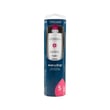
| Water filtration | Slow water, poor ice quality | Refrigerator water filter EDR5RXD1 |
| Defrost control | Frost buildup, warm temps, fan noise from ice | Refrigerator defrost bi-metal thermostat WPW10225581 |
| Ice production | No ice, intermittent harvest | Refrigerator ice maker WPW10190961 |
| Air circulation | Warm spots, noisy or stalled airflow | Refrigerator evaporator fan motor WP2315549 |
Why it matters
Ice maker and cooling problems can look “random,” but they usually come from one system affecting another. For example, a restricted water filter can reduce ice output, and a defrost problem can create frost that blocks airflow, making temperatures swing.
Helpful DIY guidance
- For filter-related issues and replacement steps, use how to replace the water filter in a KitchenAid refrigerator.
Last updated: February 2026