

What model is my Kenmore dryer?
Your Kenmore dryer’s model number is printed on the appliance’s ID label; once you find it, match it exactly (letters and numbers) to look up the correct parts and diagrams. For this parts page, the model is Kenmore 11087870100.
Where to find the model number label
On most Kenmore dryers, we see the model/serial label in one of these spots:
- Inside the dryer door opening (on the door frame or cabinet front)
- On the back panel of the dryer cabinet
- Behind the lint screen area (check the housing area around the lint screen)
- On the side panel near the front edge (less common)
How to read the model number (and why it matters)
Kenmore model numbers are usually a long string of digits. The first three digits often indicate the manufacturing source (for example, many 110-prefix Kenmore dryers are Whirlpool-built), which helps ensure the right part fit.
Quick check table
| What you see on the label | What it means for parts lookup |
|---|---|
| Exact model number (example: 11087870100) | Use it to match parts lists and diagrams exactly |
| Extra characters or spaces | Ignore spaces; keep the digits/letters in the same order |
| Serial number | Useful for production date; not a substitute for the model number |
Common mistakes that cause wrong parts
- Using only the first 3 digits (example: using “110” instead of 11087870100)
- Mixing up similar digits (0 vs O, 1 vs I)
- Ordering by a part number from a different Kenmore series
- Assuming “Kenmore” alone is enough (it is not)
If you are replacing a common wear item
Once you confirm your model number, match the part to that model. For example, a frequent replacement on Kenmore 11087870100 is the drum belt: belt 341241.
Why it matters
Using the exact model number prevents fit issues and repeat repairs; Kenmore dryers can look identical across series but use different belts, switches, and gas ignition parts.
Last updated: February 2026
How to remove front panel of Kenmore dryer?
To remove the front panel on a Kenmore dryer model 11087870100, we unplug the dryer, open the cabinet (top or lower access area, depending on the build), remove the front-panel mounting screws, then lift the panel up and off while supporting the drum and disconnecting any door-switch wiring.
Before you start (safety and prep)
- Unplug the dryer from the wall outlet.
- If it is a gas dryer, shut off the gas supply valve.
- Pull the dryer forward so you can reach the back and sides.
- Have a small container ready for screws.
- Take a quick photo of wire connections before disconnecting anything.
Front panel removal steps (common Kenmore 110-style cabinet)
- Remove the lint screen (if it pulls out from the top).
- Release the top:
- Remove screws in the lint-screen housing (if present), or
- Use a putty knife to release spring clips near the front corners, then lift the top.
- Disconnect the door switch: locate the door-switch connector and unplug it.
- Remove the front panel screws:
- Look for screws at the inside top corners of the front panel, and/or
- Screws along the lower edge (some versions use a lower toe panel first).
- Lift the front panel off: pull the top of the panel slightly forward, then lift up to unhook it from the bottom clips.
- Support the drum if the front panel also supports the drum front; avoid letting the drum drop.
If you need drum access after the panel is off
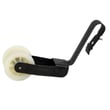
If you are going in for a squeal, thump, or no-tumble issue, the next common parts to inspect are the belt and idler pulley, such as the belt 341241 and the dryer idler pulley WP691366.
What you will typically need
| Item | Why it helps |
|---|---|
| Putty knife | Releases top spring clips |
| 1/4-in nut driver or Phillips screwdriver | Removes cabinet screws |
| Work gloves | Protects hands from sharp edges |
| Phone/camera | Records wire routing and screw locations |
Why it matters
Removing the front panel correctly prevents cabinet damage, protects the door-switch wiring, and keeps the drum aligned. That makes belt, motor, blower wheel, and lint-chute repairs faster and helps the dryer run quietly afterward.
Last updated: February 2026
How do I know if my Kenmore dryer thermal fuse is blown?
On Kenmore model 11087870100, a blown thermal fuse typically shows up as a dryer that will not start (most common) or runs but won’t heat (on some designs). The sure way to know is to unplug the dryer and test the fuse for continuity with a multimeter; no continuity means the fuse is blown.
Quick symptoms checklist
- Dryer won’t start, even though the outlet has power
- Motor hums briefly then stops (some cases)
- Dryer runs but has no heat (less common, depends on wiring)
- Problem started after long dry times or restricted airflow
- Lint screen area feels unusually hot
How to test the thermal fuse (continuity test)
- Unplug the dryer (and shut off gas if you have a gas model).
- Access the blower housing or exhaust duct area where the thermal fuse is commonly mounted.
- Remove at least one wire from the fuse terminal.
- Set your multimeter to continuity or ohms.
- Touch probes to the fuse terminals.
- Good fuse: continuity (beep) or near 0 ohms
- Blown fuse: no beep or OL/infinite resistance
What to do if the fuse is blown
A thermal fuse usually blows because the dryer overheated from poor airflow. Fix the airflow issue before running the dryer again.
Common airflow fixes:
- Clean the lint screen and the lint screen housing; replace a damaged screen such as whirlpool dryer lint screen (white) WPW10717210
- Inspect and clear the lint chute; a damaged chute can be replaced with dryer lint chute assembly W11117429
- Check the vent hose for kinks, crushing, or heavy lint buildup
- Confirm strong airflow at the outside vent hood
Why it matters
The thermal fuse is a one-time safety device. If you replace it without correcting venting or lint buildup, the dryer can overheat again and blow the new fuse, causing another no-start or no-heat failure.
Symptom to likely cause (fast guide)
| What you see | Most likely issue | What to check first |
|---|---|---|
| Won’t start | Blown thermal fuse, door switch, motor circuit | Thermal fuse continuity, door switch |
| Runs but no heat | Heating circuit issue, airflow restriction | Venting, burner/heat components |
For broader Kenmore dryer diagnostics, use Kenmore 110 series electronic control model dryer error codes.
Last updated: February 2026
Why does my Kenmore dryer make a loud noise?
A loud noise in your Kenmore dryer model 11087870100 almost always comes from a worn moving part: the drum drive belt, idler pulley, blower wheel, or drum bearing surfaces. We focus first on the sound type (squeal, thump, rumble, scraping) because it points to the most likely part to inspect and replace.
Match the noise to the most likely cause
- High-pitched squeal: idler pulley or belt slipping; check the dryer idler pulley WP691366.
- Thumping (steady bump-bump): belt damage or a flat spot developing; inspect the belt 341241.
- Rattling or vibration: loose debris in the blower housing or a cracked wheel; inspect the dryer blower wheel WP694089.
- Scraping or metal-on-metal: front drum bearing area; inspect the bearing ring 279441.
- Buzzing or humming with poor airflow: blower wheel obstruction or damage; again, check the dryer blower wheel WP694089.
Quick checks we recommend before ordering parts
- Unplug the dryer (and shut off gas if it is a gas model) before opening any panels.
- Spin the drum by hand; listen for squeaks, grinding, or a repeating thump.
- Check the lint screen and chute area for coins, buttons, or lint buildup.
- Look for belt dust (black rubber debris) near the motor or idler area.
- Inspect the blower wheel for wobble, cracks, or anything rubbing the housing.
Common noisy-part symptoms (at a glance)
| Noise you hear | Most common source | What you typically find |
|---|---|---|
| Squeal | Idler pulley | Pulley wobbles, squeaks, or feels rough |
| Thump | Drum belt | Frayed belt, glazed spots, stretched belt |
| Rattle | Blower wheel | Debris inside, wheel loose on shaft |
| Scrape/rumble | Front bearing area | Worn bearing surface or scoring |
Why it matters
A noisy dryer often keeps running for a while, but the underlying wear can lead to a broken belt, overheating from restricted airflow, or motor strain. Fixing the noise early helps protect the drive motor and keeps drying times normal.
For additional DIY guidance on dryer components and what they do, use what are the main parts of a clothes dryer.
Last updated: February 2026