Owner’s manual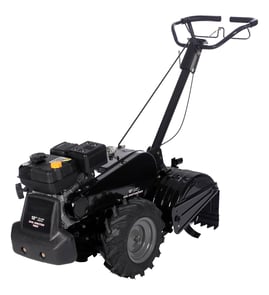



How deep can a rear tine tiller dig?
On the Craftsman 917299061 rear-tine tiller, we recommend a typical tilling depth of 4 to 6 inches for best soil preparation. You can go deeper in stages using the depth stake, but trying to till too deep too fast can overload the machine (see the 917299061 owner's manual).
What depth to use for common jobs
- New garden bed prep: 4 to 6 inches (best overall tilling depth)
- Mixing compost or amendments: 4 to 6 inches, then a second pass if needed
- Weed control (cultivating between rows): 1 to 3 inches
- Breaking hard ground or sod: start shallow, then deepen gradually
| Task | Recommended depth | Notes |
|---|---|---|
| General tilling | 4 to 6 in. | Best balance of soil breakup and control |
| Cultivating | 1 to 3 in. | Helps uproot weeds without disturbing roots |
| Hard soil first pass | 2 to 4 in. | Reduce bounce and improve handling |
How to increase depth safely (without overloading)
- Set the depth stake for a shallow first pass.
- Make multiple passes, lowering the depth stake a little each time.
- Slow your forward progress; let the tines do the work.
- In very hard ground, apply slight upward pressure on the handlebars or reduce depth.
- Avoid tilling when soil is extremely wet (it can clump) or bone dry (poor penetration).
Signs you are trying to till too deep
- The tiller surges forward or becomes hard to control.
- Excessive bouncing in dry, hard soil.
- Shallow digging even with the depth stake set deeper (often worn tines).
Quick parts check if depth suddenly gets worse
Worn tines make the tiller work harder and dig more shallow. If your tines are worn or bent, inspect and service them using the how to replace the tines on a rear tine tiller guide.
Why it matters
Using the right depth protects the transmission and drive system, improves soil texture for root growth, and helps you avoid unsafe handling that can happen when tines catch in hard ground.
Last updated: January 2026
What tiller is made in the USA?
Some tiller brands manufacture certain models in the United States, but the most reliable way to confirm “Made in USA” is to check the specific model’s product label and documentation. For your Craftsman rear-tine tiller model 917299061, use the 917299061 owner's manual to identify the exact model details, then verify the country-of-origin marking on the machine.
How to confirm where a tiller is made
Look for the country-of-origin marking in these common places:
- Product ID plate or decal on the tine shield, frame, or engine area
- Engine label (engine and tiller may have different origins)
- Carton label (if you still have the box)
- Owner documentation and warranty pages
- Retail listing specifications (useful for cross-checking)
What “made in the USA” can mean for tillers
Country-of-origin claims vary. Here are the most common labels you may see:
| Label on product | What it typically means | What to do next |
|---|---|---|
| Made in USA | Manufactured in the U.S. under applicable labeling rules | Confirm on the ID plate and keep a photo for records |
| Assembled in USA | Final assembly in the U.S.; parts may be global | Check the ID plate for additional wording |
| Made in USA with global parts | U.S. manufacturing with imported components | Verify both tiller and engine labels |
| Imported | Manufactured outside the U.S. | Use the model label for the exact country |
Why it matters
Knowing where a tiller is made helps when you are comparing build standards, sourcing parts, and matching service information. For example, maintenance items like belts and cables are wear parts on many rear-tine tillers, and correct identification helps you order the right replacements.
Parts that commonly come up during ownership
If you are troubleshooting performance or doing routine maintenance on model 917299061, these are common wear or service items:
- Drive belt (example: husqvarna rear-tine tiller drive belt 591372401)
- Clutch cable (example: tiller clutch cable 532110675)
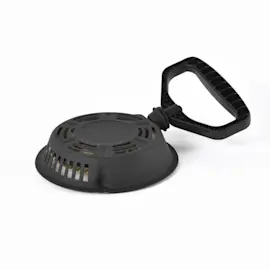
- Recoil starter (example: tiller recoil starter 532420603)
Last updated: January 2026
How to use a tiller with front tines?
A front-tine tiller is controlled differently than your Craftsman model 917299061 because 917299061 is a rear-tine tiller with wheel drive and a shift lever. For 917299061, use the wheel-drive gears and depth stake to control speed and digging; follow the steps in the Craftsman 917299061 owner's manual.
If you are using a front-tine tiller (general technique)
Front-tine units tend to pull themselves forward as the tines bite, so your job is to manage depth and keep the machine from surging.
- Start at the shallowest depth and make multiple passes
- Use a moderate throttle until you learn how aggressively the tines grab
- Keep a firm two-hand grip and a stable stance
- Let the tiller work; do not force it deeper in one pass
- If the tines catch hard ground and the tiller lunges, let go of the handlebars and do not restrain the machine
How to operate your Craftsman 917299061 (rear-tine basics)
This model uses wheel drive and a transmission, so you control travel with the drive control bar and shift lever, not by “holding it back” like a front-tine tiller.
- Know all controls before adding fuel and oil or starting the engine
- To start tine movement: move the shift lever to the till position and engage the drive control bar
- To stop tines: release the drive control bar; move the shift lever to neutral (N)
- For transport: set the depth stake to the transport position so tines do not scuff the ground
- For reverse: do not stand directly behind the tiller; slow the throttle, shift to reverse, then engage the drive control bar
Quick comparison: front-tine vs rear-tine control
| Item | Front-tine tiller | Rear-tine tiller (Craftsman 917299061) |
|---|---|---|
| What drives it | Tines pull the unit | Wheels drive; tines till |
| Main control | Handle pressure and depth | Shift lever, drive control bar, depth stake |
| Common risk | Sudden forward lunge in hard soil | Shifting/reverse safety and traction control |
Why it matters
Using the correct technique prevents loss of control and reduces strain on the drive system (belts, cables, and transmission). Rear-tine models like Craftsman 917299061 are designed to be guided with gears and depth settings for steadier tracking.
Last updated: January 2026