Owner’s manual
 View engine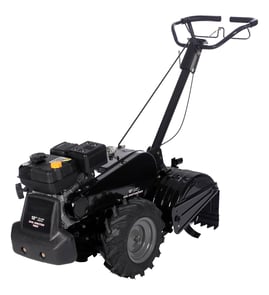


Where is the model number on a tiller?
On the Craftsman rear-tine tiller model 917297031, the model number is printed on the product identification label. On most tillers, that label is typically placed where it stays protected but still readable, such as near the tine shield/guard area or on the engine/fuel tank area.
Common places to check on a rear-tine tiller
Look for a sticker or metal tag in these spots:
- On or near the tine shield (tine guard) behind the tines
- On the main frame rail near the transmission/gear case
- Near the handle support or control panel area
- On the engine shroud or near the fuel tank (engine identification label)
- On the left side of the mainframe near belt guards
If the label is dirty or faded, wipe it with a damp rag and mild cleaner so the numbers are readable.
What numbers you might see (and which one to use)
Tillers often have more than one identification number. Use this quick guide:
| Label shows | What it identifies | When to use it |
|---|---|---|
| 917297031 | Tiller model number (Craftsman) | Ordering chassis parts, belts, tines, wheels, guards |
| 120202-3780-B1 or 120202-0417-E1 | Engine model number (Briggs & Stratton) | Ordering engine-specific parts (carburetor, ignition, gaskets) |
For parts diagrams and model-specific lists, match the tiller model number exactly in the 917297031 owner’s manual.
Why it matters
Using the correct model number prevents ordering the wrong parts. Craftsman tillers can look similar across years, but small changes in the gear case, belt routing, and tine assemblies can require different parts.
Last updated: January 2026
What are the common problems with lawn tillers?
Common problems on a Craftsman tiller like model 917297031 are no-start conditions, rough running, poor tilling performance, and tines that stop turning under load. Most issues trace back to fuel quality, ignition, drive or tine shear protection, or operating the tiller too deep or too fast (see the 917297031 owner's manual).
Most common symptoms and what usually causes them
- Engine will not start: stale fuel, clogged fuel passages, dirty spark plug, choke not set correctly
- Engine runs rough or misfires: carburetor mixture out of adjustment (especially in cold weather or high altitude), dirty plug, restricted fuel flow
- Poor tilling or excessive bouncing: soil too dry or too wet, trying to till too deep too quickly (manual recommends 4 to 6 inches for best tilling depth)
- Tines stop turning or jam easily: vines/long grass wrapped around tine shaft, broken shear pin(s), drivetrain wear
- Oil leak at gear case area: worn seal or gasket at the gear case
Quick checks we recommend before buying parts
- Shut the tiller down safely: stop the engine, wait for all moving parts to stop, and disconnect the spark plug wire.
- Confirm soil conditions: hard dry soil causes bounce; extremely wet soil clumps and reduces tilling quality.
- Inspect the tine area: remove wrapped vegetation from the tine shaft.
- Check shear pins and fasteners: shear pins are designed to break to protect the transmission; also check bolts for tightness.
- If you suspect a gear case leak: look for wet, oily dirt buildup around the gear case seam and shaft areas.
Common problem-to-fix guide
| Problem | What to check first | Typical fix |
|---|---|---|
| Won’t start | Fuel, spark plug, choke | Refresh fuel, clean/replace plug, verify choke use |
| Rough running | Carb mixture (temp/altitude) | Adjust carburetor per manual |
| Poor tilling | Depth and speed, soil moisture | Till 4 to 6 inches, slow down, pre-moisten hard soil |
| Tines stop turning | Shear pins, wrapped debris | Clear debris; replace correct shear pins |
| Gear case seep/leak | Seals and gasket surfaces | Replace seal or gasket such as rally tiller gear case oil seal 532155236 or rally tiller gear case gasket 532431022 |
Why it matters
Catching these issues early prevents transmission damage (shear pins are a built-in safeguard) and improves handling. The manual also warns that tines can catch in hard ground and propel the tiller forward, so correct depth and speed are safety-critical.
Last updated: January 2026
Are rear tine tillers better?
Yes, a rear-tine tiller is the better choice when you need maximum digging power and control, especially for breaking new ground, working rocky soil, or cutting through roots. The Craftsman 917297031 is a rear tine tiller with counter rotating tines and a 17-inch tine width, built for tougher tilling.
When a rear-tine tiller is the better choice
Rear-tine tillers put the tines behind the wheels, which improves traction and stability. Counter rotating tines (like on model 917297031) also help the machine bite into hard soil instead of skipping across the surface.
- Breaks up compacted soil more effectively than most front-tine units
- Tracks straighter and feels more stable in rough ground
- Handles deeper tilling and larger garden plots more comfortably
- Counter rotating tines help reduce “walking” and bouncing in hard soil
- Better for repeated passes when you are building a new garden bed
When a front-tine tiller can be the better fit
Front-tine tillers still make sense for lighter work and tighter spaces.
| If you need to… | Rear-tine tiller | Front-tine tiller |
|---|---|---|
| Break new ground | Best choice | Often struggles |
| Work around rocks/roots | Better control | More bouncing |
| Maintain an existing garden | Great | Good |
| Maneuver in tight areas | Larger turning radius | Easier |
Setup and operating tips that matter on this model
For the Craftsman 917297031, correct shifting and soil conditions make a big difference in how “good” the tiller feels.
- Release the drive control bar before moving the shift lever
- If it is hard to shift, briefly engage and release the drive control bar or rock the tiller slightly to align gears
- Avoid tilling bone-dry soil; moisten hard ground first, but do not till when soil is so wet it clumps
- Do not lean on the handle; it reduces wheel traction and makes the tiller harder to control
- Use the depth stake to help the tines penetrate tough sections
Why it matters
Choosing the right tiller type saves time and prevents wear. A rear-tine tiller is less likely to bounce, stall, or leave shallow results in hard ground, which also helps protect drivetrain components like the tine shaft bearings and gear case seals.
For model-specific operating and safety details, use the 917297031 owner's manual.
Last updated: January 2026
What is the back of a tiller called?
On the Craftsman 917297031 rear-tine tiller, the “back” is typically referred to as the rear tine area (tines and tine shield) and the rear of the handle assembly. On many rear-tine tillers, the rear tines can be standard-rotating or counter-rotating, depending on the design.
Common names for the “back” of a tiller
When customers say “the back,” they usually mean one of these areas:
- Tines (rear tines): the digging blades at the rear of a rear-tine tiller
- Outer side shield: adjustable shield near the tines that helps protect plants from being buried
- Leveling shield: helps level the soil behind the tines as you till
- Depth stake: the rear drag stake that controls how deep the tiller digs
- Handle assembly: the rear operator area with the drive control bar and shift lever
For labeled diagrams and control names for model 917297031, use the 917297031 owner's manual.
Quick identification guide
| What you’re pointing at | Common name | What it does |
|---|---|---|
| Spinning blades at the rear | Rear tines | Breaks up soil and digs |
| Rear drag bar with pin holes | Depth stake | Sets tilling depth and helps control forward pull |
| Shield behind/around tine area | Leveling shield / outer side shield | Levels soil and helps contain thrown soil |
| Rear operator area | Handle assembly | Holds controls for drive, shifting, and throttle |
Why it matters
Using the right term helps you get the correct Craftsman parts and the right repair steps. For example, “depth stake” issues affect digging depth, while “tines” issues affect soil breakup and tilling performance.
Parts that commonly relate to the rear tine area
If the “back” problem is noise, leaking gear oil, or poor tine drive, these gearcase-related parts are often involved:
Last updated: January 2026