Owner’s manual
 Error Codes



What is the most common problem with a GE dryer?
For the GE PTDS850EM0WW electric dryer, the most common problems we see are the drum not turning (often a worn belt), poor or no heat (airflow restriction or a heating circuit issue), and the dryer not starting (door switch or control-related). Start with the quick checks in the PTDS850EM0WW owner's manual.
- Drum not turning but motor runs: worn or broken belt, idler or drum support issue
- Runs but no heat or weak heat: restricted venting, heating element or thermostat problem
- Long dry times: clogged lint screen, crushed or blocked vent duct, overloaded drum
- Won’t start: door not fully closed, power supply issue, control or motor circuit problem
- Stops mid-cycle: overheating from poor airflow, intermittent motor or control issue
- Clean the lint screen and confirm strong airflow at the outside vent hood.
- Verify power: most electric dryers need 240V; a tripped breaker can leave the dryer running with little or no heat.
- Check the door closes firmly and the latch engages.
- Run a timed dry cycle to compare results versus sensor cycles.
- Listen for belt symptoms: a running motor with no drum movement often indicates a failed belt.
| Symptom | Most likely area | Example part for this model |
|---|---|---|
| Drum won’t turn | Drive system | Dryer drum belt WE12X10011 |
| Dryer won’t start | Door/controls/power | Control panel, door switch circuit (varies by symptom) |
| Long dry times | Venting/airflow | Ducting, lint buildup, internal ducting |
Most GE dryer failures trace back to airflow. A restricted vent can cause long dry times, overheating shutdowns, and premature wear on components like the motor and controls. Keeping venting clear is one of the best ways to prevent repeat problems.
Last updated: January 2026
What does PTDS850EM0WW stand for?
PTDS850EM0WW is the GE model number that identifies a specific electric dryer configuration. It is primarily a product identifier used to match the correct parts, wiring, and control features for your exact dryer, rather than a code you can reliably “decode” into a full feature list.
GE model numbers like PTDS850EM0WW are used to:
- Confirm you are ordering parts that fit your exact dryer
- Match the correct wiring diagram and component layout
- Identify the correct control panel and display logic version
- Ensure service procedures align with your dryer’s design
- Track production variations that can change parts compatibility
Even small model-number differences can mean different door parts, drum belt routing, or electronic controls. Using the exact model number helps prevent wrong-part returns and repeat repairs.
Use the full model number from the dryer’s data label, then cross-check it in the PTDS850EM0WW owner’s manual.
Common examples of parts that must match the exact model:
- Dryer drum belt WE12X10011 (drum rotation and proper tumbling)
- Motor assembly, door components, and control parts (fit and electrical compatibility)
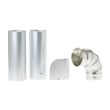
- Venting and duct parts (airflow and drying performance)
GE model numbers are structured for internal identification. Here is the practical way to think about it:
| Section | Example | Typically indicates |
|---|---|---|
| Prefix | PTDS | Product family/series identifier |
| Digits | 850 | Design or feature tier within the series |
| Suffix | EM0WW | Engineering revision and finish/color code |
For feature lists, cycle options, and any display messages, the best starting point is the PTDS850EM0WW owner’s manual. If your dryer is showing an error, use the GE gfd model series error codes guide to interpret the code and narrow down likely causes.
Last updated: January 2026
What type of appliance is the GFW550SSNWW?
GFW550SSNWW is a GE front-load washing machine (washer), not a dryer. If you are shopping parts for our GE PTDS850EM0WW electric dryer, use the model number on the dryer’s ID label and confirm it in the PTDS850EM0WW owner’s manual.
- GFW model prefix: commonly used on GE front-load washers
- PTDS model prefix: used on GE electric dryers like PTDS850EM0WW
- Washer parts and dryer parts are not interchangeable (controls, door parts, drive system)
- Always match the full model number from the appliance label
Ordering by the wrong model number is the fastest way to end up with a part that will not fit. Washers and electric dryers use different components, even when the brand is the same.
| Model number | Appliance type | Example parts you would expect |
|---|---|---|
| GFW550SSNWW | Front-load washer | Pump, inlet valve, door boot, drain filter |
| PTDS850EM0WW | Electric dryer | Drum belt, motor, ducting, door parts |
These are common PTDS850EM0WW dryer parts customers replace when troubleshooting noise, no tumble, or door issues:
- Dryer drum belt WE12X10011 (drum not turning, squealing)
- Motor assembly WE17X10013 (humming, no start, intermittent tumble)
- Dryer door handle WE01X10287 (broken handle, door won’t open easily)
Correctly identifying whether you have a washer or an electric dryer prevents fit issues, repeat repairs, and unnecessary downtime.
Last updated: January 2026
What kind of outlet is needed for a gas dryer?
For the GE PTDS850EM0WW, the correct outlet is a 240-volt electric dryer receptacle on a dedicated 30-amp circuit (not a 120-volt gas-dryer outlet). Use the wiring and grounding instructions in the PTDS850EM0WW owner’s manual to match your home’s 3-wire or 4-wire setup.
Most electric dryers like the PTDS850EM0WW require:
- 240V AC, 60 Hz power
- A dedicated 30-amp, double-pole breaker
- A dryer receptacle for a 3-prong (3-wire) or 4-prong (4-wire) cord
- A properly grounded connection (grounding method depends on 3-wire vs. 4-wire)
| Dryer type | Typical outlet/receptacle | Typical breaker | What electricity powers |
|---|---|---|---|
| Gas dryer | 120V grounded household outlet | 15A to 20A | Controls, motor, igniter, gas valve circuits |
| Electric dryer (PTDS850EM0WW) | 240V dryer receptacle (3-wire or 4-wire) | 30A double-pole | Heating system plus controls and motor |
- Check the plug shape: electric dryer plugs are larger than standard 120V plugs.
- Check the breaker: electric dryers use a 30A double-pole breaker (two linked handles).
- Match cord to outlet: 3-slot outlet uses a 3-prong cord; 4-slot outlet uses a 4-prong cord.
Using the correct 240V, 30A outlet prevents no-heat problems, nuisance breaker trips, and unsafe wiring. Correct grounding is also essential for safe operation and proper control performance.
Last updated: January 2026