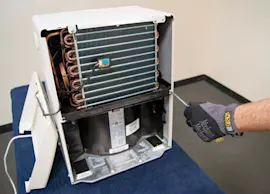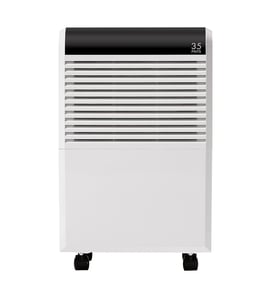



How many hours a day should you run a dehumidifier?
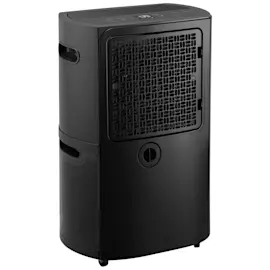
For a GE ADEL70LWQ2 dehumidifier, we typically recommend running it as long as needed to hold your target humidity (usually 30% to 50%). In many homes that works out to about 6 to 12 hours per day, but in very damp spaces it may run much longer and cycle on and off automatically.
A practical run-time guide
Use your room humidity and how fast the bucket fills to set expectations:
- Mild humidity (50% to 60%): often 4 to 8 hours/day
- Moderate humidity (60% to 70%): often 6 to 12 hours/day
- Very damp (70%+) or after water intrusion: often 12 to 24 hours/day until conditions stabilize
- Basements usually need longer run times than main floors
- If you use a drain hose, longer run times are normal because you are not limited by bucket capacity
Settings that work well
Most customers get the best balance of comfort and energy use with these targets:
- Set humidity to 45% to 50% for everyday comfort
- Use 35% to 45% for musty basements (if the space can tolerate it)
- Avoid setting extremely low humidity; it can increase run time without improving comfort
| Goal | Suggested humidity setting | Typical behavior |
|---|---|---|
| Everyday comfort | 45% to 50% | Cycles on and off |
| Basement odor control | 40% to 45% | Longer cycles |
| Initial drying | 35% to 45% | Runs most of the day |
Why it matters
Right-sizing run time helps prevent musty odors and condensation while keeping energy use reasonable. If your ADEL70LWQ2 seems to run constantly, a clogged filter can reduce airflow and moisture removal.
Quick maintenance that affects run time
- Clean or replace the dehumidifier air filter WK85X21721
- Keep the air intake and exhaust clear (several inches of space)
- Empty and reseat the bucket fully so the unit runs normally
- Clean the bucket and grille periodically (see how to clean a dehumidifier)
Last updated: January 2026
How many square feet will a 70 pint dehumidifier take care of?
A 70-pint dehumidifier like the GE ADEL70LWQ2 is sized for large spaces; most 70-pint units cover about 1,000 to 2,500 sq. ft. depending on how damp the area is, how warm it is, and how leaky the space is.
Typical coverage ranges (what to expect)
Coverage depends more on moisture load than square footage alone. Use these common ranges as a practical guide:
- Very damp / wet basement: ~1,000 to 1,500 sq. ft.
- Damp basement or large living area: ~1,500 to 2,000 sq. ft.
- Moderately damp, better-sealed space: ~2,000 to 2,500 sq. ft.
- Crawlspaces: often fall in the 1,800 to 2,600 sq. ft. range when conditions are controlled
Quick sizing table
| Space condition | Common signs | Typical 70-pint coverage |
|---|---|---|
| Very damp | musty odor, visible moisture, frequent condensation | 1,000 to 1,500 sq. ft. |
| Damp | occasional condensation, humidity feels “sticky” | 1,500 to 2,000 sq. ft. |
| Moderate | mild humidity, seasonal dampness | 2,000 to 2,500 sq. ft. |
What changes the real-world square footage
These factors can shrink or expand the area a 70-pint unit can handle:
- Temperature: cooler spaces remove less moisture
- Air movement: closed doors and poor circulation reduce effectiveness
- Moisture sources: laundry, showers, sump pits, seepage, wet crawlspace soil
- Air leaks: unsealed rim joists, open vents, leaky windows
- Maintenance: a dirty filter restricts airflow
If airflow is weak or performance drops, cleaning or replacing the dehumidifier air filter WK85X21721 often restores capacity.
Why it matters
Right-sizing prevents short cycling (too large) and nonstop running (too small). A properly sized 70-pint dehumidifier keeps humidity steadier, helps reduce odors, and improves comfort.
For more setup and performance tips, follow our what size dehumidifier do i need guide.
Last updated: January 2026
What is the downside of a dehumidifier?
A dehumidifier (including the GE ADEL70LWQ2) can raise energy costs, add noise, and require regular upkeep like cleaning the filter and emptying or draining water. If you run it too aggressively, it can also dry the air too much and make a space feel uncomfortable.
Common downsides to expect
- Higher electricity use: compressor and fan operation can noticeably add to monthly usage.
- Noise: fan airflow and compressor cycling can be distracting in bedrooms or offices.
- Ongoing maintenance: you need to keep the air path clean and manage collected water.
- Over-drying: very low indoor humidity can cause dry skin, irritated sinuses, and static.
- Limited coverage: one unit mainly helps the room or zone it is placed in.
- Cold-temperature performance: many portable units remove less moisture in cooler basements and may frost up.
Maintenance that reduces the “downsides”
Keeping the unit clean and draining correctly prevents many complaints (odor, weak airflow, water messes).
- Clean or replace the dehumidifier air filter WK85X21721 on a regular schedule.
- Empty and rinse the bucket; replace it if it is cracked or warped (see dehumidifier water bucket WK10X24673).
- Keep the intake and exhaust grilles clear; leave a few inches of space around the cabinet.
- Set a realistic humidity target (many homes feel best around 45% to 55% RH).
- If the unit leaks or will not drain, follow the steps in how to stop dehumidifier leaks.
Quick trade-off guide
| Concern | What you notice | What usually helps |
|---|---|---|
| Energy cost | longer run times | higher setpoint, clean filter |
| Noise | fan/compressor sound | move location, level floor |
| Too-dry air | dry throat/skin | raise setpoint, shorter run time |
| Water handling | frequent emptying | use drain option if available, check bucket fit |
Why it matters
A dehumidifier is most effective when it is sized and set correctly; that keeps humidity controlled without wasting power or creating comfort issues. For sizing and expectations, we use what size dehumidifier do i need as a practical starting point.
Last updated: January 2026