Installation guide
 Owner’s manual
 Error Codes



How long is the standard Frigidaire warranty?
For the Frigidaire FRS6LF7JS3 side-by-side refrigerator, the standard limited warranty is 1 year from the original date of purchase for repair or replacement of parts that prove defective when the refrigerator is installed, used, and maintained as instructed (see the FRS6LF7JS3 owner’s manual).
What the 1-year warranty typically covers
The manual describes a one-year limited warranty focused on defects in materials or workmanship.
- Coverage period: 12 months from purchase date
- Remedy: repair or replacement of defective parts (as provided under the warranty terms)
- Applies when the refrigerator is installed and maintained per instructions
- Keep proof of purchase (receipt or delivery slip) to establish the warranty period
Common exclusions to know about
Warranty exclusions vary by situation; these are examples called out in the manual.
- Units with removed/altered serial numbers
- Products moved outside the USA or Canada
- Rust on interior or exterior surfaces
- Products purchased “as-is”
- Food loss due to refrigerator/freezer failures
- Use in a commercial setting
Quick reference table
| Item | What to expect for FRS6LF7JS3 |
|---|---|
| Standard warranty length | 1 year limited |
| Start date | Original purchase date |
| What you may need | Proof of purchase, model and serial number |
| Where details live | FRS6LF7JS3 owner’s manual |
Why it matters
Knowing the warranty length helps you decide whether to troubleshoot, schedule service, or order replacement parts (such as a water filter or door gasket) based on whether the refrigerator is still within the 1-year coverage window.
Last updated: February 2026
How to defrost a side by side Frigidaire freezer?
To defrost the freezer on your Frigidaire FRS6LF7JS3 side-by-side refrigerator, move food to a cooler, unplug the refrigerator, and leave the freezer door open until all frost melts. This model also runs automatic defrost cycles periodically (about 30 minutes), which is normal.
Fast, safe manual defrost steps
- Turn the ice maker OFF (raise the wire signal arm to UP on side-mounted units, or switch to “O” on rear-mounted units).
- Unplug the refrigerator (fans and compressor stop when power is off).
- Open the freezer door and keep it open; place towels to catch meltwater.
- Speed it up with bowls of hot water on shelves; replace as they cool.
- Never chip ice with sharp tools; it can puncture the evaporator and cause a sealed-system leak.
- When ice is gone, wipe dry, plug back in, and allow 8 to 12 hours to fully cool.
For model-specific control locations and ice maker details, follow the steps in the FRS6LF7JS3 owner’s manual.
What “normal defrost” looks like on this model
Your refrigerator is designed to defrost automatically. During an automatic defrost cycle:
| What you notice | What it means | What to do |
|---|---|---|
| Compressor not running | Unit may be in defrost | Wait; cycle is normal |
| Slight temperature swing | Defrost heater is melting frost | Keep doors closed |
| Water in drain pan | Meltwater is draining | No action needed |
Automatic defrost cycles occur periodically and typically last about 30 minutes.
If frost keeps coming back quickly
Heavy frost buildup usually points to an air leak or airflow problem.
- Check for gaps, rips, or a loose seal on the door gasket.
- Clean the gasket and the cabinet sealing surface.
- Make sure packages are not preventing the door from closing.
- Limit long door openings and confirm the refrigerator is level.
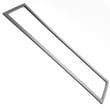
If the gasket is damaged, the correct replacement depends on which door is leaking; see refrigerator door gasket (white) 241786013 for a common door-seal option listed for this model.
Why it matters
Excess frost restricts airflow across the evaporator, which makes the refrigerator run longer, warm up, and can lead to poor ice production and temperature issues.
Last updated: February 2026
How to force a Frigidaire ice maker to cycle?
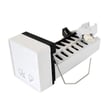
On the Frigidaire FRS6LF7JS3, we force an ice maker “cycle” by turning the ice maker OFF and back ON, then letting it run a harvest and refill; once the freezer is at 0°F, the ice maker typically begins producing ice within 24 hours. For exact ice maker on/off details for your configuration, use the FRS6LF7JS3 owner’s manual.
Quick checks before you try
- Confirm the freezer temperature is 0°F (or slightly below).
- Make sure the ice bin is seated correctly and not jammed with clumped ice.
- Verify the ice maker is actually ON (wire arm down or switch set to “1”).
- If the unit was just installed or water was recently shut off, purge air from the water system.
- Discard the first 24 hours of ice after new plumbing connections or a new filter.
How to “force” a cycle (safe, model-correct method)
- Turn the ice maker OFF:
- Side-mounted style: raise the wire signal arm until it clicks into OFF.
- Rear-mounted style: press the ON/OFF switch to “0”.
- Wait 30 seconds.
- Turn the ice maker ON:
- Lower the wire arm to ON, or press the switch to “1”.
- Close the freezer and allow time for a harvest and refill.
If it still will not cycle
Use this table to narrow it down:
| Symptom | Most likely cause | What we recommend |
|---|---|---|
| No water fill after harvest | Air in line or supply issue | Purge the dispenser for several minutes; confirm shutoff valve is open |
| Cycles but makes little/no ice | Freezer not cold enough | Set freezer colder and wait 24 hours |
| Ice maker seems “stuck” | Ice jam or bin/arm issue | Clear clumps, reseat bin, confirm arm moves freely |
| Bad taste/discolored first batch | New plumbing/filter | Discard first 24 hours of ice |
Why it matters
Forcing a cycle the right way helps you confirm the ice maker is powered, the shutoff arm or switch is working, and the water system can refill the mold. It also prevents damage that can happen when gears are manually turned.
Helpful DIY guidance
Last updated: February 2026
Is Frigidaire Gallery high end?
Frigidaire Gallery is not a high-end luxury line; it is a strong mid-range tier. In practical terms, Gallery appliances typically add more features and styling than basic Frigidaire models, while staying below premium lines in price and pro-style build.
Where Gallery fits in the Frigidaire lineup
We see Frigidaire positioned in tiers; “high end” usually means luxury pricing, pro-grade components, and specialty performance.
- Frigidaire (base): core features, value-focused
- Frigidaire Gallery: upgraded features and finishes, mid-range pricing
- Premium/pro-style lines: higher cost, heavier-duty design, niche performance features
For model FRS6LF7JS3, the best way to confirm which feature set your refrigerator has (dispenser options, filter indicators, alarms) is to check the FRS6LF7JS3 owner’s manual.
What “high end” usually means for refrigerators
Luxury or high-end refrigerators typically emphasize build and performance details that go beyond everyday convenience.
- Dual compressors or dual evaporators on many models
- Very tight temperature control and advanced sensors
- Premium interior materials and lighting
- Higher-capacity ice systems and specialty zones
- Built-in or counter-depth designs with premium trim options
Quick comparison
| Line | Typical positioning | What you usually get |
|---|---|---|
| Frigidaire (base) | Value | Essentials, fewer premium finishes |
| Frigidaire Gallery | Mid-range | More convenience features and styling |
| Premium/pro-style | High end | Pro-style design, higher-end components |
Why it matters
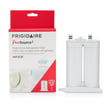
If you are deciding on parts, maintenance, or upgrades for your FRS6LF7JS3, knowing the tier helps set expectations for features (like filter status lights and dispenser options) and long-term ownership costs. For example, many Frigidaire side-by-side models use a cartridge-style water filter such as the Frigidaire puresource2 refrigerator water filter WF2CB.
Last updated: February 2026
What does sy cf mean on a Frigidaire refrigerator?
On a Frigidaire FRS6LF7JS3 side-by-side refrigerator, the SY CF code indicates a communication problem between the user interface (display) and the main control board. A power reset often clears it; if it returns, a loose or damaged wire connection is the most common cause.
What to do first (quick reset)
- Unplug the refrigerator (or switch off the breaker) for 3 to 5 minutes.
- Restore power and wait 1 to 2 minutes for the control to reboot.
- Confirm the refrigerator starts cooling normally and the code stays off.
- If the code returns quickly, move to the wiring checks below.
For control locations and access steps specific to this model, follow the FRS6LF7JS3 owner's manual.
Wiring and connection checks (most common fix)
Unplug power before handling any wiring.
- Reseat the wire harness connectors at the display/control panel and at the main control board.
- Look for bent pins, corrosion, or a connector that is not fully latched.
- Inspect the harness for pinched, cut, or rubbed-through wires (often near hinges or where the harness routes through panels).
- If the refrigerator recently had a door removed or moved, recheck every connector you touched.
When it points to a failed control
If the harness and connectors are solid and SY CF keeps coming back, the issue is typically one of these:
| Symptom | Most likely cause | What to do |
|---|---|---|
| Code appears immediately at power-up | Display board not communicating | Reseat connectors; replace the failed board if needed |
| Code appears after door movement | Intermittent harness connection | Inspect/repair harness routing and connectors |
| Random resets, lights flicker | Power or control instability | Verify outlet power; then evaluate controls |
Why it matters
When the display and main control cannot communicate, the refrigerator may not respond correctly to temperature changes, dispenser commands, or alarms. Clearing the code and securing the harness helps restore reliable cooling and normal operation.
If you’re also seeing other codes, use our Frigidaire refrigerator error codes reference to narrow the failure faster.
Last updated: February 2026
What is the most common problem with a Frigidaire refrigerator?
The most common Frigidaire refrigerator problem we see is a cooling complaint: temperatures run too warm because warm air gets in through frequent door openings, a door that is slightly open, or dirty condenser coils. On model FRS6LF7JS3, these are also top causes listed in the troubleshooting chart in the FRS6LF7JS3 owner's manual.
Most common symptoms customers notice
- Fresh food section is warm but freezer seems closer to normal
- Refrigerator runs too long or seems to run constantly
- Food spoils faster than expected
- Frost or moisture builds up inside
- Door ajar alarm beeps after the door is left open
Quick checks that fix many “not cold enough” calls
- Confirm the doors seal and close fully: make sure bins and containers are not blocking the door.
- Reduce door openings: every opening dumps warm, humid air into the cabinet.
- Clean the condenser coils: dirty coils make the unit run longer and cool poorly.
- Give temperatures time to stabilize: after changing controls, allow about 24 hours for temps to even out.
- After a power outage or unplugging: allow 8 to 12 hours for the refrigerator to cool completely.
Common causes and what to do
| Likely cause | What you’ll observe | What to do first |
|---|---|---|
| Doors opened too often/too long | Temps creep up, unit runs more | Open less often; organize for quick access |
| Door slightly open or blocked | Warm spots, moisture/frost | Reposition food; level unit if needed |
| Dirty condenser | Long run times, weak cooling | Clean coils and airflow path |
| Worn/dirty gasket | Condensation, long run times | Clean gasket; replace if torn |
Why it matters
Cooling problems are usually airflow and heat-transfer issues. Fixing door sealing habits and coil cleanliness reduces run time, helps food stay safe, and can prevent secondary issues like frost buildup and moisture inside the refrigerator.
Helpful DIY resources
- Use our Frigidaire refrigerator error codes guide if your display is flashing or showing a code.
- If the issue is tied to water or ice performance, follow how to prevent water dispenser and ice maker problems.
Last updated: February 2026
Why won't my Frigidaire side by side refrigerator make ice?
If your Frigidaire FRS6LF7JS3 side-by-side refrigerator is not making ice, the most common causes are the ice maker being turned off, the household water supply valve being closed, air trapped in the water system after a hookup, or a clogged water filter restricting flow.
Quick checks that fix most no-ice problems
- Make sure the ice maker is ON: lower the wire signal arm to the down/ON position (side-mounted) or set the power switch to ON (rear-mounted).
- Confirm the household water shutoff valve is fully open.
- Check for slow water at the dispenser; slow flow usually points to a restricted filter or supply.
- If the refrigerator was just installed or reconnected, purge air by dispensing water for several minutes.
- Allow time: after the refrigerator cools for several hours, ice can begin within 24 hours.
Step-by-step troubleshooting (in the right order)
- Verify freezer temperature: If the freezer is too warm, the ice maker will not cycle normally.
- Check the ice maker shutoff: The wire signal arm must move freely and stay in the down position.
- Confirm water supply and connections: Turn on the shutoff valve and check for leaks at the valve connection (tighten snugly, not excessively). Use the water line routing guidance in the FRS6LF7JS3 installation guide.
- Flush the water system: Hold a glass to the dispenser until water flows, then continue dispensing for about 3 minutes to clear air and impurities.
- Replace a clogged filter: If flow is slow or ice is hollow/small, replace the Frigidaire puresource2 refrigerator water filter WF2CB.
What “normal” ice production looks like
| Ice maker type | Typical output per 24 hours | Notes |
|---|---|---|
| Side-mounted | 4 to 4.5 lb (about 4 quarts) | Output drops with warm freezer or low water flow |
| Rear-mounted | 3 to 4 lb (about 3.5 quarts) | New plumbing air can delay full trays |
Why it matters
Ice makers depend on two things: a cold enough freezer and steady water flow. A partially closed valve, trapped air, or a clogged filter can stop fills or create small, hollow cubes that lead to jams and “no ice” complaints.
For model-specific operating details (including turning the ice maker on/off and first-use guidance), follow the FRS6LF7JS3 owner’s manual.
Last updated: February 2026