Error Codes



How much does it cost to run a dehumidifier 24 hours a day?
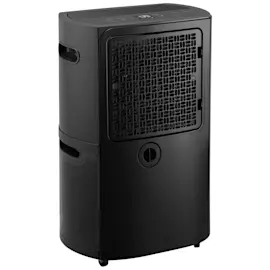
Running a GE dehumidifier like model ADEL20LYQ1 for 24 hours a day typically costs about $0.70 to $4+ per day (roughly $20 to $120+ per month), depending on the unit’s wattage, your electric rate (cents per kWh), and how often the compressor actually runs.
Use this formula:
- Daily cost = (Watts ÷ 1000) × 24 × (your $/kWh)
Most residential dehumidifiers draw about 300 to 700 watts while running.
Assuming the dehumidifier runs continuously at the listed wattage:
| Running watts | kWh per day | Cost/day at $0.15/kWh | Cost/month (30 days) |
|---|---|---|---|
| 300W | 7.2 | $1.08 | $32.40 |
| 500W | 12.0 | $1.80 | $54.00 |
| 700W | 16.8 | $2.52 | $75.60 |
Even if you leave it on 24/7, it usually does not run at full power every minute. These factors drive real-world cost:
- Humidity level (higher humidity means longer run time)
- Room temperature (cool basements can reduce efficiency and increase run time)
- Set humidity (a lower setpoint makes it run more)
- Airflow and cleanliness (a dirty filter restricts airflow and can increase run time)
- Drain method (bucket fill shutoff vs. continuous drain)
If airflow is restricted, cleaning or replacing the filter can help the unit run more efficiently; for this model, the correct part is the filter assembly WK85X21720.
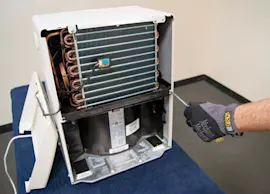
A dehumidifier is basically a small refrigeration system (compressor, fan, coils). When it runs longer to hit your humidity target, it uses more electricity. Keeping airflow strong and settings realistic helps control both moisture and operating cost.
Related help: how to clean a dehumidifier
Last updated: January 2026
How many hours a day should you run a dehumidifier?
For a GE ADEL20LYQ1 dehumidifier, we typically run it as long as needed to hold your target humidity (about 30% to 50% RH); in many homes that works out to roughly 6 to 12 hours per day, and in very damp spaces it may run nearly continuously for the first 24 to 48 hours.
- Normal maintenance: 6 to 12 hours/day (unit cycles on and off as humidity changes).
- After a leak or flooding: close to continuous for 24 to 48 hours, then reassess.
- Basements and crawl spaces: often longer run times due to cooler air and higher moisture load.
- Seasonal humidity spikes: longer run times during rainy periods.
- If the room feels dry but the unit runs a lot: check airflow and the filter.
| Situation | Suggested humidity setting | Typical behavior |
|---|---|---|
| Comfort and general dampness | 45% to 50% | Cycles throughout the day |
| Musty odors, persistent damp | 40% to 45% | Longer cycles, more frequent starts |
| Very damp space (initial dry-down) | 35% to 40% | May run most of the day |
- Clean or replace the air filter; a clogged filter makes the compressor run longer (see filter assembly WK85X21720).
- Empty and reseat the bucket fully so the unit can keep running (see water bucket assembly WK10X24755).
- Keep doors and windows closed in the space you are drying.
- Leave clearance around the intake and exhaust so air can circulate.
- If coils frost up or moisture removal is weak, use our dehumidifier doesnt collect water troubleshooting steps.
Running long enough to maintain a steady humidity level helps prevent condensation and musty odors, but running harder than necessary wastes energy. The best “hours per day” is the amount of time it takes to hold your setpoint consistently.
Last updated: January 2026
What are the downsides of using a dehumidifier?
Using a dehumidifier like the GE ADEL20LYQ1 improves comfort and helps prevent moisture damage, but the main downsides are higher energy use, added noise, and ongoing maintenance (cleaning the filter and emptying or draining the bucket). If you run it too aggressively, it can also over-dry the air.
- Energy cost: Dehumidifiers cycle like a small refrigerator; longer run times increase your electric bill.
- Noise: Fan and compressor noise can be noticeable in bedrooms or quiet living areas.
- Maintenance: You need to clean the air filter and keep the bucket and drain path clean.
- Over-drying risk: Very low humidity can cause dry skin, irritated sinuses, and static; it can also stress wood floors or furniture.
- Water handling: If the bucket is mis-seated or the drain setup is poor, you can get leaks or shutoffs.
- Cold-space performance: Many units remove less moisture in cooler basements and may frost up more easily.
- Rinse or clean the air filter regularly; replace it if it will not clean up well (see filter assembly WK85X21720).
- Empty and wash the bucket with mild soap; replace a cracked or warped bucket (see water bucket assembly WK10X24755).
- Keep the intake and exhaust grilles clear; leave a few inches of space around the cabinet.
- Set a realistic humidity target (most homes feel best around 45% to 55% RH).
- If you use continuous drain, keep the hose sloped downward with no kinks.
| What you notice | Most common cause | What we recommend |
|---|---|---|
| Room feels too dry | Humidity set too low, unit runs constantly | Raise setpoint to 45% to 55% RH, use Auto/Comfort mode if available |
| Musty odor | Dirty bucket, stagnant water, dirty filter | Clean bucket and filter; sanitize and dry before storage |
| Water on floor | Bucket not seated, drain issue | Reseat bucket, check hose routing; follow how to stop dehumidifier leaks |
| Not removing moisture | Dirty filter, low room temp, airflow blocked | Clean/replace filter, improve airflow; follow dehumidifier doesn't remove moisture |
Most dehumidifier complaints come from airflow restriction, dirty water handling, or an overly low humidity setting. Keeping the filter and bucket clean protects indoor air quality and helps the GE ADEL20LYQ1 run efficiently.
Last updated: January 2026