Installation guide
 Owner’s manual
 Error Codes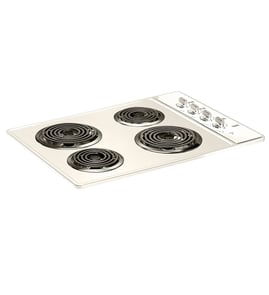

How to reset an electric cooktop?
To reset your Whirlpool electric cooktop model GJC3034RB03, we recommend turning OFF the cooktop controls, then switching the cooktop’s circuit breaker OFF for 1 minute and back ON. This power reset clears many control glitches and restores normal operation (especially after a power interruption). See the owner's manual for model-specific troubleshooting steps.
Reset steps (safe, standard method)
- Turn all surface element knobs to OFF.
- At your home electrical panel, switch the cooktop breaker fully OFF.
- Wait 1 minute.
- Switch the breaker ON.
- Test one element on a low setting, then increase heat gradually.
- If the cooktop is hardwired, do not attempt to unplug it; use the breaker.
If the cooktop still will not operate
The GJC3034RB03 troubleshooting guidance focuses on power supply, correct control use, and control lock conditions.
- Check whether a household fuse blew or the breaker tripped again; reset once.
- Confirm the cooktop is wired properly (installation wiring issues can prevent operation).
- Make sure you push in the knob before turning to a heat setting.
- If your cooktop has a Control lock, turn it off and retry.
Quick symptom guide
| What you see | What it usually means | What to do next |
|---|---|---|
| Nothing works | Power supply issue | Reset breaker; check fuse/breaker again |
| Knob turns but no heat | Control not engaged or failed switch | Push in knob; if still dead, test the switch |
| Lights blink on/off | Touch keys stuck or over-temp standby | Clean panel; power reset; let it cool |
Why it matters
A breaker reset restores the control to a known good state and helps you separate a simple power or control issue from a failed component such as a surface element switch or wiring connection.
Parts that commonly relate to “won’t heat” problems
If only one burner will not heat after a reset, these model-matched parts are common suspects:
- Cooktop element control switch WP3191050 (burner control)
- Range surface element control switch WP9759474 (burner control)
- Wire harness 8286409 (power and signal wiring)
Last updated: February 2026
Which brand of electric cooktop is best?
The best electric cooktop brand is the one that matches your cooking style, budget, and installation needs; for many homes, Whirlpool is a strong choice because it balances everyday reliability with practical features like dual elements, bridge elements, and ACCUSIMMER-style simmer control. Use your owner's manual to compare features and cookware guidance for your kitchen.
How we recommend choosing “best”
When you compare brands (Whirlpool, GE, Bosch, KitchenAid, JennAir, Frigidaire, and others), focus on the factors that change real-world performance and satisfaction:
- Heating technology: radiant electric vs. induction (induction is faster and more efficient, but requires compatible cookware)
- Element layout: dual elements, bridge elements, and warm zones for griddles and oversized pans
- Simmer control: look for a dedicated simmer feature (Whirlpool uses ACCUSIMMER on many models)
- Serviceability: availability of common replacement parts like element switches and radiant elements
- Fit and electrical requirements: cutout size, junction box location, and circuit rating
What “best” looks like for a Whirlpool GJC3034RB03-STYLE cooktop
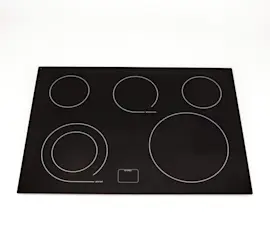
Your Whirlpool GJC3034RB03 family is designed around ceramic-glass cooking with multiple element options (dual, bridge, warm zone depending on configuration). If you value repairability and keeping an older cooktop running, brands with strong parts support tend to be the best long-term value.
Common repairs that influence brand satisfaction
If a cooktop brand feels “bad,” it is often because a high-wear part fails. For this model family, the most common categories are:
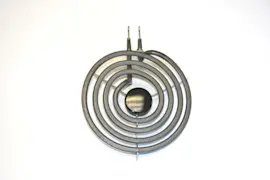
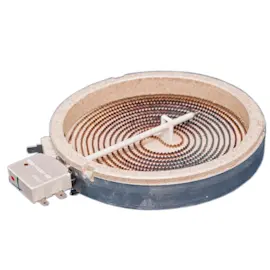
- Radiant surface elements that stop heating or heat unevenly
- Infinite switches that will not regulate heat (stuck on high or will not turn on)
- Knobs and seals that wear, crack, or allow spills into the control area
Quick comparison table (what to prioritize)
| Priority | If you care most about | What to look for in any brand |
|---|---|---|
| 1 | Fast boiling and efficiency | Induction cooktop, compatible cookware |
| 2 | Flexible pan sizes | Dual element and bridge element options |
| 3 | Low, steady simmer | Dedicated simmer feature and stable low settings |
| 4 | Long-term ownership | Readily available switches, elements, knobs |
Why it matters
“Best” is not just performance on day one; it is also how consistently the cooktop holds a simmer, how well it fits your countertop and electrical setup, and how easy it is to maintain with parts over time.
Last updated: February 2026
What are the disadvantages of a ceramic cooktop?
Ceramic-glass cooktops like the Whirlpool GJC3034RB03 heat smoothly and look sleek, but they scratch and mark more easily than many surfaces, can crack from impact or trapped heat, and often feel slower to respond because the glass retains heat after you turn an element off (see the GJC3034RB03 owner's manual).
Common disadvantages you will notice day to day
- Scratches and metal marks: sliding cookware can leave scratches; aluminum or copper bottoms and rough finishes can leave marks.
- Crack risk from impact: dropping a heavy or hard object can crack the cooktop.
- Heat retention: the surface can stay hot after cooking, increasing burn risk.
- Spills can “bake on”: especially sugary spills, which can pit the surface if not cleaned while still warm.
- Some cookware is a poor match: undersized pans can expose part of the heating area; some glass or ceramic cookware can break with sudden temperature changes.
- Cosmetic color changes: on white or biscuit ceramic glass, the surface can appear to change color when hot (it returns as it cools).
What we recommend to reduce the downsides
- Use flat-bottom pans sized to cover the heating element.
- Lift, do not slide pots and pans across the glass.
- Clean spills before and after each use; address sugary spills promptly (carefully, while warm).
- Avoid leaving a hot lid on the cooktop; trapped air as it cools can contribute to breakage.
- Keep heavy items (jars, cans) from being stored above the cooktop.
Quick comparison: ceramic vs other cooktop types
| Feature | Ceramic-glass radiant (this cooktop type) | Gas | Induction |
|---|---|---|---|
| Response time | Slower; retains heat | Fast | Very fast |
| Surface durability | Can scratch/crack | Grates can chip; top can stain | Glass can scratch/crack |
| Cleanup | Flat surface but spills can bake on | More crevices | Flat surface; less baked-on heat |
Why it matters
Most complaints about ceramic cooktops come down to surface care and cookware habits. Following the handling and cleaning guidance in the manual helps prevent permanent marks, pitting, and avoidable damage.
Last updated: February 2026
How much does it cost to replace an electric stove top?
Replacing an electric stovetop typically runs about $300 to $1,100 total (parts plus labor). For a Whirlpool GJC3034RB03 electric cooktop, the biggest cost drivers are whether you’re replacing the entire cooktop (main top) versus a failed radiant element or control switch, and whether you hire installation.
Typical cost ranges (parts + labor)
These are common U.S. ranges for electric cooktops and electric stovetops; your final total depends on cutout fit, wiring condition, and countertop access.
- Surface element replacement: about $200 to $500 total (part plus service call)
- Control switch replacement: about $200 to $450 total
- Full cooktop replacement: about $500 to $1,500+ total (cooktop plus installation)
- DIY parts-only repair: often $80 to $350 depending on the failed component
What you might replace on model GJC3034RB03 (examples)
If only one burner is acting up, repairing the cooktop is usually far cheaper than replacing the whole top.
| Repair scenario | Common symptom | Example part for this model | Typical outcome |
|---|---|---|---|
| Replace a radiant element | Burner will not heat or heats unevenly | Range radiant surface element, 6-in W10823711 | Restores heat on that position |
| Replace a dual radiant element | Large burner not working on one ring | Range dual radiant surface element W10823692 | Restores inner/outer heat control |
| Replace an infinite switch | Burner stuck on high or won’t regulate | Cooktop element control switch WP3191050 | Restores temperature control |
| Replace the glass/main top | Cracked glass surface | Main top W10239865 | Restores safe, flat cooking surface |
How to decide: repair vs replace
- Repair when only one element fails, the glass is intact, and knobs/switches still feel normal.
- Replace the cooktop when the glass is cracked, multiple burners are failing, or the cutout and wiring need major changes.
- Check fit first: cutout size and electrical requirements must match before buying a new cooktop.
Why it matters
A smooth-top electric cooktop can look like a “whole unit” problem, but many issues are isolated to a radiant surface element, an AccuSimmer switch, or an element control switch. Targeted repairs reduce cost and downtime.
Installation cost notes
Cooktop installation involves countertop mounting and an electrical connection; we recommend following the safety and electrical requirements in the installation guide.
Last updated: February 2026
How do you measure a cooktop for replacement?
For Whirlpool electric cooktop model GJC3034RB03, measure both the cooktop’s overall size and the countertop cutout opening. Then compare your numbers to the model’s installation dimensions so the unit drops in correctly and the glass top fully covers the opening. Use the installation guide for the dimension diagram.
What to measure (step by step)
Use a tape measure; measure in inches and write everything down.
- Overall width: left outer edge to right outer edge of the glass.
- Overall depth: front outer edge to back outer edge of the glass.
- Overall height: from the underside of the cooktop base to the top surface.
- Cutout width: inside edge to inside edge of the countertop opening.
- Cutout depth: inside edge to inside edge of the countertop opening.
- Clearances below: check for drawers, braces, and any undercounter oven interference.
Model-specific dimensions to compare against (GJC3034RB03)
The GJC3034RB03 installation instructions list these product dimensions:
| Measurement | Dimension |
|---|---|
| Overall width | 30 5/16 in |
| Overall depth | 16 9/16 in |
| Overall height | 2 7/8 in |
| Front-to-back base dimension shown as “A” | 22 1/8 in |
Quick fit check before you buy
Use this checklist to confirm the replacement will fit your countertop and cabinet.
- The cutout opening must match the required opening size in the installation instructions.
- The glass top must be large enough to cover the cutout with a clean finished edge.
- The height must clear anything below the cooktop (especially over an undercounter oven).
- The cooktop should sit flat; uneven counters can stress the glass.
- Plan for the junction box location so there is slack for future servicing.
Why it matters
Cooktops are sold by “nominal” sizes (like 30-inch), but the real dimensions and cutout requirements are precise. Measuring both the cooktop and the cutout prevents gaps, binding, and installation problems.
Last updated: February 2026