
How to defrost an ice maker?
To defrost your Dcs RF15I-70879 freestanding ice maker, we recommend turning the unit off, emptying the bin, and gently melting any ice buildup with warm air or warm towels. Once thawed, restore power and confirm water flow and normal ice production.
- Turn the ice maker OFF and unplug it (or switch off the dedicated breaker).
- Remove and empty the ice bin; wipe out standing water.
- Leave the door open to speed thawing.
- Use warm towels on frosted surfaces; replace towels as they cool.
- If you use a hair dryer, keep it on low heat and keep it moving to avoid overheating plastic liners and wiring.
- Dry the interior thoroughly before restarting.
Ice makers often freeze up again when water flow is restricted or a component is sticking.
- Verify the water supply shutoff valve is fully open.
- Inspect the fill path for ice or kinks; a restricted line can cause slow fills and refreezing.
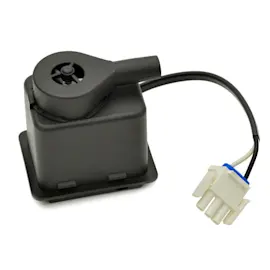
- If the unit is not filling correctly after thawing, the Dcs fisher & paykel ice maker water inlet valve 239699 is a common part to inspect or replace.
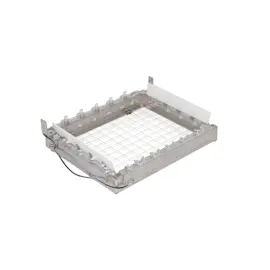
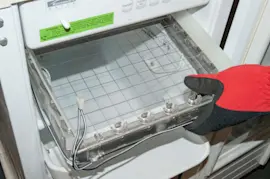
- If cubes are not separating or you see a slab forming, the cutter system may need attention; see how to replace a freestanding ice maker cutter grid.
| What you see | Most common cause | What to do next |
|---|---|---|
| Solid ice sheet or clumps | Incomplete cutting or harvest issue | Inspect cutter grid area; clean and descale; check cutter operation |
| Little or no water entering | Supply issue or inlet valve problem | Confirm supply pressure and line; test inlet valve |
| Water leaking then freezing | Overfill, drain restriction, or misrouting | Check for leaks and proper drainage; level the unit |
| Re-freezes quickly | Airflow/door seal issue or recurring fill problem | Confirm door closes tightly; avoid blocking vents |
Defrosting removes the immediate blockage, but checking water inlet, cutting, and airflow prevents repeat freeze-ups that can reduce ice output and strain components like the compressor.
Last updated: February 2026
What is a freestanding ice machine?
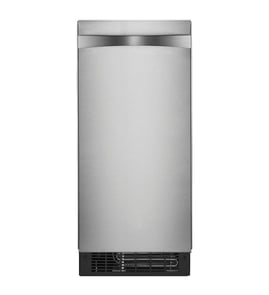
A freestanding ice machine is a floor-standing, self-contained ice maker that produces ice and stores it in an internal bin, so you do not need a separate freezer ice maker. For the Dcs RF15I-70879, it is designed for higher, more consistent ice demand than most countertop units.
Most freestanding ice makers follow the same basic cycle:
- A water inlet valve fills a reservoir or water circuit
- A refrigeration system freezes water on an evaporator plate
- A harvest cycle releases the ice
- A cutter grid (on many models) cuts the slab into cubes
- Ice drops into the storage bin until the bin is full
If you are troubleshooting performance, our freestanding ice maker troubleshooting guide covers the most common symptoms and checks.
| Feature | Freestanding ice machine | Countertop ice machine |
|---|---|---|
| Typical output | Higher daily production | Lower daily production |
| Storage | Built-in bin (larger) | Small basket |
| Water connection | Often plumbed-in | Usually manual fill or small tank |
| Best for | Steady, high ice use | Occasional, light use |
On the RF15I-70879, these parts are often involved when the unit runs but does not make ice or makes inconsistent ice:
- Dcs fisher & paykel ice maker water inlet valve 239699 (fill problems, slow fill)
- Dcs fisher & paykel compressor assembly 239697 (cooling problems)
- Dcs fisher & paykel ice maker cutter grid 239463 (ice not cutting cleanly)
Knowing you have a freestanding ice machine helps you troubleshoot correctly: issues often involve water supply, condenser airflow, or the harvest and cutting system, not just an “ice maker module” like you would see in a refrigerator.
Last updated: February 2026
What is the life expectancy of an ice maker?
Most ice makers last 5 to 10 years. For a freestanding unit like the Dcs RF15I-70879, we typically see the longer end of that range when it has good airflow, clean condenser areas, and consistent water quality.
Ice maker life varies mainly by design and how hard it runs.
- Freestanding ice makers: 7 to 10 years (often longer with regular cleaning)
- Refrigerator ice makers: 5 to 8 years
- Heavy-use or “always on” situations: expect the lower end of the range
| Ice maker type | Typical life expectancy | What most affects it |
|---|---|---|
| Freestanding (like RF15I-70879) | 7 to 10 years | Ventilation, cleaning, water quality |
| Built-in refrigerator ice maker | 5 to 8 years | Freezer temps, fill valve wear, usage |
| High-demand use | 5 to 7 years | Scale buildup, heat load, run time |
These are the biggest real-world factors we see:
- Hard water and scale buildup (clogs water paths and reduces heat transfer)
- Poor ventilation around the cabinet (raises compressor run time)
- Dirty condenser area (reduces cooling efficiency)
- Leaks or slow drips that cause corrosion and mineral deposits
- Infrequent cleaning/sanitizing (biofilm and odor issues can follow)
If the machine stops making ice or performance drops, these parts often determine whether repair is practical:
- Sealed system and cooling components such as the Dcs fisher & paykel compressor assembly 239697
- Water fill components such as the Dcs fisher & paykel ice maker water inlet valve 239699
- Ice cutting components such as the Dcs fisher & paykel ice maker cutter grid 239463
Knowing the expected lifespan helps you decide whether to clean and tune the ice maker, replace a wear part, or plan for a larger repair. If your unit is near the 7 to 10 year mark, maintenance and water quality improvements can make a noticeable difference in reliability and ice production.
Last updated: February 2026
Is it worth repairing an ice maker?
Yes, it’s worth repairing your Dcs RF15I-70879 freestanding ice maker when the problem is isolated (water fill, cutting, door/hinge issues) and the repair restores reliable ice production. Replacement makes more sense when a major sealed-system component is involved or the unit has repeated failures.
- If the ice maker is cooling poorly or not cooling at all, a sealed-system repair can be high cost (often tied to the compressor).
- If the unit runs but won’t fill, leaks, or makes little ice, repairs are usually more practical.
- If the ice quality issue is mechanical (not cutting, clumping, odd shapes), a targeted part replacement is often cost-effective.
- If you have frequent breakdowns, replacement typically delivers better long-term value.
- If the repair cost approaches about half the price of a comparable new unit, replacement is usually the better investment.
These are typical, fixable failures on freestanding ice makers like the RF15I-70879:
- Water not entering the unit: check/replace the Dcs fisher & paykel ice maker water inlet valve 239699.
- Ice slab not cutting cleanly: inspect/replace the Dcs fisher & paykel ice maker cutter grid 239463.
- Door not sealing or sagging: inspect/replace the fisher & paykel hinge assembly 242930.
| Issue you’re seeing | Likely area | Typical value of repair |
|---|---|---|
| Runs but no ice | Water fill, circulation, controls | High |
| Not cutting ice | Cutter grid | High |
| Leaking water | Water valve, tubing, fittings | Medium to high |
| Not cooling well | Compressor or sealed system | Low to medium |
A freestanding ice maker depends on three systems working together: water supply, freezing/cooling, and harvest/cut. When only one system is failing, replacing the right component often restores performance without the cost of replacing the entire appliance.
Use our symptom-based troubleshooting to narrow the failure before buying parts: freestanding ice maker troubleshooting.
Last updated: February 2026
Why is my free standing ice maker not making ice?
If your Dcs RF15I-70879 freestanding ice maker isn’t making ice, the most common causes are no water getting into the reservoir, poor water circulation over the evaporator plate, or a cutting/harvest issue. Start by confirming water supply and flow, then check for leaks or a failed inlet valve.
- Make sure the unit is powered on and the bin is seated correctly (a mis-seated bin can stop production).
- Confirm the water supply shutoff valve is fully open and the supply line is not kinked.
- Look in the reservoir: if it’s empty, focus on water supply and fill; if it’s full, focus on circulation.
- Inspect for visible leaks, especially around fittings and tubing.
- Clean mineral scale if you see white buildup on water-contact surfaces; scale can reduce flow and freeze performance.
| What you see | What it usually means | What to do next |
|---|---|---|
| Reservoir empty | Water is not entering the ice maker | Check supply valve, line, then the inlet valve |
| Reservoir full but evaporator plate stays dry | Water isn’t being pumped/recirculated | Check for circulation problems and related components |
| Water present but ice won’t form or is very slow | Cooling or airflow issue, or heavy scale | Clean, verify ventilation, then evaluate cooling |
If you confirm the unit has power but isn’t filling correctly, the water inlet valve is a primary suspect.
- Dcs fisher & paykel ice maker water inlet valve 239699: Controls water fill into the ice maker.
- Dcs fisher & paykel tube assembly 239454: Tubing/fill path issues can restrict flow or leak.
- Dcs fisher & paykel compressor assembly 239697: If the unit runs but never gets cold enough, cooling system problems can stop ice production.
Ice makers depend on the right amount of clean water moving across a cold evaporator plate. If water cannot enter, cannot circulate, or the unit cannot cool, the freeze cycle never completes and you get little or no ice.
Last updated: February 2026