Installation guide
 Owner’s manual


How can I tell how old my Maytag dryer is?
To tell how old your Maytag dryer is, we use the serial number from your Maytag MED3500FW0 rating label. The model number alone does not show the exact build date; the serial number contains the manufacturing date code you can decode.
Where to find the model and serial label
On the Maytag MED3500FW0 electric dryer, the rating label is typically located in the door opening (inner door well) or on the cabinet opening near the door.
Check these common spots:
- Inside the dryer door opening on the cabinet frame
- On the inner door well area near the door switch/strike
- On the back panel of the dryer cabinet
- Behind the lint screen housing area (varies by design)
For diagrams and label-location guidance specific to this dryer family, use the MED3500FW0 installation instructions.
How to decode the age from the serial number
Maytag serial formats vary by production era and factory, so we cannot identify the exact year and month for a MED3500FW0 without seeing your serial number characters.
In general, you will:
- Write down the full serial number exactly as shown
- Look for a letter and number pattern that represents month and year
- Decode the date code using the Maytag/Whirlpool style chart for that serial format
Quick decode checklist
- Confirm you are reading the serial number (not the model number)
- Record all letters and numbers in order
- Note any spaces or dashes exactly as printed
- If the label is worn, take a clear photo before cleaning it
Why it matters
Knowing the manufacture date helps us match the correct parts and revisions for your Maytag MED3500FW0, especially for wear items like a belt, rollers, or thermostats.
| What you have | What it tells you | Best use |
|---|---|---|
| Model number (MED3500FW0) | Product design family | Finding compatible parts diagrams |
| Serial number | Build date code | Determining age and production run |
Last updated: January 2026
What is the most common problem with the Maytag dryer?
For the Maytag MED3500FW0 electric dryer, the most common real-world issue we see is poor drying or no heat caused by restricted airflow (lint buildup in the screen, housing, duct, or vent). That restriction can overheat the dryer and lead to a blown thermal fuse or other heat-related failures.
What to check first (fast, high-impact)
- Clean the lint screen after every load; wash it with warm water if you use dryer sheets.
- Inspect the lint screen housing for packed lint or a stuck door.
- Check the vent run for crushing, kinks, or long runs with too many elbows.
- Confirm the outside vent hood opens fully while the dryer runs.
- If drying times are long, stop using Auto cycles until airflow is corrected.
For venting rules and maximum vent lengths, follow the MED3500FW0 installation instructions.
Common symptoms and the likely cause
| Symptom | Most common cause | What we recommend |
|---|---|---|
| Clothes take too long to dry | Vent restriction | Clean venting end-to-end, then retest |
| No heat but drum tumbles | Heat circuit opened from overheating | Check airflow first, then test heat components |
| Dryer won’t start | Door not sensed closed, or safety device opened | Verify door switch and power, then test fuse |
| Loud thumping/squealing | Worn drum support parts | Inspect rollers, idler, and belt |
Parts that often end up being replaced (after airflow is fixed)
If airflow is restricted, heat-related parts can fail. If the dryer is noisy or the drum stops turning, drive parts are common wear items.
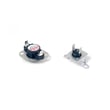
- Thermal fuse W10909685 (opens if the dryer overheats)
- Dryer thermal cut-off fuse kit 279973 (heat safety devices used in the heater circuit)
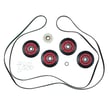
- Dryer drum belt WPW10112954 (broken belt can stop tumbling)
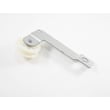
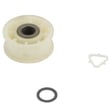
- Dryer idler pulley W10837240 (can squeal or seize)
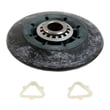
- Dryer drum support roller WPW10314173 (can thump or rumble)
Why it matters
Airflow problems do not just cause long dry times; they raise operating temperatures. That can shorten the life of the heating system and repeatedly blow safety fuses until the venting is corrected.
Last updated: January 2026
What is the capacity of the Maytag med3500fw0?
The Maytag MED3500FW0 electric dryer has a 7.4 cu. ft. capacity, which is sized for family laundry loads like jeans, towels, and bedding. For model-specific setup and venting details that affect real-world drying performance, use the MED3500FW0 installation instructions.
What 7.4 cu. ft. means for typical loads
A 7.4 cu. ft. drum is usually a good fit for:
- Full loads of everyday mixed laundry
- Multiple bath towels and sheets in one cycle
- Bulky items (dry one at a time for best tumbling)
- Better results when you avoid packing the drum tight
Quick capacity comparison
| Dryer capacity | Best for | What you will notice |
|---|---|---|
| 6.5 to 7.0 cu. ft. | Smaller households | More loads for bulky items |
| 7.4 cu. ft. (MED3500FW0) | Most families | Good balance of space and efficiency |
| 8.0+ cu. ft. | Large households | Bulky loads tumble more easily |
Why it matters
Capacity and airflow work together. Even with a large drum, restricted venting or overloading can cause long dry times, higher heat stress on fabrics, and more wrinkles.
Tips to get the best drying performance
- Load loosely; items should tumble freely
- Separate heavy items (jeans, towels) from lightweight items
- Clean the lint screen before every load; if the screen is missing or damaged, replace the correct one for your model
- If drying is slow, confirm you are using a 4-inch metal vent and keeping the run as short and straight as possible (see venting requirements in the install guide)
Last updated: January 2026
What is the life expectancy of a Maytag dryer?
Maytag electric dryers like model MED3500FW0 typically last 10 to 15 years with normal household use. Consistent airflow maintenance (lint screen and venting) and quick replacement of common wear parts can push service life toward the high end of that range.
What affects lifespan the most
A dryer’s life is usually determined by heat stress, airflow restriction, and wear on moving parts.
- Clean the lint screen every load; replace it if it’s torn or warped (dryer lint screen W11758174).
- Keep the exhaust venting short, smooth, and unobstructed; poor venting can overheat components.
- Avoid overloading; heavy loads strain the drum support rollers and belt.
- Level the dryer so the drum rides evenly on supports.
- Address new noises early (thumping, squealing, scraping) before they damage the drum or motor.
Maintenance checklist for MED3500FW0
Use these as practical “life-extenders” for this Maytag dryer.
- Vacuum lint from the lint duct area periodically.
- Inspect the vent hood outside for blockage.
- If drying times increase, verify venting first before replacing parts.
- If the dryer stops heating or runs hot, check safety devices and airflow.
Quick reference: symptoms and likely wear areas
| Symptom | Common cause area | What to do first |
|---|---|---|
| Long dry times | Venting restriction | Clean vent path and hood |
| No heat | Heating circuit or safety cutoff | Confirm airflow, then test components |
| Squealing/thumping | Drum support system | Inspect rollers, idler, belt |
| Won’t start | Door switch or power supply | Check door closure and power |
Why it matters
A dryer that is vented correctly and kept clear of lint runs cooler and more efficiently; that reduces nuisance shutdowns, protects the heating system, and helps major components (motor, drum supports, controls) last longer. For venting and clearance best practices specific to this platform, follow the MED3500FW0 installation instructions.
Last updated: January 2026