Owner’s manual


How do I tell what model my Kenmore dryer is?
Your Kenmore dryer’s model number is printed on the model and serial number label located at the top inside the dryer door well. For Kenmore model 11072062100, you’ll see the model number and serial number together on that label; write both down for parts and service.
Where to look on model 11072062100
Open the dryer door and check these spots:
- Top inside the dryer door well (most common on this model)
- Along the door opening near the door frame
- On the cabinet opening where the door closes (if the label is positioned there)
For the exact label location and what the fields mean, use the 11072062100 owner's manual.
What to write down (and why)
Record these items exactly as shown on the label:
- Model number (example: 11072062100)
- Serial number (used to identify production details)
- Purchase date (helpful for warranty paperwork and service history)
Quick reference
| Item on label | What it’s used for | When you need it |
|---|---|---|
| Model number | Matching parts to your exact dryer | Ordering parts like a thermal fuse or igniter |
| Serial number | Identifying your specific unit | Service records, verifying unit details |
| Purchase date | Ownership and warranty documentation | Warranty and maintenance tracking |
Why it matters
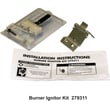
Kenmore dryers often look similar across multiple series, but parts can differ by model. Using the full model number helps us match the correct gas dryer parts (for example, a dryer thermal fuse WP3390719 or igniter 279311) and avoid returns caused by near-match models.
Last updated: February 2026
What size is a Kenmore Model 11072062100 dryer?
The Kenmore gas dryer model 11072062100 is a full-size dryer; most Kenmore 110-series dryers measure about 27 inches wide, 29 to 30 inches deep, and 38 to 43 inches high. For the exact cabinet dimensions and required clearances for your installation, use the 11072062100 owner's manual.
Typical dimensions and what to plan for
When you are measuring a laundry space, we recommend planning for both the cabinet size and the space the dryer needs to vent and breathe.
- Width (typical): ~27 in.
- Depth (typical): ~29 to 30 in. (not including the vent elbow)
- Height (typical): ~38 to 43 in.
- Rear clearance (common requirement): allow room for the exhaust vent connection
- Side clearance (recommended): extra space helps reduce noise transfer and makes service easier
Installation clearance guidance (model-specific)
Your 11072062100 manual calls out that most installations need at least 5 1/2 inches of clearance behind the dryer to accommodate the exhaust vent with an elbow. That rear space often matters more than the cabinet depth when you are checking fit.
Quick planning table
| What you are measuring | What to include | Practical tip |
|---|---|---|
| Cabinet width | Dryer body only | Most are ~27 in. wide |
| Cabinet depth | Dryer body only | Add space for venting behind |
| Installed depth | Dryer + vent elbow | Plan for at least 5 1/2 in. behind |
| Height | Floor to top | Check if you have shelves above |
Why it matters
Correct sizing prevents crushed or kinked venting (poor drying and overheating risk), avoids door swing issues, and helps you meet closet or recessed installation spacing requirements.
Last updated: February 2026
How do I know if my Kenmore dryer thermal fuse is blown?
On your Kenmore gas dryer model 11072062100, a blown thermal fuse commonly shows up as a dryer that will not run at all (no motor, no tumble). The sure way to confirm is a continuity test with a multimeter; a good fuse reads closed (continuity), and a blown fuse reads open.
Quick symptoms to look for
A thermal fuse is a safety device that opens if the dryer overheats, often from restricted airflow.
- Dryer will not start even though the door is closed and a cycle is selected
- You have power to the dryer, but pressing START does nothing
- Lint screen is packed, or the vent run is long, crushed, or clogged
- Dryer previously ran hot, smelled hot, or shut down mid-cycle
For basic “won’t run” checks (power, door closed, cycle selected), follow the troubleshooting steps in the owner's manual.
How to test the thermal fuse (basic method)
- Unplug the dryer (and shut off gas as a safety step).
- Access the thermal fuse (typically on the blower housing or exhaust duct area).
- Pull the wires off the fuse terminals.
- Set a multimeter to continuity or lowest ohms.
- Touch probes to the fuse terminals.
- Beep or near 0 ohms: fuse is good
- No beep or OL/infinite: fuse is blown
What to do if the fuse is blown
Replace the fuse and fix the overheating cause first, or the new fuse can fail again.
- Clean the lint screen and housing
- Inspect the entire vent path for lint buildup
- Replace crushed or kinked venting with heavy metal venting
- Confirm strong airflow at the outside hood
If you need the correct replacement for this model, use the parts list for model 11072062100 and match the fuse by description; a common replacement listed for this model is the dryer thermal fuse WP3390719.
Why it matters
A blown thermal fuse is telling you the dryer overheated. Restoring proper airflow helps protect the burner system, motor, and wiring, and it improves drying performance.
| Test result | What it means | Next step |
|---|---|---|
| Continuity present | Fuse is good | Check door switch, start switch, power supply |
| No continuity | Fuse is blown | Replace fuse and correct vent restriction |
Last updated: February 2026