 Owner’s manual
 Error Codes



How to tell cubic feet of Kenmore refrigerator by model number?
For Kenmore Elite model 59672283200, the model number alone usually does not state the exact cubic-foot capacity. The most reliable way is to look up the capacity in the specifications section of the owner's manual, or calculate an estimate from the usable interior dimensions.
- Check the specifications or “product data” section in the owner's manual.
- Look for a tech/spec sheet stored behind the toe grille or on the back of the refrigerator (common on many Kenmore units).
- Estimate capacity by measuring the usable interior space (refrigerator and freezer separately) and converting to cubic feet.
- If you are comparing sizes, use the cabinet style as a guide: most bottom-mount refrigerators are commonly in the 18 to 25 cu. ft. range.
- Empty enough space to measure the inside walls (not the door bins).
- Measure width x height x depth in inches for:
- Fresh food (refrigerator) compartment
- Freezer compartment
- Convert each compartment to cubic feet:
- Cubic feet = (W x H x D) / 1728
- Add the two results for total capacity.
- Measure to the inside liner, not to shelves or drawers.
- Subtract obvious “non-usable” areas (large air channels, thick housings) if they skew depth.
- Use the same method for both compartments so your total is consistent.
| What you want | Best method | Accuracy |
|---|---|---|
| Exact rated capacity | Specs in the owner's manual | Highest |
| Close estimate for planning | Interior measurement and /1728 | High |
| Rough comparison only | Typical bottom-mount range (18 to 25 cu. ft.) | Medium |
Cubic feet helps us match your needs to the right storage space and accessories (bins, shelves, and drawers). It also prevents buying organizers that fit the cabinet size but reduce usable space.
Last updated: February 2026
What is the average lifespan of a Kenmore 59672283200 Elite refrigerator?
A Kenmore Elite 59672283200 bottom-mount refrigerator typically lasts 10 to 15 years. Regular maintenance (especially keeping airflow clear and cleaning) helps it reach the high end of that range, while heavy use, poor ventilation, and cooling-system strain can shorten service life.
Most refrigerators in this class run about a decade or more; the biggest swing factors are heat, airflow, and door sealing.
- Condenser cleanliness and airflow: dust buildup and tight clearances raise operating temperatures
- Door gasket condition: warm air leaks force longer run times
- Ice maker and water system health: leaks or slow fills can create recurring issues
- Temperature settings and loading habits: overpacking blocks vents and reduces circulation
- Power quality: frequent outages or surges stress controls and the compressor start components
Your owner's manual for model 59672283200 includes warranty coverage that highlights which components were designed for longer-term support.
| Component area | Warranty coverage (from purchase date) | Why it matters for lifespan |
|---|---|---|
| Full refrigerator | 1 year | Covers early defects and workmanship issues |
| Sealed refrigeration system | 5 years | Cooling system repairs are among the most expensive |
| Compressor parts | 10 years (parts) | Compressor longevity is a key driver of total life |
These symptoms usually mean the unit is working harder than it should, or a major system is weakening.
- Food temperatures drift even after adjusting controls
- Compressor runs almost constantly, or cycles with loud clicking
- Frost buildup or repeated warm-freezer events
- Water under the unit or recurring ice maker problems
- Doors do not close firmly or you feel air leaks around the seal
Once a refrigerator gets past the 10-year mark, preventing heat buildup and air leaks is the best way to avoid costly cooling-system strain. If you are troubleshooting ice production or leaks, replacing a worn component early can extend the usable life of the refrigerator.
Last updated: February 2026
Is Kenmore 59672283200 Elite high end?
Yes. Kenmore Elite models, including the Kenmore Elite 59672283200 bottom-mount refrigerator, are positioned as the brand’s higher-end line, typically offering upgraded features, styling, and performance compared with standard Kenmore refrigerators. For the most accurate feature set for your exact unit, use the owner's manual.
Kenmore Elite generally indicates a step up in design and capability. On bottom-mount refrigerators like model 59672283200, that often translates to a more premium user experience and better food-storage convenience.
Common “Elite” traits include:
- More advanced temperature management and controls
- Higher-end interior layout (bins, shelves, deli storage)
- Quieter operation compared with entry-level models
- More feature-rich ice and water systems (if equipped)
- More premium exterior finishes and trim details
“High end” is mostly about features, fit-and-finish, and long-term serviceability. We recommend checking these items on your 59672283200:
- Cooling performance: steady temps in fresh food and freezer
- Ice maker performance: consistent ice production and harvest
- Door seal and alignment: doors close easily and seal fully
- Noise level: compressor and fans sound smooth, not loud or erratic
- Parts availability: key components are still obtainable when needed
| Line | Typical positioning | What you usually get |
|---|---|---|
| Kenmore (standard) | Mid-range | Core features, simpler controls |
| Kenmore Elite | Premium | More features, upgraded design, higher-end components |
If you consider the 59672283200 “high end,” it helps set expectations for maintenance and repair. Premium refrigerators often use more specialized components; when issues come up, replacing the correct part (ice maker, valve, control board) restores performance faster.
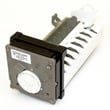
If you are troubleshooting ice production on this model, a common replacement is the refrigerator ice maker D7824706Q.
Last updated: February 2026
What are the common problems with Kenmore 59672283200 Elite refrigerators?
Common issues on the Kenmore 59672283200 Elite bottom-mount refrigerator are warm temperatures from dirty condenser coils or defrost-related problems, water leaks tied to the water supply system, ice maker troubles, and “new” operating noises that are actually normal. Our owner's manual also notes that cleaning the condenser coils about every 3 months helps cooling performance.
- Not cooling well or temperatures too warm: dirty condenser coils, blocked rear air grille, doors not sealing, or controls set incorrectly
- Runs too much: door not closing fully, controls set too cold, dirty coils, or warm room conditions
- Water leaking: low water pressure, incorrect water valve, or issues in the water connection
- Ice maker not working or slow ice: freezer temperature too high, water supply restriction, or ice maker component wear
- Noises (clicking, gurgling, air rushing, sizzling in defrost): often normal operation per the troubleshooting noise chart
- Confirm doors seal and close: check gaskets and look for bins or drawers preventing closure.
- Clean condenser coils: dust buildup is a top cause of poor cooling and long run times.
- Check airflow: keep the rear air grille clear and avoid overpacking.
- Verify control settings: adjust temperatures gradually and allow time to stabilize.
- After a power interruption: if lights are on but the compressor is off, allow up to 40 minutes for the defrost cycle to end and cooling to restart.
| Problem | Common part area | Example part for this model |
|---|---|---|
| No ice or intermittent ice | Ice maker assembly | Refrigerator ice maker D7824706Q |
| Water dispenser or ice maker not filling | Water inlet valve | Refrigerator valve WP12544002 |
| Warm temps with heavy frost symptoms | Defrost control components | Refrigerator defrost timer board WP12566102 |
Catching simple causes (dirty coils, poor door seal, blocked airflow) prevents food from warming up, reduces energy use, and helps avoid unnecessary replacement of higher-cost components like the compressor.
Last updated: February 2026
Why is my Kenmore 59672283200 Elite refrigerator leaking water out of the bottom?
Water leaking from the bottom of your Kenmore Elite 59672283200 is usually caused by a defrost drain problem (water cannot reach the drain pan), a leaking water supply connection (often plastic tubing or a poor valve connection), or a leak in the ice maker or dispenser water line. Use the owner's manual troubleshooting guidance to narrow it down safely.
- Water is inside the fresh food section and then runs down: defrost drain is likely clogged or frozen.
- Water is only on the floor near the back: water supply line, inlet valve, or connection is leaking.
- Leak happens when the ice maker fills or dispenser is used: ice maker fill tube, internal tubing, or valve issue.
- Water is clear and odorless: usually supply water or defrost meltwater.
- Water is sticky or has food debris: spill or condensation issue, not a plumbing leak.
- Unplug the refrigerator before inspecting behind panels or near wiring.
- Check the water supply line behind the unit for drips; copper tubing is preferred because plastic is less durable and can leak.
- Confirm water pressure is in the normal range; this model family typically needs 20 to 100 psi (35 psi minimum is commonly recommended when a water filter is used).
- Inspect the drain pan area (bottom rear) for overflow; if the pan is full repeatedly, the defrost drain is likely restricted.
- If the leak is tied to ice production, inspect the ice maker area and consider replacing the ice maker if it is seeping or overfilling; the refrigerator ice maker D7824706Q is a common replacement for this model.
| What you notice | Most likely cause | What we recommend |
|---|---|---|
| Water after defrost cycles, puddle under crisper area | Clogged/frozen defrost drain | Clear the drain path and flush with warm water |
| Drip at the back where the line connects | Loose fitting, cracked plastic line, or valve seep | Tighten fittings; replace damaged line; inspect valve |
| Leak only during ice maker fill | Fill tube icing, low pressure, or valve issue | Verify pressure; check for icing; inspect valve |
A bottom leak can damage flooring and also lead to ice buildup, odors, and temperature swings if airflow passages or drain paths freeze over. Fixing the root cause protects the sealed system and keeps the freezer and fresh food sections cooling normally.
Last updated: February 2026





