Owner’s manual
 Error Codes

Can I run my Kenmore refrigerator without a water filter?
Yes. On Kenmore model 59672013015, you can use the water dispenser and ice maker without the water filter, but the water will not be filtered. For proper operation, install the blue bypass cap in place of the filter (the manual notes to remove and retain this bypass cap for later use). See the owner's manual.
What to do if you want to run without the filter
- Turn off the ice maker before changing anything (use the shutoff arm if your model has one).
- Remove the installed filter.
- Install the blue bypass cap (keep it in a safe place when you are using a filter).
- Dispense water to clear air from the system; some spurting is normal at first.
- Discard the first few batches of ice after changes to the water system.
What changes when you bypass the filter
| Item | With filter installed | With bypass cap installed |
|---|---|---|
| Water taste and odor | Reduced | Depends on your home water |
| Ice quality | Typically better | Depends on your home water |
| Flow restriction | Can drop as filter clogs | Often improves |
| Protection from sediment | Higher | Lower |
When we recommend replacing the filter instead
Replace the filter if you notice any of these:
- “Replace” filter light is on (if your model has an indicator)
- Water flow at the dispenser slows down
- Ice cubes get smaller or production drops
- Water tastes or smells off
For this model, a compatible replacement is the Kenmore refrigerator water filter (9084) EDR4RXD1.
Why it matters
Running without a filter is fine for basic operation, but filtration helps protect water quality and can reduce sediment that contributes to clogs in the dispenser and ice maker over time.
Last updated: February 2026
How do I know which water filter fits my refrigerator?
For Kenmore refrigerator model 59672013015, the correct fit is the filter type specified for your model and the filter head in the fresh food compartment. The water filter mounts in the upper right-hand corner of the refrigerator compartment; matching the model and the filter’s ID ensures proper sealing, flow, and filtration.
Fast ways to confirm the right filter
- Check the model tag and confirm it matches 59672013015.
- Look at the filter currently installed and match its ID/number.
- Confirm the filter location and style (this model uses an internal, twist-in style filter behind a cover).
- Use the replacement interval guidance in the owner's manual.
- If your dispenser flow is weak, replace the filter sooner than the normal schedule.
Filter replacement details that help confirm compatibility
Your 59672013015 uses a filter that installs by inserting into the filter head and rotating clockwise until it stops, then closing the filter cover. After installation, the water system needs flushing to clear air.
| What you check | What you should see on this model | Why it helps |
|---|---|---|
| Filter location | Upper right inside refrigerator compartment | Confirms the correct filter style |
| Install method | Twist-in, rotate clockwise to lock | Confirms the correct end-cap and seal |
| Flush requirement | Dispense about 4 gal. (15 L) total | Confirms the filter is seated and flowing |
| Change interval | Replace at least every 6 months | Confirms you are using the correct consumable filter |
Recommended replacement part for this model
If you are ordering by part ID, we list the compatible water filter as Kenmore refrigerator water filter (9084) EDR4RXD1 for Kenmore 59672013015.
Why it matters
A mismatched refrigerator water filter can leak at the filter head, reduce water flow to the dispenser and ice maker, or bypass filtration. Using the correct filter and flushing the system helps protect the water inlet valve and keeps water tasting fresh.
Last updated: February 2026
How to fix a fridge door that has dropped under?
If the door on your Kenmore 59672013015 bottom-mount refrigerator has dropped (sags or rubs), the fix is usually adjusting the cabinet leveling and, if needed, re-seating or tightening the door hinges so the refrigerator door lines up evenly with the freezer drawer. Use the steps in the owner's manual to safely support the door while you work.
Quick checks that fix most “dropped door” complaints
- Make sure the refrigerator is stable and not rocking.
- Adjust the front leveling screws so the cabinet tilts slightly to the rear (this helps the doors close and stay aligned).
- Check for loose top-hinge screws (a common cause of sagging).
- Confirm the door gasket is not folded or pulling the door out of position.
- Verify door bins are not overloaded (extra weight can worsen sag).
How we level the cabinet (most important step)
- Remove the base grille.
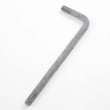
- Using a 1/4-inch hex driver, turn the front leveling screw on each side.
- Recheck door swing and closing.
Typical adjustment direction:
| Goal | What to do | Result |
|---|---|---|
| Raise the front | Turn leveling screws clockwise | More rearward tilt, easier closing |
| Lower the front | Turn leveling screws counterclockwise | Less rearward tilt |
If leveling does not solve it: re-seat and align the door on the hinges
Door sag often comes from hinge movement. When we correct it, we support the door, loosen hinge screws slightly, align the door so the bottom of the refrigerator door is even with the top of the freezer drawer, then tighten all screws.
- Disconnect power before removing doors.
- Keep doors closed until you are ready to lift them free.
- Support the door during hinge work (do not rely on gasket magnets).
When a gasket problem is the real cause
If the door looks “dropped” because it will not seal, inspect the gasket for gaps, tears, or warping. A damaged gasket can let the door sit slightly open and appear misaligned. If you need a replacement, match the gasket to your model; common options listed for this model include refrigerator door gasket W10443320 and refrigerator door gasket W10830162.
Why it matters
A sagging or misaligned door can cause warm air leaks, frost buildup, longer run times, and temperature swings in both the fresh food and freezer sections.
Last updated: February 2026
What are the common problems with Kenmore 59672013015 Elite refrigerators?
Common issues we see with the Kenmore 59672013015 bottom-mount refrigerator are warm temperatures, ice maker or water dispenser problems, water leaks, and normal-to-loud operating noises. Many of these trace back to airflow restrictions, door sealing, or water supply and filtration setup described in the owner's manual.
Most common symptoms and what they usually mean
- Refrigerator too warm: doors opened often, large food load, or controls not set cold enough.
- Ice maker not making ice: water shutoff valve closed, kinked supply line, or ice maker not turned on.
- Water dispenser weak or not working: low home water pressure, kinked line, or a clogged/incorrectly installed filter.
- Moisture buildup inside: humid room air entering from frequent door openings.
- Noises (buzzing, hissing, popping, gurgling): often normal sounds from the compressor, fans, defrost cycle, or water valve.
Quick checks we recommend first (safe, no tools)
- Confirm the unit is plugged into a grounded 3-prong outlet and the outlet works.
- Make sure temperature controls are turned on and set appropriately; recheck temps after 24 hours.
- Keep doors fully closed and minimize openings; warm air causes temperature swings and moisture.
- If newly installed or recently moved, allow 24 hours to cool completely.
- For ice and water issues, verify the shutoff valve is fully open and the water line is not kinked.
Water and ice problems: filter and valve basics
If water flow is slow, remove the filter briefly and test the dispenser. If flow improves, the filter is the restriction.
| Symptom | Most likely cause | Common fix |
|---|---|---|
| Slow dispenser flow | Clogged filter | Replace Kenmore refrigerator water filter (9084) EDR4RXD1 and flush the system |
| No ice production | Water off or line kinked | Open shutoff valve, straighten line, wait 24 hours |
| Buzzing noise during ice fill | Water valve opening | Normal operation |
Why it matters
Warm temps and poor airflow can lead to food spoilage, while low water flow can stop ice production and strain the water system. Addressing door habits, control settings, and filtration early prevents repeat problems.
Last updated: February 2026