Owner’s manual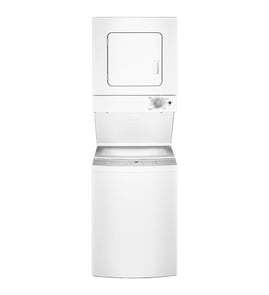


What are the most common issues with 11081422510?
For the Kenmore 11081422510 stacked laundry center, the most common problems are washer no-drain or leak symptoms, washer won’t spin or agitate, and dryer no-heat or noisy operation. These issues usually trace to a small set of wear parts and simple checks in the owner's manual.
Common problems we see (washer and dryer)
- Washer won’t drain or drains slowly (often a pump or hose restriction)
- Washer won’t spin or agitate (often a lid switch or drive coupling issue)
- Water leaking under the washer (often a tub seal or tub gasket issue)
- Dryer won’t heat or heats poorly (often a heating circuit or wiring issue)
- Dryer is loud or squeals (often an idler pulley or drum support wear)
- Cycles act erratic or don’t advance (often a timer or control issue)
Quick checks before replacing parts
- Confirm the lid is closing and latching fully; a lid safety problem can stop spin
- Check the drain hose for kinks, clogs, or a crushed section
- Reduce load size and redistribute items; off-balance loads can prevent proper spin
- Clean the dryer lint screen and verify the vent path is clear and not crushed
- Verify the correct power supply; electric dryers need full voltage to heat
Parts that commonly solve these symptoms
| Symptom | Commonly involved part | Example part on this model page |
|---|---|---|
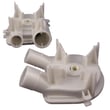
| No drain / slow drain | Drain pump | Washer drain pump WP3363394 |
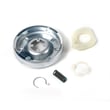
| Won’t spin / agitate | Lid switch, coupling | Washer lid switch assembly WP3355806, coupling 285753A |
| Leak underneath | Tub seal, tub gasket | Washer tub seal WP8577376, washer tub gasket W10814296 |
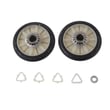
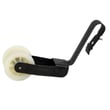
| Dryer squeal / rumble | Idler pulley, rollers | Dryer idler pulley WP691366 |
| No heat | Heating element, wiring | Dryer heating element WP3403591, dryer heating element wire kit 279457 |
Why it matters
Catching these issues early prevents secondary damage, like a leaking tub seal washing out bearings, or a restricted dryer vent overheating the heater circuit. Using model-matched Kenmore parts keeps fit and function correct.
Last updated: March 2026
What is the average lifespan of 11081422510?
The average lifespan of the Kenmore 11081422510 stacked laundry center is 13 years with normal use and routine maintenance (good airflow for the dryer, correct loads in the washer, and timely replacement of wear parts).
What affects lifespan the most
- Overloading the washer or dryer drum (extra strain on the drive system and rollers)
- Poor venting or lint buildup (overheats the dryer and shortens heater and motor life)
- Hard water and detergent overuse (can contribute to residue, odors, and seal wear)
- Ignoring early symptoms (squealing, thumping, slow drain, lid not latching)
- Delayed wear-part replacement (small parts can prevent bigger failures)
Maintenance that helps you reach (or beat) the average
- Clean the lint screen every load; keep the exhaust path clear
- Avoid tightly packing loads; balance bulky items
- Use the correct water level and cycle for the load size
- Check hoses for bulges or seepage; replace at the first sign of wear
- Follow the care and cleaning steps in the owner's manual
Common wear parts and what they usually indicate
| Symptom | Common cause | Example part on this model |
|---|---|---|
| Washer won’t drain or drains slowly | Drain pump issue or blockage | Washer drain pump WP3363394 |
| Washer won’t start or stops when lid opens | Lid switch problem | Washer lid switch assembly WP3355806 |
| Dryer squeals or has a loose belt feel | Idler pulley or roller wear | Dryer idler pulley WP691366 |
| Dryer heats poorly or not at all | Heating circuit issue | Dryer heating element WP3403591 |
Why it matters
Knowing the typical lifespan helps you decide whether to repair or refresh key components. On a stacked laundry center, replacing a few high-wear parts at the right time often restores reliable washing, spinning, and drying without replacing the whole unit.
Last updated: March 2026
What is the capacity of the Kenmore dryer model 11081422510?
The Kenmore stacked laundry center dryer in model 11081422510 is a compact-size dryer; capacity is about 3.4 cu. ft. Use the load examples and cycle guidance in the 11081422510 owner's manual to match real-world loads (towels, mixed loads, sheets) to the best drying results.
What “3.4 cu. ft.” means for everyday loads
A 3.4 cu. ft. dryer is designed for smaller, balanced loads and steady airflow. For best performance, follow these practical limits:
- Load items loosely; do not pack the drum
- Dry similar-weight fabrics together (towels separate from lightweight synthetics)
- For bulky items, dry fewer pieces at a time
- Clean the lint screen before every load
- If items are still damp, finish with a timed cycle rather than overfilling
Load examples you can use
The manual provides balanced-load examples (such as towels and mixed loads). Use this quick guide to stay in the right range.
| Load type | Good target for this dryer | Result you should expect |
|---|---|---|
| Towels | Small to medium towel load | Better tumbling, fewer damp spots |
| Mixed load | A few shirts plus light items | More even drying, fewer wrinkles |
| Sheets/bulky | Fewer pieces per cycle | Shorter dry time, less bunching |
Why it matters
Capacity directly affects tumbling space and airflow. Keeping loads sized for a compact Kenmore dryer helps prevent long dry times, “clothes still damp” results, and extra wear on moving parts like the belt system and dryer idler pulley WP691366.
Last updated: February 2026