Owner’s manual
 Error Codes




How do I find the cubic feet of my Whirlpool refrigerator?
For your Whirlpool G2IXEFMWB02 top-mount refrigerator, the most accurate way to find cubic feet is to look up the capacity listed in the specifications section of the owner's manual. If you need a quick estimate, you can calculate interior volume by measuring usable space and converting cubic inches to cubic feet.
Fast ways to get the capacity
- Check the specifications section in the owner's manual (best option for an exact number).
- Look for a model/serial label inside the fresh food compartment; it often lists key specs or helps confirm the exact model.
- Estimate capacity by measuring the usable interior (good for a ballpark figure).
How to estimate cubic feet by measuring
- Empty the compartment you are measuring (refrigerator section and freezer section).
- Measure usable interior:
- Width (inches)
- Height (inches)
- Depth (inches)
- Multiply:
width x height x depth = cubic inches. - Convert to cubic feet:
cubic inches ÷ 1,728 = cubic feet.
Quick conversion table
| What you have | What to do | Result |
|---|---|---|
| Inches (W x H x D) | Multiply to get cubic inches | Total cubic inches |
| Cubic inches | Divide by 1,728 | Cubic feet (approx.) |
Why your estimate may not match the published capacity
Published refrigerator capacity is based on standardized measurement methods; your tape-measure estimate can be lower because it excludes:
- Shelves, bins, and air channels
- Rounded corners and molded liners
- Space taken by the evaporator cover and ducting
Why it matters
Knowing cubic feet helps us match the right Whirlpool refrigerator parts and accessories for the G2IXEFMWB02, and it also helps when comparing storage needs (fresh food vs. freezer space) and planning organization.
Last updated: February 2026
What model is my Whirlpool refrigerator?
Your Whirlpool refrigerator’s model number is printed on the appliance ID label inside the fresh food (refrigerator) compartment. On Whirlpool top-mount models like G2IXEFMWB02, the label is most often on a side wall near the front, on the ceiling, or behind the crisper drawers.
Where to look for the model number label
Check these common spots with the refrigerator door open:
- Left or right interior side wall (usually near the front edge)
- Ceiling of the fresh food compartment
- Behind or above the crisper pans (remove the drawers to see the back wall)
- Along the frame around the door opening
What you should write down (and why)
Record both numbers exactly as shown:
- Model number (used to match parts and diagrams)
- Serial number (used to identify production details)
- Revision or engineering code (if listed; helps avoid ordering the wrong variation)
Why it matters
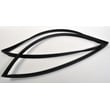
Parts like a refrigerator ice maker, door gasket, or water inlet valve can vary by model and even by production run. Using the exact model number helps us match the correct Whirlpool refrigerator parts the first time.
Quick check: model number vs. serial number
| Item | What it looks like | What it’s used for |
|---|---|---|
| Model number | Letters and numbers (example: G2IXEFMWB02) | Finding correct parts and manuals |
| Serial number | Longer code, often includes numbers only or mixed | Manufacturing date and unit identity |
If the label is missing or unreadable
Use these practical options:
- Look for a second label behind the crisper drawers or on the cabinet wall
- Clean the label gently with a damp cloth to remove haze or food residue
- Take a clear photo and zoom in to read faint characters
- If you’re troubleshooting and need model-specific guidance, use the G2IXEFMWB02 owner's manual to confirm label location and identification details
Last updated: February 2026
What's the average lifespan of a Whirlpool refrigerator?
Most Whirlpool refrigerators last 10 to 18 years. For a Whirlpool G2IXEFMWB02 top-mount refrigerator, lifespan depends most on condenser airflow, door seal condition, and how well the defrost and fan systems keep temperatures stable; routine maintenance is what gets you to the high end of that range.
Typical lifespan by what you control
- Ventilation and coil cleanliness: Dusty condenser coils make the compressor run hotter and longer.
- Door gasket seal: A weak seal forces longer run times and can cause moisture and frost issues.
- Ice maker and water system health: Leaks or slow fills can create icing and temperature swings.
- Fan performance: A weak evaporator fan reduces airflow and can cause warm spots.
- Stable settings and loading: Overpacking blocks vents; frequent door openings add heat and humidity.
Quick maintenance checklist (best ROI)
- Vacuum condenser area and keep airflow clear (every 6 to 12 months).
- Confirm doors close squarely and seal all the way around.
- Keep interior vents unblocked; leave space around the back wall.
- If you have a water dispenser or ice maker, replace filters on schedule and purge air after changes.
- Watch for early warning signs: louder running, warmer temps, frost buildup, or water puddles.
Common “life-shortening” symptoms and what they usually point to
| Symptom | Most common cause | What to check first |
|---|---|---|
| Frost on back wall or freezer | Defrost or airflow issue | Door seal, vents, fan noise |
| Warm refrigerator, freezer OK | Airflow problem | Evaporator fan, blocked vents |
| Water under crisper | Drain or water line issue | Drain path, tubing connections |
| Lights stay off or on | Door switch issue | Door alignment, switch action |
Why it matters
A refrigerator that runs longer to hold temperature wears the sealed system faster and raises energy use. Keeping airflow strong and doors sealing correctly reduces compressor run time and helps your Whirlpool refrigerator reach its full expected lifespan.
For model-specific care and cleaning guidance, follow the maintenance section in the owner's manual.
Last updated: February 2026
What is the most common problem with a Whirlpool refrigerator?
The most common Whirlpool refrigerator problem is a cooling complaint (warm fridge, warm freezer, or temperature swings). On the Whirlpool G2IXEFMWB02 top-mount, the most frequent root causes are airflow restrictions (dirty condenser coils, blocked vents, frost buildup) or a failed evaporator fan system.
Most common symptoms and what they usually mean
- Fridge warm, freezer cold: weak or failed evaporator fan, iced-over evaporator, or blocked air damper/vents
- Both sections warm: dirty condenser coils, condenser airflow issue, or sealed system/compressor start issue
- Frost on freezer back wall: defrost system problem (heater, thermostat, timer/control)
- Water under crisper or on floor: clogged/iced defrost drain or leaking water line
- Ice maker not making ice: water supply issue, inlet valve issue, or ice maker failure
Quick checks we recommend first (no parts needed)
- Set temps to typical targets: 37°F fresh food and 0°F freezer.
- Make sure vents are not blocked by food packages.
- Clean condenser coils and confirm the unit has good airflow at the rear/bottom.
- Listen for the evaporator fan in the freezer (door switch held in); it should run when cooling is called.
- Look for heavy frost buildup on the freezer rear panel (a strong defrost clue).
Common part-related fixes for this model
If the quick checks point to a component failure, these parts are commonly involved on G2IXEFMWB02:
| Problem area | What you may notice | Example part on this model page |
|---|---|---|
| Evaporator airflow | No fan sound, poor cooling in fridge | Evaporator motor WPW10189703 |
| Defrost control | Frost blanket on evaporator, warming over days | Refrigerator defrost bi-metal thermostat WP2321800 |
| Ice and water | No ice, slow fill, leaks at valve | Refrigerator water inlet valve WP2188808 |
| Ice maker assembly | No harvest, no ice even with water present | Refrigerator ice maker 4317943 |
Why it matters
Cooling problems usually get worse over time. Catching an airflow issue early can prevent food spoilage and reduce strain on the compressor and start components.
Model-specific tip
Use the troubleshooting and component location details in the G2IXEFMWB02 owner's manual to confirm access steps and safety guidance before testing or replacing parts.
Last updated: February 2026