Owner’s manual
 Error Codes



How do I remove the base grille on my Whirlpool refrigerator?
On the Whirlpool GI0FSAXVY011 bottom-mount refrigerator, the base (toe) grille typically pulls straight forward from the bottom front of the cabinet to release its retaining clips; if your version uses screws, remove them first, then pull the grille forward and lift it off.
Steps to remove the base grille
- Unplug the refrigerator (or switch off power at the breaker) for safety.
- Open both fresh food doors for better access.
- Look along the top edge of the grille for fasteners.
- If screws are present, remove them.
- Grasp the grille at both ends and pull straight forward to pop it free.
- If it feels stuck, pull from one end, then the other; avoid twisting.
What to check before you pull
- Make sure the grille is not caught on the leveling legs.
- Check for hidden screws near the ends.
- Pull from the solid plastic areas, not the vent slats.
- Use a towel or cardboard to protect flooring and the grille finish.
- If the refrigerator was recently moved, the grille may be slightly misaligned.
Reinstalling the grille (quick guide)
Align the grille ends with the leveling assemblies, then press until the clips snap in. If your grille uses screws, reinstall and snug them (do not overtighten).
| Grille style | What you’ll see | Removal method |
|---|---|---|
| Clip-on | No visible screws | Pull straight forward to release clips |
| Screw-secured | Screws at ends or top edge | Remove screws, then pull forward |
Why it matters
The base grille helps direct airflow and protects the machine compartment area. Removing it correctly prevents broken clips and makes routine tasks like coil cleaning and leveling adjustments easier.
For model-specific illustrations and any screw locations, use the GI0FSAXVY011 manual. If you’re replacing a damaged grille, match it to the correct part for this model, such as the refrigerator grille WPW10534155.
Last updated: January 2026
Is a bottom mount or top mount fridge better?
For the Whirlpool GI0FSAXVY011, a bottom-mount refrigerator is usually “better” if you use fresh-food items most often because the refrigerator section sits at eye level; a top-mount is often “better” if you want a lower upfront cost and access the freezer frequently. Use the GI0FSAXVY011 user manual to confirm features and storage layout for your exact unit.
Quick comparison: bottom-mount vs top-mount
| Feature | Bottom-mount (freezer on bottom) | Top-mount (freezer on top) |
|---|---|---|
| Fresh-food access | Easier; most-used shelves are higher | Requires more bending for fresh food |
| Freezer access | More bending; drawer-style storage | Easier reach for freezer items |
| Organization | Often better fresh-food visibility | Simple, traditional layout |
| Typical cost | Often higher | Often lower |
| Best for | Fresh-food heavy households | Freezer heavy households |
How we recommend choosing for your kitchen
- Pick bottom-mount if you open the refrigerator door many times a day for produce, drinks, and leftovers.
- Pick top-mount if you rely on frozen foods, want a simpler layout, or are shopping primarily by price.
- Consider who uses the fridge most; frequent bending can be a daily annoyance.
- Measure door swing and aisle clearance; either style can be “better” depending on traffic flow.
- Think about cleaning and loading; bottom freezer drawers can be great for bulk items but heavier to pull out.
Why it matters
The “better” refrigerator style is the one that matches how you actually use it. Layout affects daily comfort (bending and reaching), food visibility (wasted food), and how often doors stay open (temperature stability and efficiency).
Helpful model-specific tip
If your GI0FSAXVY011 doors do not sit level after moving the refrigerator, leveling the cabinet helps the doors seal correctly and can reduce frost and temperature swings. Door sealing issues can also relate to the freezer gasket; if you see gaps or heavy frost, inspect the refrigerator door gasket WPW10714545.
Last updated: January 2026
What is the most common problem with Whirlpool refrigerators?
On Whirlpool refrigerators like model GI0FSAXVY011, the most common problem we see is poor cooling (warm fresh-food section, soft ice, or temperature swings). The usual causes are dirty condenser coils, airflow problems, or a defrost-system issue; use the GI0FSAXVY011 manual to match checks to your exact layout.
Most common symptoms (and what they often point to)
- Fridge section warm but freezer cold: restricted airflow, iced evaporator area, or an air baffle/damper issue
- Both sections warm: condenser airflow problem, compressor start problem, or a sealed-system concern
- Frost buildup on freezer back wall: defrost heater or defrost thermostat issue
- Loud humming, clicking, or buzzing: condenser area, compressor start device, or ice maker noise
- Ice maker not making ice: ice maker assembly issue or a water supply problem (filter, line, or valve)
Quick checks we recommend first (no parts swapping)
- Make sure interior vents are not blocked by food packages
- Clean dust from the condenser coil area and listen for normal fan airflow at the bottom/back
- Check door gaskets for gaps, tears, or doors not closing fully
- Set temperatures to normal targets and allow 24 hours to stabilize
- Look for heavy frost that suggests a defrost failure
Model-matched parts that often relate to these problems
| Symptom | System to check | Example part for GI0FSAXVY011 |
|---|---|---|
| Frost buildup, warm temps | Defrost system | Refrigerator defrost heater WP12729123 |
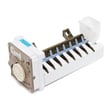
| Ice maker not working | Ice maker system | Refrigerator ice maker assembly WPW10300024 |
| Poor heat removal, warm temps | Condenser airflow | Refrigerator condenser fan blade WP12825803 |
| Clicking, won’t start, intermittent cooling | Compressor start circuit | Refrigerator start device WPW10448874 |
Why it matters
Cooling problems can spoil food and make the compressor run longer than normal. Catching airflow or defrost issues early often prevents more expensive repairs.
If you’re seeing an error code, use our Whirlpool refrigerator error codes guide to narrow the problem to a specific system.
Last updated: January 2026