Installation guide
 Owner’s manual
 Error Codes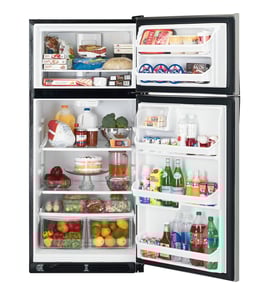



What is the upper part of a fridge called?
In most top-mount refrigerators like Kenmore model 25371822104, the upper compartment is the freezer (often called the freezer section); the lower compartment is the fresh food or refrigerator section. For your exact compartment features and layout, use the 25371822104 owner's manual.
- Freezer compartment: the upper, colder section that keeps food frozen
- Fresh food compartment: the lower section that keeps food refrigerated
- Freezer door and refrigerator door: the doors for each compartment
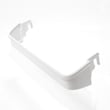
- Freezer shelf / door bin: storage areas inside the freezer
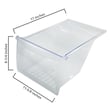
- Refrigerator shelves, door bins, crispers: storage areas in the fresh food section
| If the upper section has... | It is usually called... | What it is for |
|---|---|---|
| An ice bin or ice maker area | Freezer | Ice storage and freezing |
| The coldest temperatures and frost | Freezer | Long-term frozen storage |
| Frozen food shelves and a freezer light | Freezer | Everyday frozen items |
Knowing the correct compartment name helps when you are ordering parts, following temperature and loading guidance, or troubleshooting cooling issues. For example, airflow and loading practices in the freezer affect how well cold air circulates through the whole refrigerator.
- Leave space between packages so cold air can circulate in the freezer.
- Avoid overloading the freezer with warm food at one time.
- Keep vents unblocked in both compartments to prevent temperature swings.
- Level the refrigerator so doors close tightly (this supports stable temperatures).
Last updated: January 2026
What are the dimensions of a Kenmore refrigerator model 25371822104?
Kenmore top-mount refrigerator model 25371822104 is a standard-width top-freezer style; most units in this class measure about 28 to 30 inches wide, 65 to 67 inches tall, and 30 to 33 inches deep (not counting the door swing). For the exact cabinet and clearance dimensions for your unit, use the 25371822104 owner's manual.
Refrigerator fit issues usually come from clearances and door swing, not just the cabinet size. Use these checks before ordering parts or planning a move:
- Measure width at the widest point (cabinet, then doors/handles if they protrude)
- Measure height from floor to top of cabinet (include hinge cover if present)
- Measure depth three ways: cabinet only, to door front, and to handle
- Allow clearance for door opening and drawer pull-out (crispers, deli drawer)
- Confirm the unit is level; a tilted cabinet can change door alignment and swing
These ranges help you plan a rough fit while you confirm the exact specs in the manual.
| Measurement | Typical range for top-mount refrigerators | What to include |
|---|---|---|
| Width | 28 to 30 in. | Cabinet, then doors/handles if needed |
| Height | 65 to 67 in. | Floor to top, including hinges/cover |
| Depth | 30 to 33 in. | Cabinet-to-handle varies most |
Correct dimensions help prevent airflow restrictions, door clearance problems, and installation headaches. They also help you avoid ordering storage components that will not fit your shelf and bin layout.
For placement, leveling, and ventilation basics (including where to locate the serial plate and installation considerations), follow the 25371822104 installation guide.
Last updated: January 2026
What are the common problems with Kenmore Elite refrigerators?
Common problems that stop a Kenmore refrigerator from cooling or running normally include power supply issues, temperature controls set incorrectly, defrost-related cooling problems, and sealed-system failures such as a compressor that will not start. For model 25371822104, the 25371822104 owner's manual troubleshooting list covers several of these basics.
- Refrigerator will not run: confirm the plug is fully seated; check the breaker or a 15-amp time-delay fuse.
- Controls set wrong: make sure the temperature control is not set to "0" (off).
- Defrost cycle confusion: if it just stopped, wait about 20 minutes and recheck.
- Noisy or vibrating: level the cabinet; a weak or uneven floor can amplify vibration.
- Light not working: unplug the unit before replacing the bulb; use the correct bulb type for the socket.
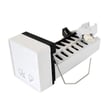
- Ice maker not working (some models): confirm the water supply valve is open and the ice maker is turned on.
| Symptom | Likely cause | Best first step |
|---|---|---|
| Not running at all | Power issue or control set to off | Check outlet, breaker/fuse, control setting |
| Runs but warm temps | Airflow/defrost issue or dirty condenser area | Verify vents are clear; allow 24 hours after adjustments |
| Clicking, won’t start | Start device or compressor issue | Listen for repeated clicks; inspect start components |
| Frost buildup, weak cooling | Defrost system problem | Check for heavy frost on freezer back panel |
If troubleshooting points to a specific failure, these model-compatible parts are often involved:
- Refrigerator compressor 5304507765 for hard-start or no-cool sealed-system symptoms
- Refrigerator defrost bi-metal thermostat 5303918202 for defrost and frost-buildup complaints
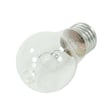
- Refrigerator light bulb 316538904 for a dead interior light
Catching simple issues first (power, control settings, leveling, and defrost-cycle timing) prevents unnecessary part replacement and helps protect the compressor; low voltage or improper power can damage it.
Last updated: January 2026