Owner’s manual
 Error Codes



Can I use a generic water filter in my GE refrigerator?
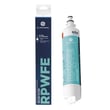
Yes, but for GE model CYE22TP2MDS1 we recommend using the specified RPWFE filter because select models use RFID to monitor filter status and detect issues; many generic filters will not be recognized or may not perform to the same NSF-tested standards.
What your CYE22TP2MDS1 is designed to use
Your refrigerator uses the RPWFE-style cartridge located inside the fresh food compartment (left wall near the top). The manual also notes that some models use RFID technology for filter monitoring, which can prevent non-matching cartridges from working as expected. See the CYE22TP2MDS1 owner's manual.
Recommended replacement part
- Use the correct cartridge style: GE refrigerator water filter RPWFE
- Replace about every 6 months, or sooner if flow drops
- Replace earlier if you dispense a lot of water (the manual references a gallon limit)
If you still want to try a generic filter
A generic filter only makes sense if it is fully compatible with your cartridge type and the refrigerator accepts it.
- Match the exact cartridge type (RPWFE) and fit
- Choose a filter that is NSF certified for the contaminants you care about
- Expect possible “filter not detected” or status issues on RFID-equipped units
- Watch for slow dispensing, odd taste, or cloudy ice after installation
- Avoid forcing the housing; a poor fit can cause leaks
Quick comparison
| Option | Best for | Common downside |
|---|---|---|
| Genuine RPWFE | Reliable fit, proper monitoring, consistent filtration | Higher cost |
| Generic “RPWFE-compatible” | Lower cost if it’s truly compatible | May not be recognized; variable filtration results |
Why it matters
The water filter affects water flow to the dispenser and ice maker, and it also protects internal components from sediment. Using the correct RPWFE cartridge helps maintain performance and reduces nuisance filter alerts.
Last updated: February 2026
How much does it cost to replace a control board on a GE refrigerator?
On a GE bottom-mount refrigerator like model CYE22TP2MDS1, replacing a control board usually costs $250 to $600 total when you include the part plus a typical service call and labor. DIY replacement often costs the part price only, but correct diagnosis and safe handling are critical.
Typical cost ranges (parts and labor)
Control board pricing varies by which board failed (main control board vs. display or interface board) and whether the board is new, rebuilt, or OEM.
- Control board part: $150 to $400+
- Service call and labor: $100 to $200+
- Common add-ons: diagnostic fee, wiring repair, connector replacement
- DIY cost: usually the part price only (no labor)
| Repair approach | What you pay for | Typical total |
|---|---|---|
| DIY replacement | Part only | $150 to $400+ |
| Professional repair | Part + labor | $250 to $600 |
| Repeat visit (misdiagnosis) | Extra labor and parts | Often higher than $600 |
How we recommend confirming it is the board
Many “control board” symptoms are caused by sensors, fans, or wiring. Before ordering a board, we use these checks:
- Unplug the refrigerator before any inspection or repair (power cannot be shut off from the control panel).
- Reseat harness plugs; look for loose connectors or pinched wiring.
- Check for burn marks or a burnt odor near the board area.
- If temperatures are erratic, test inputs such as the refrigerator temperature sensor WR55X10025.
- If the display or dispenser acts up, inspect related components such as the refrigerator water filter indicator board WR55X35905 and its wiring.
Why it matters
A correct board replacement restores normal cooling control, defrost timing, and dispenser operation. A wrong diagnosis wastes money and can leave the real failure (sensor, fan motor, defrost issue, or wiring) unresolved.
Safety and documentation
We follow the safety guidance in the CYE22TP2MDS1 manual; it instructs you to unplug the refrigerator before repairs and notes that repairs should be performed by a qualified service professional.
Last updated: February 2026
How to remove bottom grille on GE refrigerator?
On the GE CYE22TP2MDS1 bottom-mount refrigerator, the bottom grille (base grille) typically comes off by releasing its retaining tabs or removing a couple of screws (model variations exist). Once released, pull the grille straight out from the front to remove it.
Quick steps
- Unplug the refrigerator or switch off power at the breaker (safer around wiring and fans).
- Open both fresh food doors for better access.
- Look along the top edge of the bottom grille for retaining clips or screws.
- If you see screws: remove them with a Phillips screwdriver.
- If you see clips/tabs: press the tabs in (or gently pry at the clip points) while pulling the grille forward.
- Pull the grille straight out; avoid twisting so you do not crack the plastic.
What you should see and what it means
| What you find | What to do | Common mistake to avoid |
|---|---|---|
| 2 Phillips screws | Remove screws, then pull grille forward | Stripping the screw head by using the wrong bit size |
| Snap-in tabs/clips | Depress tabs, then pull straight out | Pulling from one corner only and breaking a clip |
| Tight fit at the floor | Lift slightly, then pull out | Dragging the grille and scratching flooring |
Reinstalling the grille
- Line up the grille with the mounting slots.
- Push straight in until the tabs click (or reinstall the screws).
- Confirm it sits flush and does not rattle.
Why it matters
We remove the bottom grille to access and clean the lower front area, improve airflow, and reduce dust buildup that can affect cooling performance and noise.
For model-specific diagrams and access notes, use the CYE22TP2MDS1 owner’s manual.
Last updated: February 2026
What is the most common problem with a GE refrigerator?
In GE refrigerators like model CYE22TP2MDS1, the most common issue we see is poor cooling (warm fresh food section or freezer), usually caused by restricted airflow or heat not being released properly. Start by checking condenser coil cleanliness, door sealing, and whether fans are running.
Quick checks that fix many cooling complaints
- Make sure the doors fully close and the gaskets seal all the way around.
- Confirm air vents inside the fresh food section are not blocked by food containers.
- Clean dust and pet hair from the condenser coil area (unplug the refrigerator first).
- Listen for the evaporator fan; it should run when the compressor is running and the door is closed.
- If temperatures swing, a sensor issue is common; see refrigerator temperature sensor WR55X10025.
Common causes and what they look like
| Symptom | Most likely cause | What you can do first |
|---|---|---|
| Fresh food warm, freezer OK | Airflow blocked, fan issue | Clear vents; listen for fan operation |
| Both sections warm | Dirty condenser coil, sealed system or compressor start issue | Clean coils; verify compressor is running |
| Frost buildup, weak airflow | Defrost system problem | Check for heavy frost on rear freezer panel |
| Door alarm, warm temps after | Door not sealing or left ajar | Reset and confirm closure; see how to reset the door alarm on a GE refrigerator |
Parts that commonly relate to cooling problems
These are model-relevant parts we often see involved when basic cleaning and airflow checks do not solve the issue:
- Refrigerator evaporator fan motor and blade WR60X10352 (moves cold air through compartments)
- Refrigerator defrost heater WR51X10131 (melts frost off the evaporator)
- Refrigerator defrost bi-metal thermostat WR50X10108 (helps control defrost heating)
- Refrigerator temperature sensor WR55X10025 (reports temperature to the control)
Why it matters
Poor cooling is more than an inconvenience; it can lead to food spoilage and can force the compressor to run longer than normal. Addressing airflow restrictions and coil cleaning early is the fastest way to restore normal temperatures and reduce wear.
For model-specific control features, temperature settings, and care steps, follow the CYE22TP2MDS1 owner’s manual.
Last updated: February 2026
Which is better, top mount or bottom mount fridge?
A bottom-mount refrigerator like GE model CYE22TP2MDS1 is usually better for everyday convenience because fresh food sits at eye level and the freezer is in a pull-out drawer. A top-mount is usually the better pick when you want the simplest layout and the lowest upfront cost.
Quick comparison
| Feature | Top mount (freezer on top) | Bottom mount (freezer drawer) |
|---|---|---|
| Fresh food access | More bending | Less bending, easier daily access |
| Freezer access | Easy to reach | Drawer style, can be easier to organize |
| Organization | Basic shelves/bins | Often more bins, dividers, and drawer storage |
| Space needs | Typically a bit less depth/complexity | Often larger, heavier doors and drawer hardware |
How we recommend choosing
- Choose bottom mount if you use the refrigerator section most and want easier access to produce, deli items, and beverages.
- Choose top mount if you want a straightforward design with fewer moving parts and typically lower purchase price.
- If you have tight kitchen clearance, measure door swing and drawer pull-out space before deciding.
- If you use ice and water often, plan for routine filter changes and good water flow.
- If you are sensitive to noise, compare fan and compressor sound ratings across models.
Why it matters for CYE22TP2MDS1 owners
Your CYE22TP2MDS1 is a bottom-freezer design (counter-depth family), so it is built around frequent fresh-food access and a freezer drawer layout. That design is great for day-to-day cooking and grocery organization, but it also means you will want to keep airflow paths clear and maintain the water system for the dispenser and ice maker.
Maintenance tip that applies to both styles
Water and ice performance depends heavily on filter condition. If you have slow dispensing, odd taste, or reduced ice production, replacing the filter is a smart first step; use the GE refrigerator water filter RPWFE.
For model-specific features, controls, and care guidance, follow the CYE22TP2MDS1 owner’s manual.
Last updated: February 2026