Owner’s manual
 Error Codes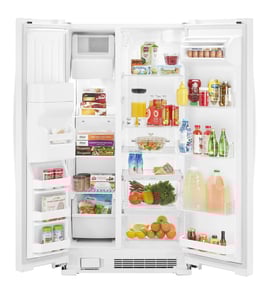



Where is the model number on a Kenmore side by side refrigerator?
On Kenmore side-by-side refrigerator model 10656826603, the model number is printed on the appliance’s rating label (the same label that lists the serial number). You’ll typically find that label inside the fresh food compartment, near the top or along a side wall; confirm the exact location in the owner's manual.
Where to look first (fast checks)
- Open the refrigerator (fresh food) door and check the cabinet walls near the top front
- Look along the left or right interior wall behind the door bins
- Check the ceiling area inside the fresh food compartment near the light housing
- If you do not see it in the refrigerator section, check inside the freezer compartment on an interior side wall
What the label looks like and what to copy down
The rating label usually includes both the model number and serial number. For parts lookup and troubleshooting, we recommend writing down:
- Model number (example: 10656826603)
- Serial number
- Electrical ratings (volts/amps), if listed
Quick ID guide
| Item | What it’s used for | Why it matters |
|---|---|---|
| Model number | Finding the correct parts diagrams and parts list | Ensures parts fit your exact Kenmore configuration |
| Serial number | Identifying production details | Helps match revisions when parts changed over time |
Why it matters
Kenmore model numbers can look similar across 106-series refrigerators, but small differences affect fit for parts like the water filter, ice maker, door bins, and electronic controls. Using the exact model number prevents ordering the wrong replacement.
Last updated: February 2026
What are the most common problems with Kenmore refrigerators?
The most common issues we see with Kenmore refrigerators like model 10656826603 are cooling problems, ice maker and dispenser trouble, water leaks, excess frost, and unusual noises. Many of these start with airflow restrictions, dirty condenser coils, door sealing problems, or a failing fan or control.
Most common symptoms and what usually causes them
- Not cooling or warm temperatures: dirty condenser coils, blocked vents, evaporator fan problems, or control issues
- Runs too much: frequent door openings, warm room, large food load, or temperature controls set too warm
- No ice or low ice production: water supply shutoff not fully open, kinked water line, ice maker switched off, or new installation needs time
- Bad-tasting or discolored ice: new plumbing connections, ice stored too long, food odor transfer, or filter needs flushing
- Noisy operation: normal sounds (buzzing, pulsating, sizzling/gurgling, popping) or items rattling on top of the cabinet
For model-specific operating and troubleshooting steps, use the owner's manual.
Quick checks we recommend first (fast, no parts)
- Confirm the refrigerator is plugged into a grounded 3-prong outlet (no adapter or extension cord).
- Verify the outlet works (test with a lamp) and reset any tripped breaker.
- Make sure both doors close fully and vents inside are not blocked by food packages.
- If ice is the issue, confirm the shutoff arm or switch is ON and the water shutoff valve is fully open.
- After a new install or ice maker restart, allow 24 hours to begin making ice and up to 72 hours for full production.
Common part-related fixes for this model
If the basic checks do not solve it, these parts are commonly involved on side-by-side refrigerators:
| Problem area | Commonly involved part | Example part for 10656826603 |
|---|---|---|
| Poor cooling, warm fresh food section | Evaporator fan not moving air | Refrigerator evaporator fan motor WP2315549 |
| Ice maker not producing ice | Ice maker assembly failure | Refrigerator ice maker WPW10190961 |
| Bad taste, slow water flow, cloudy ice | Clogged water filter | Genuine Kenmore refrigerator water filter EDR3RXD1 |
Why it matters
Cooling and ice maker complaints often share the same root causes: restricted airflow, unstable temperatures, or poor water flow. Catching those early helps prevent food spoilage, frost buildup, and unnecessary part replacements.
Last updated: February 2026
What causes a side-by-side refrigerator to stop cooling?
A Kenmore side-by-side refrigerator like model 10656826603 usually stops cooling because power is interrupted, controls are turned off or set incorrectly, airflow is blocked, or the unit is still in the first 24 hours of cooling after installation. Use the checks below to pinpoint the cause quickly; see the owner's manual.
Quick checks (fastest fixes first)
- Confirm the power cord is fully plugged into a grounded 3-prong outlet.
- Test the outlet by plugging in a lamp.
- Check the home fuse or circuit breaker; reset or replace if needed.
- Make sure the refrigerator controls are turned ON.
- Verify vents inside the fresh food and freezer sections are not blocked by packages.
- If it was just installed or moved, allow 24 hours to cool completely.
Temperature and usage issues that mimic “not cooling”
Warm temps often come from normal conditions that overwhelm cooling temporarily:
- Doors opened often or left ajar (warm air rushes in)
- Large load of warm groceries added (needs several hours to pull down)
- Controls not set cold enough for the room conditions
What to do
- Set controls one step colder.
- Keep doors closed as much as possible.
- Recheck temperatures in 24 hours.
When it is likely a part or system problem
If power and settings are correct and temperatures keep rising, common culprits include airflow or control issues.
| Symptom | Most likely area | What we check first |
|---|---|---|
| Freezer cold, fridge warm | Airflow between compartments | Blocked vents, frost buildup, evaporator fan |
| Both sections warm, unit running a lot | Cooling system efficiency | Dirty condenser area, weak compressor start components |
| Temps swing or defrost issues | Defrost/control | Adaptive defrost control, defrost thermostat |
Model-related parts that can be involved include the refrigerator evaporator fan motor WP2315549 and the refrigerator defrost bi-metal thermostat WPW10225581.
Why it matters
Running warm can lead to food spoilage and can force the compressor and fans to run longer than normal, especially in warm rooms or with frequent door openings.
Last updated: February 2026