Installation guide
 Owner’s manual
 Error Codes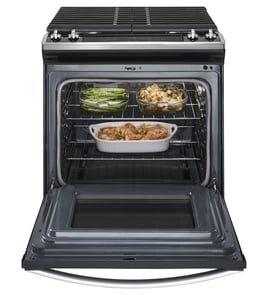



How to replace KitchenAid oven temperature sensor?
On the KitchenAid KGST307HBS9 gas slide-in range, replacing the oven temperature sensor follows the same basic process used on most KitchenAid ranges: disconnect power, access the sensor inside the oven cavity, swap the connector, then secure the sensor and route the wiring safely. Use the KGST307HBS9 owner's manual for model-specific safety and access guidance.
Before you start (safety and prep)
- Turn the oven off and let it cool completely.
- Unplug the range or switch off the circuit breaker.
- Use gloves; sheet metal edges can be sharp.
- Keep wiring away from hot surfaces and moving panels.
- If you ever smell gas, keep all burner knobs OFF and stop.
Typical replacement steps for an oven sensor
- Remove oven racks for working room.
- Locate the sensor probe inside the oven (commonly mounted on the rear wall).
- Remove the mounting screws holding the sensor.
- Pull the sensor toward you just enough to reach the connector.
- Separate the wire connector (press the locking tab; do not pull on wires).
- Connect the new sensor firmly until it locks.
- Tuck excess wire back through the opening so it cannot contact hot areas.
- Reinstall the screws, restore power, and test bake operation.
What to check if the oven still heats wrong
- Connector fully seated and not loose
- Wire not pinched behind the rear panel
- Oven igniter and burner lighting normally (a weak igniter can mimic sensor problems)
| Symptom | More likely cause | What to do next |
|---|---|---|
| Oven temp swings widely | Sensor or control issue | Verify sensor connection; then check calibration in the manual |
| Long preheat, poor heat | Igniter/burner issue | Inspect ignition and flame pattern |
| Error code related to temp | Sensor circuit issue | Recheck connector and wiring routing |
Why it matters
The sensor tells the control board the actual oven temperature. A bad sensor or poor connection causes overbaking, underbaking, or temperature instability.
Last updated: February 2026
How to replace igniter on KitchenAid gas range?
On the KitchenAid KGST307HBS9 gas slide-in range, igniter replacement is a straightforward swap once you can access the burner area: shut off power and gas, remove the old igniter from its mounting, transfer the wire connection, then secure and test for reliable ignition. See the installation guide for safety and gas shutoff details.
Before you start (safety and access)
- Turn the cooktop and oven controls to OFF.
- Unplug the range or switch OFF the circuit breaker.
- Shut OFF the gas supply valve to the range.
- Let all surfaces cool completely.
- Pull the range out only as far as needed if access is required; disconnect gas and power only when necessary.
Surface burner igniter (top burner) replacement steps
These steps apply when a surface burner clicks but will not spark, or sparks intermittently.
- Remove the grate and burner cap/head from the affected burner.
- Lift off the burner base components as needed to expose the igniter tip and mounting.
- Disconnect the igniter wire connector (note routing and any clips).
- Remove the mounting screw(s) holding the igniter.
- Install the new igniter, align it the same way as the original, and tighten the screw(s).
- Reconnect the wire, reassemble the burner head and cap, then restore power and gas to test.
Common replacement part for this model: Surface igniter WP9782116
Oven (bake) igniter notes
If the oven will not heat and you do not see ignition, the bake igniter is a different part than the surface igniter. Access typically requires removing the oven bottom panel and flame spreader to reach the igniter mounted near the bake burner.
| Symptom | Most likely area | What to check first |
|---|---|---|
| Burner clicks but no flame on top | Surface ignition | Burner cap alignment, moisture, igniter condition |
| Oven will not ignite/heat | Bake ignition | Igniter glow/operation, wiring connections |
| Nothing works (no clicking, no heat) | Power or gas supply | Breaker/fuse, outlet, gas valve open |
Why it matters
A weak or damaged igniter can prevent proper lighting, cause delayed ignition, or lead to uneven heating. Replacing the correct igniter restores safe, consistent burner operation.
Last updated: February 2026
What are the parts of a gas oven?
A gas oven like the KitchenAid KGST307HBS9 is built around a bake burner and a broil burner that heat the oven cavity, plus supporting parts such as the oven racks, door gasket, oven vent, and oven light. Your model also uses electric ignitors to light the gas burners (bake and broil). See the owner's manual for the full parts and features list.
Main gas oven parts you will see on this model
These are the core components called out for this KitchenAid gas slide-in range:
- Bake burner (main heat source for baking)
- Broil burner (high heat from the top for broiling; door must be closed for broil operation)
- Electric ignitors (ignite gas for bake and broil)
- Oven racks (support cookware and control cooking position)
- Oven vent / oven door vent (routes heat and moisture out of the oven)
- Door gasket (helps seal heat in the oven cavity)
- Oven light and light switch (lets you see inside while cooking)
Common related range parts (cooktop and controls)
Many customers mean the whole range when they say “gas oven.” On KGST307HBS9, these are also key parts:
- Surface burners (cooktop)
- Burner heads and caps
- Control knobs and control panel
- Electronic oven control
- Storage drawer
- Anti-tip bracket
Parts you can replace for common symptoms
If you are troubleshooting, these parts from our list are frequently involved:
| Symptom | Likely part area | Example part for KGST307HBS9 |
|---|---|---|
| Oven light out | Oven light | Oven light bulb 8009 |
| Surface burner won’t spark | Ignition system | Surface igniter WP9782116 or spark module WPW10110491 |
| Oven won’t heat or takes too long to ignite | Oven ignition | Range oven igniter WP9782065 |
| Door won’t close smoothly | Door hardware | Range oven door hinge WP9782033 |
Why it matters
Knowing the major parts helps you pinpoint whether the issue is gas flow (valve and burner), ignition (ignitor/spark module), or heat containment (door gasket and venting). That makes troubleshooting faster and helps you order the right replacement part the first time.
Last updated: February 2026