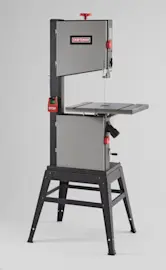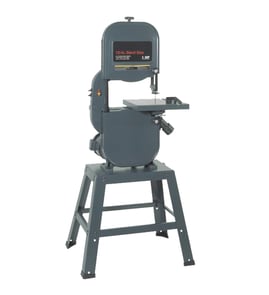

Can you resaw with a 9 inch band saw?
Yes, you can resaw with a 9-inch band saw, but on a small saw like the Tradesman 8166L you should expect slower feed rates, narrower boards, and more blade drift than you would get on a larger 14-inch saw.
A 9-inch band saw is best for light resawing and thin stock. The limiting factors are usually motor power, blade width the saw can tension, and the saw’s maximum resaw height.
- Use a slow, steady feed rate; forcing the cut overheats the blade and increases drift
- Keep the board face flat to the table and the edge tight to the fence
- Plan for a cleanup pass (jointing or planing) after resawing
- Choose straight-grained stock; knots and reversing grain amplify wandering
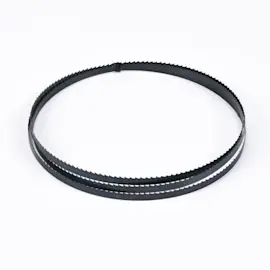
For resawing, a wider blade with fewer teeth per inch (TPI) tracks straighter and clears sawdust better. On many small 9-inch saws, the practical “resaw blade” ends up being narrower than what you’d run on a 14-inch saw.
| Goal | Typical blade choice | Why it helps |
|---|---|---|
| Straighter resaw cuts | Widest blade your saw can properly tension | Reduces twisting and drift |
| Faster cutting in thick wood | Lower TPI (often 3 TPI when available) | Clears chips, runs cooler |
| Smoother surface | Higher TPI | Less tooth marking, slower cutting |
These steps matter more on a compact saw like the Tradesman 8166L.
- Track the blade centered on the wheels before cutting
- Set side guides and thrust bearings close (not rubbing constantly)
- Square the table to the blade, then set the fence
- Use a sharp blade; dull blades wander and burn
- Support tall stock with an outfeed surface so it cannot tip
Resawing asks the most from a band saw: it loads the motor, stresses blade tension, and magnifies small alignment issues. With a 9-inch saw, good blade choice and careful setup are what make resawing practical.
For help finding the correct replacement blade size and other parts for your Tradesman 8166L, use the model parts list first, or search by model on Sears PartsDirect.
Last updated: February 2026
What is the 3-tooth rule for bandsaws?
The 3-tooth rule for a bandsaw (including the Tradesman 8166L) means you choose a blade tooth pitch (TPI) so at least three teeth are in the material at all times during the cut. This helps prevent tooth snagging or stripping, improves chip clearance, and produces a smoother, more controlled cut.
- Measure the material thickness at the cut (for tubing, use the wall thickness; for solids, use the full thickness).
- Pick a blade where 3 or more teeth will contact that thickness at once.
- If the cut sounds “grabby” or the blade chatters, move to a finer TPI.
- If the gullets pack with dust or chips and the blade heats up, move to a coarser TPI.
- For mixed-thickness cuts (like angle iron), choose based on the thinnest section.
Use this as a practical starting point; then fine-tune based on cut quality and feed rate.
| Material thickness at cut | Typical blade choice | What you’ll notice |
|---|---|---|
| Under 1/8 in. | 18 to 24 TPI | Less tooth snagging on thin stock |
| 1/8 to 1/4 in. | 10 to 14 TPI | Good control with decent chip clearance |
| 1/4 to 1/2 in. | 6 to 10 TPI | Faster cutting with stable tracking |
| Over 1/2 in. | 3 to 6 TPI | Efficient chip removal in thicker stock |
Bandsaw teeth act like tiny chisels. With fewer than three teeth engaged, each tooth takes too big a bite, which can strip teeth, pull the work, or damage the blade. With too many teeth engaged, chips cannot clear the gullets, which increases heat, dulls the blade faster, and can cause wandering cuts.
For help finding the exact model tag when ordering blades or other replacement items, use how to find your appliance model number (and what it means for parts). For broader parts lookup by model number, search on Sears PartsDirect.
Last updated: February 2026
How do I find the model number on my 8166L?
The model number for your Tradesman band saw is typically printed on the saw’s rating label (data plate). On the Tradesman 8166L, check the frame or base area near the motor, the rear of the upper wheel housing, or the stand for a sticker or metal tag.
Check these common label locations first:
- Back of the upper wheel cover or wheel housing
- Side or rear of the main frame column
- Base casting near the front edge
- Stand leg or stand cross brace (if your saw is mounted on a stand)
- Near the motor mount or belt guard area
Most power tool rating labels include several identifiers. Use the model number field (not the serial number).
| Label item | What it’s used for | Example of what it may say |
|---|---|---|
| Model number | Matching diagrams and parts | 8166L |
| Serial number | Production tracking | A longer number/letters |
| Electrical rating | Power requirements | Volts/amps/Hz |
If the tag is dusty or faded, these steps usually help:
- Unplug the saw before cleaning around the label
- Wipe with a damp cloth and mild soap, then dry
- Use a flashlight at an angle to highlight faint printing
- Take a close-up photo and zoom in to read small text
Using the exact model number (8166L) helps us match the correct Tradesman band saw parts, diagrams, and any model-specific information so you avoid ordering the wrong item.
For more help identifying model information, use [how to find your appliance model number (and what it means for parts)].
Last updated: March 2026