Owner’s manual
 View engine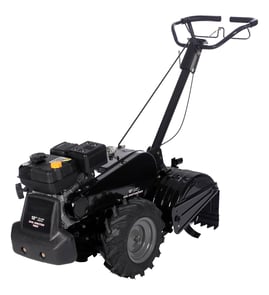



Where is the model number on a Craftsman rear tine tiller?
On the Craftsman rear-tine tiller model 917294271, the model number is printed on the tiller’s model/serial label. On this style of tiller, the label is most often found on the tine shield or tine guard area, and sometimes on the front of the frame. See the 917294271 owner's manual for the exact label location and identification details.
Look for a sticker or metal tag in these spots (wipe off dirt and oil first):
- On the tine shield (the guard covering the tines)
- On the tine guard area near the rear of the unit
- On the front of the main frame (near the engine mount area)
- Near the belt guard or transmission/gearcase area
- On the handle support/frame upright
We recommend matching the full model number exactly, including punctuation used in manuals.
| What you might see | What it means | What to do |
|---|---|---|
| 917.294271 | Manual formatting for the same model | Use 917294271 when searching parts |
| 917294271 | Model number used on parts listings | Use this to find diagrams and parts |
| Serial number | Production identifier | Keep it for service and ordering |
Using the correct model number ensures you get the right parts and diagrams for your exact Craftsman tiller configuration (tine shield, drive system, and hardware can vary by model). It also helps confirm fit when ordering items like a drive belt or clutch cable.
Last updated: February 2026
How to lubricate a tiller?
For the Craftsman 917294271 rear-tine tiller, lubrication mainly means keeping the engine properly oiled and greasing the transmission gear case. We recommend checking engine oil often, changing it on schedule, and adding gear case grease once per season to prevent wear and overheating.
- Engine crankcase oil: check before starting and after every 5 hours of continuous use.
- Engine oil change: change after every 50 hours of operation or at least once a year.
- Transmission gear case: once per season, grease the right-hand gear case grease fitting with 1 oz. of EP #1 grease.
- Spark plug wire safety: disconnect the spark plug wire before maintenance.
Use oil that meets API service classification SG-SL. Many owners use SAE 30 in warmer conditions; multi-viscosity oils (such as 10W-30) can increase oil consumption above 40°F, so check the level more frequently.
- Park the tiller on a level surface.
- Warm the engine briefly (warm oil drains better), then shut it off.
- Remove the drain plug and drain into a suitable container.
- Reinstall and tighten the drain plug.
- Refill through the oil fill plug; tighten the oil filler plug securely.
For diagrams, oil locations, and the grease fitting callout, use the 917294271 owner's manual.
Use EP #1 grease and apply 1 oz. to the right-hand gear case grease fitting once per season.
| Lubrication point | Lubricant | Interval |
|---|---|---|
| Engine crankcase | API SG-SL oil (often SAE 30) | Check before starting and every 5 hours |
| Engine oil | Same as above | Change every 50 hours or yearly |
| Transmission gear case fitting | EP #1 grease | 1 oz. once per season |
Correct lubrication prevents accelerated wear on internal engine parts and transmission gears, reduces heat buildup, and helps your Craftsman 917294271 tiller maintain consistent tine and wheel performance.
Last updated: February 2026
Are Craftsman rear tine tillers any good?
Yes. Craftsman rear tine tillers like model 917294271 are a solid choice for homeowners because they are built to dig effectively and, with routine maintenance, stay reliable for years. Like any tiller, long-term “good” performance depends on safe operation and keeping wear items (tines, belts, cables) in good condition.
A rear tine tiller earns its keep when it can maintain tine speed under load, track straight, and till consistently without excessive vibration.
Key signs your tiller is performing as it should:
- Tines pull into soil without you forcing the handlebars
- Tilling depth stays consistent when you slow down
- No belt squeal or burning smell under load
- Wheels and tines engage smoothly when you operate the drive control
- No unusual grinding from the transmission area
Most complaints about “not good” come from normal wear parts or adjustment issues, not the basic design.
| Area | What wears first | What you’ll notice | Typical fix |
|---|---|---|---|
| Drive system | Belt, cable | Slipping, weak drive, inconsistent tine speed | Adjust cable; replace belt/cable |
| Tines | Tine edges, bent tines | Shallow tilling, poor chopping/mixing | Inspect and replace tines |
| Protection | Shear pins | Sudden loss of tine drive after a jam | Replace shear pin(s) with correct type |
The owner’s manual calls out safe operation and routine checks that directly affect performance and longevity. Use the 917294271 owner’s manual for the exact procedures and intervals.
We recommend these habits:
- Avoid overloading: don’t try to till too deep at too fast a rate
- Check fasteners often (shear pins, engine mounting bolts, and other bolts)
- Inspect tines for wear and bending; worn tines make the tiller work harder and dig shallower
- Replace worn drive components promptly, such as the husqvarna rear-tine tiller drive belt 591372401 or tiller clutch cable 532110675
- Use only manufacturer-approved attachments and accessories
A rear tine tiller is powerful enough to lurch forward if the tines catch hard ground. Keeping the drive adjusted, guards in place, and wear parts fresh helps the tiller stay controllable, dig evenly, and avoid preventable breakdowns.
Last updated: February 2026
What kind of oil do you use in a Craftsman tiller?
For the Craftsman rear-tine tiller model 917294271, use engine oil that meets API service SG-SL: SAE 30 when temperatures are above 40°F, or SAE 5W-30/10W-30 when temperatures are below 40°F. The engine oil capacity is 19 oz; confirm fill and check steps in the 917294271 owner's manual.
Use the oil grade that matches your typical operating temperature:
- Above 40°F: SAE 30
- Below 40°F: SAE 5W-30 or 10W-30
- Oil spec: API SG-SL
- Capacity: 19 oz (do not overfill)
| Temperature range | Recommended oil | What to watch for |
|---|---|---|
| Above 40°F | SAE 30 | Best for warm-weather operation |
| Below 40°F | SAE 5W-30 or 10W-30 | Improves cold starting |
We recommend checking oil before starting and after every 5 hours of continuous use.
- Park the tiller on a level surface
- Remove the oil fill cap/dipstick
- Wipe, reinsert, then recheck the level
- Add oil slowly and recheck often
- Tighten the oil filler plug securely when finished
For this Craftsman tiller, change the engine oil every 50 hours of operation or at least once a year (even if you do not reach 50 hours).
Using the correct viscosity helps protect the engine at operating temperature and improves starting in cold weather. Multi-viscosity oils can increase oil consumption in warm conditions, so checking the level regularly prevents low-oil engine damage.
Last updated: February 2026
What tiller is made in the USA?
Some tillers are made or assembled in the USA, but it depends on the exact brand and model, not the product type alone. For your Craftsman rear-tine tiller model 917294271, the most reliable way to confirm country of origin is the product data plate and the documentation that shipped with the unit; use the 917294271 owner's manual to locate identification and labeling details.
We recommend verifying origin using the most specific sources first:
- Check the product data plate on the tiller frame (often lists country of origin)
- Look for “Made in USA” or “Assembled in USA” wording on the carton or hang tags
- Record the full model number and any serial number before shopping or calling for support
- Verify the engine’s country of origin separately (engine origin can differ from the tiller)
- Confirm where major assemblies are made (transmission/gear case, tine drive, handle assembly)
Country-of-origin claims are not all the same; this quick comparison helps you shop accurately.
| Label wording | What it typically means | What to do next |
|---|---|---|
| Made in USA | Product is manufactured domestically under applicable labeling rules | Still confirm the specific model and production run |
| Assembled in USA | Final assembly is domestic; parts may be imported | Ask where key components are sourced |
| Designed in USA | Engineering is domestic; manufacturing may be elsewhere | Treat as not an origin claim |
The Craftsman 917294271 documentation focuses on safe operation, maintenance, and parts identification. Use it to match the correct parts and service procedures, then use the data plate on your machine to confirm origin.
If you are troubleshooting performance while you shop or compare models, these wear items commonly affect tilling results:
- Drive belt condition and tension
- Clutch cable adjustment
- Tine wear and tine hardware
Country of origin is important for many buyers, but long-term satisfaction comes from correct fit parts, routine maintenance, and serviceability. Confirming origin from the data plate prevents assumptions based on brand name alone.
Last updated: February 2026