Installation guide
 Owner’s manual
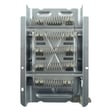



How do I tell if my dryer heating element is bad?
If your Kenmore 11066132410 electric dryer runs but won’t heat (or heats weakly), the heating element is a top suspect. With power disconnected, a good element typically shows continuity and measures roughly 10 to 50 ohms; an open (no continuity) reading indicates a failed element.
- Dryer tumbles normally but clothes stay cold and damp
- Very long dry times even on high heat
- No heat on any heated cycle (Timed Dry, Normal, etc.)
- Breaker trips when heat should turn on (can also be wiring or heater housing)
- Burning smell or visible damage at heater connections (stop using until inspected)
- Unplug the dryer (electric shock hazard).
- Access the heater terminals (location varies by build; follow the disassembly guidance in the 11066132410 installation guide.)
- Set a multimeter to ohms (Ω).
- Measure across the two heater terminals.
- Interpret the reading using the table below.
| Meter result | What it usually means | What we recommend |
|---|---|---|
| 10 to 50 Ω and continuity | Element coil is likely intact | Check airflow, thermostats, thermal fuse, and wiring |
| OL / no continuity | Element is broken (open) | Replace the heating element |
| Very low Ω (near 0) | Possible shorted coil | Replace element; inspect heater box and wiring |
On the 11066132410, a no-heat complaint is often caused by a safety device opening due to overheating or restricted venting.
- Dryer thermal fuse WP3392519 (opens if the dryer overheats)
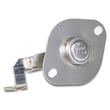
- Dryer high-limit thermostat WP3977767 (can open and stop heat)
- Vent restriction (lint buildup, crushed vent, too many elbows)
- House power issue (electric dryers need full 240V supply; one leg out can cause “runs but no heat”)
Replacing the heating element without fixing poor airflow can cause repeat failures. Good venting and a clean lint screen help protect the heater, thermostats, and thermal fuse and keep dry times normal.
Last updated: January 2026
What does PF stand for on a Kenmore dryer?
On our Kenmore dryer model 11066132410, PF stands for power failure. It means the dryer’s cycle was interrupted because the incoming power dropped out or was unstable, so the control stopped the cycle and displayed PF. See the 11066132410 use & care manual.
- Touch START once to clear the PF message.
- Press and hold START/PAUSE to resume the cycle.
- If the load is already cool, you can also reselect the cycle and start it again.
Common causes are outside the dryer itself:
- Brief outage or flicker from the utility
- Tripped breaker (electric dryers typically use two breakers)
- Loose power cord connection at the outlet or terminal block
- Power strip or extension cord use (not recommended for dryers)
- Home wiring or outlet issues causing low voltage
- Confirm the dryer is plugged directly into the wall outlet.
- Reset the dryer breakers fully (OFF, then ON).
- Try a Timed Dry heated cycle to see if the dryer runs normally.
- If PF returns often, have an electrician check the outlet and supply voltage.
PF is usually a power supply event, but if the display is erratic or buttons do not respond after power is restored, the user interface or control area may need attention. For model 11066132410, a related component is the dryer control panel W10649772.
| Display code | What it means | What to do first |
|---|---|---|
| PF | Power failure interrupted the cycle | Clear with START; then hold START/PAUSE to resume |
| L2 | Low or no line voltage condition | Check breakers, cord, outlet; call electrician if it persists |
Repeated PF events can leave clothes damp and can point to a home power issue that may also prevent proper heating (especially on 240V electric dryers). Addressing the power source helps restore normal drying performance.
Last updated: January 2026
How do I reset my Kenmore dryer?
To reset your Kenmore dryer model 11066132410, we recommend doing a simple power reset: turn the dryer off, unplug it (or switch the breaker off) for 1 minute, then restore power and start a new cycle. For control and display behavior, see the 11066132410 use & care manual.
- Touch Power to turn the dryer off.
- Unplug the dryer (or turn both dryer breakers off if it is hardwired).
- Wait 60 seconds.
- Restore power.
- Touch Power, select a cycle, then touch and hold Start/Pause (up to 3 seconds).
This model can show messages such as PF (power failure) or L2 (low/no line voltage). A reset may clear the display, but the underlying issue can still be present.
| What you see | What it usually means | What to do next |
|---|---|---|
| PF | Power interruption during a cycle | Touch Start to clear, then restart the cycle |
| L2 | Low/no line voltage affecting heat | Check both breakers/fuses; verify proper 240V supply |
| F# E# | Control detected a fault | Power reset once; if it returns, service is typically needed |
For installation-related electrical checks and venting requirements, use the 11066132410 installation guide.
If the dryer still will not start after a power reset, the most common causes are power supply, door not fully closed, or a failed door switch.
- Confirm the door closes firmly and latches
- Verify the dryer has 240V power (electric dryers often use two breakers)
- Try a different cycle and hold Start/Pause for up to 3 seconds
- If the door feels fine but the dryer acts like it is open, inspect the dryer door switch WP3406107
A proper reset clears temporary control glitches and power-failure messages, but it also helps you quickly separate a one-time interruption from a real issue like low voltage, venting problems, or a failed switch.
Last updated: January 2026
How much to replace a dryer start switch?
On Kenmore electric dryer model 11066132410, starting is done with a START/PAUSE button, and the model-specific information we have does not call out a separate, standalone “start switch” part. Total replacement cost depends on what actually failed (control, door safety circuit, or power supply issue).
Most “start switch” pricing ends up in one of these categories:
- Service diagnosis to confirm the no-start cause
- Part replacement (only after testing identifies the failed component)
- Labor for console or cabinet access and reassembly
| Cost item | What it covers | What changes the price |
|---|---|---|
| Diagnostic/service call | Testing power, door circuit, controls | Region, provider, time on site |
| Part cost | The specific failed component | Which part is needed |
| Labor | Disassembly, replacement, verification | Access difficulty, stacked/closet installs |
The troubleshooting section for this model lists several common causes:
- Door not fully closed
- START/PAUSE not touched and held long enough (up to 3 seconds)
- Household fuse blown or breaker tripped (many electric dryers use two fuses/breakers)
- Power supply issue; electric dryers are typically wired for 120/240V or, if specified on the rating plate, 120/208V
- Displayed power-related messages such as “PF” (power failure) or “L2” (low/no line voltage)
For the model-specific troubleshooting table and code descriptions, use the 11066132410 use & care manual.
If the dryer will not start because the door safety circuit is not closing, the door switch is a common repair item for this model: dryer door switch WP3406107.
Pricing a “start switch” before confirming the failure can lead to the wrong repair. Verifying door closure, proper START/PAUSE use, and correct supply voltage usually narrows the problem quickly.
Last updated: January 2026