Owner’s manual
 Error Codes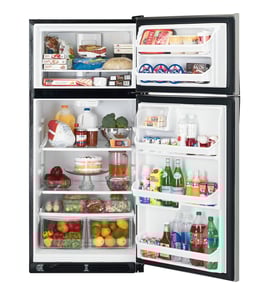


What are the disadvantages of a top mount fridge?
Top-mount refrigerators like the Samsung RT18M6213SR put the freezer on top, which can make fresh-food access less convenient and limit premium features. They are usually simpler and efficient, but the layout can feel less ergonomic for everyday fridge use.
Common disadvantages you may notice
- More bending for fresh food: the refrigerator section is lower, so you reach down more often.
- Less “eye-level” organization: shelves and drawers can feel harder to see and sort compared to bottom-freezer designs.
- Fewer built-in dispenser options: many top-mount models do not include through-the-door ice or water.
- Smaller freezer usability for bulky items: the top compartment can be tighter for pizza boxes or wide containers.
- Manual ice features on some versions: depending on configuration, you may have a twist ice maker or an optional ice maker kit.
Model-specific notes for RT18M6213SR
The RT18M6213SR user documentation covers features that can vary by version (for example, optional ice maker setups). For the most accurate feature and layout details for your exact unit, use the RT18M6213SR user manual.
Quick comparison: top-mount vs bottom-freezer
| Feature | Top-mount (RT18M6213SR style) | Bottom-freezer style |
|---|---|---|
| Fresh-food access | Lower, more bending | Higher, easier reach |
| Freezer access | Eye-level | Lower drawer/bins |
| Typical features | Simpler controls, fewer dispensers | More organization, more premium options |
| Cost/complexity | Often lower and simpler | Often higher and more complex |
Why it matters
If you use the refrigerator section far more than the freezer, the top-mount layout can feel less comfortable day to day. If you prioritize simplicity, fewer electronics, and straightforward storage, a top-mount can still be a great fit.
Last updated: January 2026
What is the common problem with Samsung fridges?
Samsung refrigerators (including the Samsung RT18M6213SR top-mount) most commonly run into cooling complaints and ice-making complaints. In many cases, the root cause is airflow restriction, dirty condenser coils, doors not sealing, or settings such as Cooling Off (Shop) mode; our first goal is to confirm basics before replacing parts.
Most common issues we see (and what to check first)
- Not cooling or weak cooling: verify temperature settings, blocked vents, and condenser coil cleanliness.
- Freezer cold but fridge warm: check for blocked air passages and frost buildup that can restrict airflow.
- Ice maker not making ice (if equipped): confirm the ice maker is turned on, water supply is on, and the bucket is positioned correctly.
- Noisy operation: some sounds are normal; new rattles or grinding can point to a fan or compressor area issue.
- Water leaks or moisture: often tied to door sealing, defrost drain issues, or water line connections on models with an ice maker.
For model-specific operating modes and button functions (including Cooling Off mode and Power Cool/Power Freeze), follow the steps in the RT18M6213SR user manual.
Quick triage: symptoms and likely causes
| Symptom | What it often points to | What we recommend first |
|---|---|---|
| Fridge and freezer both warm | Cooling Off mode, airflow, condenser coils, sealed system issue | Confirm Cooling Off mode is off; clean coils; verify doors seal |
| Freezer OK, fridge warm | Airflow restriction, frost/defrost issue | Check vents and airflow paths; look for heavy frost |
| Ice maker not working | Ice maker off, low water pressure, frozen fill tube | Confirm ice maker setting; verify water supply and pressure |
| Runs constantly | Dirty coils, warm room, frequent door openings, door gasket leak | Clean coils; check door seal; reduce door openings |
Why it matters
Cooling and ice-making problems can look like “major failures,” but many are caused by setup, airflow, or maintenance issues. Ruling those out first helps you avoid unnecessary part replacement and gets temperatures back to safe food-storage ranges faster.
When a part is more likely involved
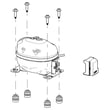
If you have verified settings, airflow, and coil cleanliness and the refrigerator still will not cool, the sealed-system components become more suspect. One compatible component listed for this model is the refrigerator compressor MSV4A1AL1RTT3 (the compressor is the pump that circulates refrigerant through the system).
If you want step-by-step help with maintenance that prevents cooling problems, use our refrigerator maintenance checklist.
Last updated: January 2026
What is the difference between force defrost FD and RD?
On Samsung refrigerator model RT18M6213SR, the user manual we have for this model does not define FD or RD as display codes or service-mode options. Because those labels are not model-documented here, we cannot confirm what FD vs RD means specifically on your unit; use the RT18M6213SR user manual for the supported control-panel functions and safe operation.
What we can confirm for RT18M6213SR
This model’s manual documents normal operating features (Power Freeze, Freezer Convert, Fridge On/Off, Power Cool, Cooling Off mode, Sabbath mode), but it does not list FD/RD forced-defrost codes.
- The control panel supports Cooling Off (Shop) mode and how to toggle it.
- It supports Power Freeze and Power Cool for faster temperature pull-down.
- It supports Freezer Convert modes (Fridge, Off, Freezer).
- It includes troubleshooting guidance, but not service-code definitions.
Why you might be seeing FD or RD anyway
On some Samsung platforms, letter codes can appear during technician diagnostics or on different control-board versions. For RT18M6213SR, the exact meaning depends on the specific control board and display logic installed.
- The refrigerator may have a different revision of the control board than the one described in consumer documentation.
- The code may be from a service procedure not included in the user manual.
- The display may be showing an abbreviated status that varies by model family.
What to do if you entered a diagnostic or defrost mode
If the refrigerator is not cooling normally after experimenting with button sequences:
- Cancel any special mode you intentionally enabled (especially Cooling Off mode).
- Unplug the refrigerator for 5 minutes, then plug it back in.
- Confirm the freezer and fridge are set to normal temperatures.
- Monitor for 24 hours for temperature recovery.
| Symptom after code | What it often indicates | Best next step |
|---|---|---|
| Lights and fans run, but no cooling | Cooling Off mode is enabled | Cancel Cooling Off per the manual |
| Warm temps and unusual compressor behavior | Possible cooling-system issue | Schedule service; sealed-system diagnosis |
Why it matters
Misinterpreting FD/RD can lead to unnecessary resets or masking a real cooling problem. If you suspect a cooling failure (warm freezer and fridge), the compressor is a key component; see refrigerator compressor MSV4A1AL1R/tt3 for the model-matched part.
Last updated: January 2026