Owner’s manual


What size is a Kenmore Model 11087721702 dryer?
For Kenmore Elite dryer model 11087721702, the cabinet footprint is about 27 inches wide. The installation section of the owner's manual also shows a stacking height of 76 inches for a stacked washer and dryer setup, and notes clearance requirements that affect the total space you need.
Use a tape measure and confirm these before moving the dryer into place:
- Width: measure the cabinet side-to-side (most 110-series cabinets are 27 inches wide)
- Depth: measure front-to-back, then add room for the vent elbow and cord
- Height: measure floor-to-top; add any pedestal height if used
- Door swing: make sure the door can open fully in the space
- Rear clearance: plan for venting space behind the dryer
The manual calls out common installation spacing points that change the real-world space needed.
| Installation detail | What to plan for | Why it matters |
|---|---|---|
| Dryer width | ~27 in. | Determines alcove/closet opening size |
| Rear clearance (typical) | 5 in. minimum behind dryer (for vent with elbow) | Prevents crushed venting and overheating |
| Side/bottom venting clearance | 2 in. spacing allowed (side venting) | Helps in tight installs |
| Pedestal option | 10 in. or 15.5 in. pedestal | Increases total height |
This model supports optional pedestals; the manual notes the pedestal increases total dryer height:
- 10-inch pedestal: total height approximately 46 inches
- 15.5-inch pedestal: total height approximately 51.5 inches
- For garage installs, the dryer (or pedestal) may need to be raised to meet clearance guidance
Dryer “size” is not just the cabinet width; vent clearance, door swing, and pedestal height often determine whether the dryer fits a closet, recessed nook, or stacked laundry center without airflow restrictions.
Last updated: February 2026
Where is the model number on a Kenmore 11087721702 dryer?
On the Kenmore Elite dryer model 11087721702, the model and serial number are printed on the model/serial label attached to the dryer cabinet. Open the dryer door and check the door opening (door frame area) first; that is the most common location.
- Open the dryer door and inspect the cabinet frame around the opening
- Check the upper-left and upper-right areas of the door opening
- Look along the inside edge of the front panel (near the lint screen housing)
- If you do not see it immediately, use a flashlight and look for a white or silver sticker/plate
For the exact label location and how it is referenced in the documentation, use the owner's manual.
The label typically lists:
- Model number (for this unit: 11087721702)
- Serial number
- Electrical ratings and other identification details
Using the correct model number ensures you get the right Kenmore Elite dryer parts and diagrams for repairs like a no-heat issue (often tied to the heating circuit) or a noisy drum (often tied to rollers and idler components).
| Symptom | Common related part type | Example part on this model page |
|---|---|---|
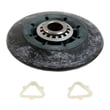
| Dryer is noisy or thumping | Drum support/roller parts | Support WPW10314173 |
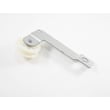
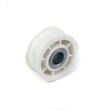
| Dryer squeals or drum will not turn smoothly | Idler pulley/belt drive parts | Dryer idler pulley 279640 |
| Dryer not heating | Heating circuit parts | Dryer heating element WP8544771 |
Last updated: February 2026
How do I know if my Kenmore dryer thermal fuse is blown?
On your Kenmore Elite dryer model 11087721702, a blown thermal fuse commonly shows up as a dryer that will not run at all, or a dryer that tumbles but has no heat (often tied to a tripped fuse/breaker condition). The sure way to confirm is a continuity test with a multimeter after disconnecting power; then correct the venting issue that caused overheating. See the owner's manual for model-specific troubleshooting steps.
- Dryer will not start even though the door is closed and Start is pressed firmly
- Drum turns but there is no heat (electric dryers can still tumble with one leg of power lost)
- You recently had restricted airflow (crushed vent, heavy lint buildup)
- You see an airflow-related message such as AF (blocked or crushed vent) on some cycles
- You have repeated overheating shut-downs or very long dry times
- Unplug the dryer (or shut off the breaker) before opening any panels.
- Access the fuse location (commonly on the blower housing or heater housing, depending on design).
- Remove at least one wire from the fuse terminal.
- Set a multimeter to continuity (or lowest ohms).
- Test across the fuse terminals.
| Meter result | What it means | What to do next |
|---|---|---|
| Beep / near 0 ohms | Fuse is good | Check airflow, thermostats, and power supply |
| No beep / OL / infinite ohms | Fuse is blown | Replace the fuse and fix the vent restriction |
A thermal fuse usually opens because the dryer overheated from poor airflow. If you replace the fuse without fixing the airflow problem, it can blow again.
- Clean the lint screen and confirm it seats correctly
- Inspect the vent hose for kinks, crushing, or excessive length
- Clear lint from the exhaust duct and outside hood
- Watch for airflow warnings; the manual notes AF can indicate a crushed or blocked vent
Depending on what you find during testing, these model-compatible parts are commonly involved:
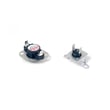
- Dryer thermal cut-off fuse kit 279973
- Dryer high-limit thermostat WP8557403
- Dryer thermistor WP8577274
A blown thermal fuse is a safety device; it stops the dryer from operating normally when temperatures get unsafe. Restoring safe airflow protects the heating system, wiring, and drum seals, and helps drying performance.
Last updated: February 2026
What are common problems with Kenmore dryers?
Common problems on the Kenmore Elite dryer model 11087721702 include no heat or long dry times (often airflow restriction or a failed heating component), the dryer not starting (power supply or door/start issues), the drum not turning (belt or support wear), and loud squealing or thumping (worn rollers or idler parts). For model-specific checks and error/diagnostic codes, use the owner's manual.
- Clothes take too long to dry: crushed/blocked venting, lint buildup, weak airflow, or a failing blower wheel
- No heat: failed heating element, thermal cut-off, high-limit thermostat, or a power supply issue (electric dryers need 240V)
- Won’t start or won’t run: tripped breaker or blown fuse (many electric dryers use 2), door not fully latched, start button not pressed firmly
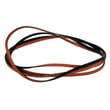
- Drum won’t tumble: worn drum support rollers, idler pulley issues, or drive system wear
- Loud noise: worn rollers, idler pulley, or debris in the blower housing
- Clean the lint screen and confirm strong airflow at the outside vent hood.
- Check both household breakers/fuses; electric dryers commonly use two.
- Close the door firmly; if the door does not latch, the control can beep and the cycle will not start.
- Run a Timed Dry heated cycle to rule out cycle/setting issues.
- If you see an AF code, treat it as a vent restriction; if you see L2, treat it as a home power supply issue affecting heat.
| Symptom | Common fix | Example part on this model |
|---|---|---|
| No heat | Replace failed heater or safety device | Dryer heating element WP8544771 |
| No heat after overheating | Replace thermal cut-off kit and correct venting | Dryer thermal cut-off fuse kit 279973 |
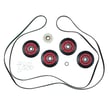
| Squealing/thumping | Rebuild drum support and idler wear items | Dryer repair kit 4392067 |
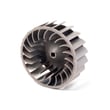
| Poor airflow/noisy airflow | Replace damaged blower wheel | Dryer blower wheel WP697772 |
Most “dryer problems” trace back to airflow and heat safety. A blocked vent can trigger overheating, blow a thermal cut-off, and leave the dryer running with little or no heat. Fixing the venting first prevents repeat failures.
Last updated: February 2026