Owner’s manual


How to read Kenmore washer model numbers?
Kenmore washer model numbers are structured so the first 3 digits identify the manufacturer, the next set of digits identifies the base model, and the remaining digits indicate specific variations. For model 11026902690, the 110 prefix is the key manufacturer identifier; record the full model and serial from the washer’s model/serial plate for accurate parts matching.
Where to find the model and serial number
Your Kenmore washer’s model and serial numbers are printed on the model and serial number plate. We recommend copying them exactly as shown before ordering parts or checking wiring and installation details.
- Look for the Model and Serial Number Plate on the washer cabinet area (commonly under the lid opening on top-load washers).
- Write down the full model number (example: 11026902690) and the serial number.
- Keep the information with your purchase date for service and parts lookup.
- Use the full number, not just the 3-digit prefix, when searching for parts.
For the exact plate location and how the washer documentation references it, use the 11026902690 owner's manual.
How the number breaks down (quick guide)
Kenmore model numbers typically follow this pattern:
| Section of model number | What it tells you | Example using 11026902690 |
|---|---|---|
| First 3 digits | Manufacturer prefix | 110 |
| Middle digits | Base model identifier | 26902 (base series) |
| Last digits | Feature/production variation | 690 (variation) |
Why it matters for parts and troubleshooting
Using the complete model number prevents ordering the wrong lid switch, drain pump, or timer. Even small suffix differences can change the correct fit, wiring connector, or mounting style.
- Ensures correct part fit and compatibility
- Helps match the right diagrams and repair procedures
- Reduces returns caused by similar-looking parts
Last updated: January 2026
How to hard reset kenmore washer?
To hard reset your Kenmore washer model 11026902690, we recommend unplugging the washer (or switching off the breaker) for 2 minutes, then restoring power and restarting a cycle. This clears many temporary control and cycle issues without changing any settings in the timer.
Hard reset steps (recommended)
- Turn the cycle selector (timer) knob to Off.
- Unplug the washer from the outlet (or turn off the circuit breaker).
- Wait 2 minutes.
- Restore power.
- Set the cycle and pull the timer knob out to start.
- If the washer was mid-cycle, run a Rinse and Spin (or a short cycle) to confirm normal operation.
For normal operation details (including stopping and restarting by pushing/pulling the timer knob), use the 11026902690 owner's manual.
If the washer still will not start after a reset
These checks solve the most common “no start” situations on a top-load Kenmore washer:
- Confirm the outlet has power (test with a lamp).
- Make sure the lid is fully closed; a failed lid switch can prevent agitation and spin.
- Verify the timer knob is pulled fully out (some knobs feel “out” but are not engaged).
- Check that water faucets are turned on and hoses are not kinked.
- Listen for drain pump or motor sounds; silence can point to a lid switch or timer issue.
Common part-related causes (and what they affect)
| Symptom | Likely area | Example part for this model |
|---|---|---|
| Won’t spin or agitate with lid closed | Lid safety circuit | Washer lid switch WP3949238 |
| Hums, won’t drain, water stays in tub | Drain system | Washer drain pump WP3363394 |
| Motor runs but washer won’t agitate/spin | Drive connection | Coupling 285753A |
Why it matters
A hard reset clears minor “stuck cycle” behavior and power glitches. If the problem returns immediately, the washer usually has a mechanical or electrical issue (lid switch, drain pump, coupling, or timer) that a reset will not fix.
Last updated: January 2026
What is the average lifespan of a Kenmore washer?
A Kenmore washer typically lasts 10 to 15 years. For Kenmore model 11026902690 (a classic top-load, agitator-style design), reaching the higher end of that range is common when the washer is installed correctly and maintained using the guidance in the 11026902690 owner's manual.
Typical lifespan by washer type
Most Kenmore washers fall into these real-world averages:
| Washer type | Typical lifespan | Notes |
|---|---|---|
| Top-load (agitator) | 12 to 15 years | Often simpler mechanics; easier to service |
| Top-load (high-efficiency/impeller) | 10 to 14 years | More sensors and control components |
| Front-load | 10 to 12 years | More wear points (door boot, bearings) |
What shortens washer life fastest
These are the most common factors we see that reduce lifespan:
- Chronic overloading (stresses the drive system and suspension)
- Unbalanced loads and frequent off-balance spinning
- Hard water scale buildup (affects inlet valve and internal passages)
- Slow draining or repeated clogs (overworks the drain pump)
- Skipping basic care (hoses, leveling, cleaning residue)
Parts that commonly wear as a washer ages
When a washer is nearing the end of its service life, these parts often show symptoms first:
- Washer lid switch WP3949238 (won’t start, stops mid-cycle)
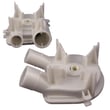
- Washer drain pump WP3363394 (won’t drain, humming, leaks)
- Coupling 285753A (motor runs but tub won’t agitate or spin)
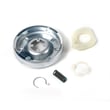
- Clutch 285785 (weak or no spin, burning smell)
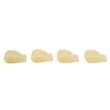
- Agitator dog 80040 (agitator slips or doesn’t “grab” clothes)
Why it matters
Knowing the typical 10 to 15 year lifespan helps you decide whether to repair or replace. If your 11026902690 is already in that age range and needs multiple major parts (drive, gearcase, tub), replacement is often the better value; if it needs one common wear part, repair usually makes sense.
Last updated: January 2026
How to unclog drain hose on Kenmore washer?
To unclog the drain hose on Kenmore washer model 11026902690, we unplug the washer, remove standing water, then clear the hose and the drain pump inlet. After the clog is removed, reinstall and clamp the hose exactly as shown in the 11026902690 owner's manual to prevent leaks and backflow.
Safety and prep
- Unplug the washer.
- Turn off both water faucets.
- Put towels and a shallow pan under the hose and pump area.
- Lower the drain hose into a bucket to drain as much water as possible.
- Wear gloves; small items and sharp debris can be inside the hose.
Step-by-step: clear the clog
- Check routing first: make sure the hose is not kinked, crushed, or shoved too far into the standpipe.
- Remove the hose: loosen the clamp, then twist the hose back and forth while pulling it off the washer drain outlet.
- Flush the hose: run hot tap water through it; push lint out with a flexible brush (avoid puncturing the hose).
- Inspect the pump inlet: if the hose is clear, check the drain pump inlet for socks, coins, or lint.
- Reinstall correctly: push the hose fully onto the drain connector until it hits the ribbed stop, then reposition the clamp.
Reinstall details that prevent leaks
- Wet the inside of the hose end with tap water only (no lubricants).
- Set the clamp about 1/4 inch from the end of the hose.
- Keep the hooked end in the standpipe or laundry tub; rotate it to eliminate kinks.
Quick symptom guide
| Symptom | Most likely cause | First check |
|---|---|---|
| Won’t drain or drains slowly | Kink or clog | Hose routing, internal blockage |
| Leaks during drain | Hose not seated or clamp off | Hose fully seated, clamp position |
| Noisy drain, still won’t drain | Pump jam | Pump inlet for debris |
Parts that may be needed
- Drain hose WPW10358149 if the hose is cracked, soft, or repeatedly clogging.
- Washer drain pump WP3363394 if the pump is jammed, noisy, or not pumping.
Why it matters
A restricted drain path can cause no-drain, no-spin, wet loads, and leaks. Correct hose seating and clamping protects floors from water damage.
Last updated: January 2026