Owner’s manual
 Error Codes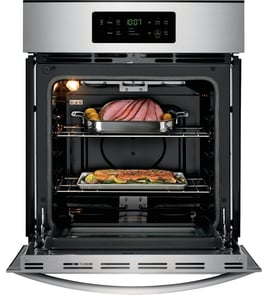



Why are wall ovens not gas?
Most wall ovens, including the GE JKP37G0L1WG electric wall oven, are electric because built-in installations are simpler and more consistent with a 240V circuit, while gas wall ovens add fuel-line routing, shutoff access, and combustion-venting requirements inside cabinetry.
- Easier installation in a cabinet cutout: Electric needs a dedicated 240V supply; gas needs a properly routed gas line and an accessible shutoff.
- Ventilation and heat management: Gas combustion produces byproducts that often require more deliberate venting planning in a built-in cavity.
- Tighter temperature control for baking: Electric elements typically deliver steadier, even heat for baking and self-clean performance.
- Fewer code and inspection variables: Gas piping rules and venting expectations can vary by location and installation details.
- Product design history: Many wall-oven platforms were engineered around electric bake and broil elements and self-clean systems.
| Feature | Electric wall oven (common) | Gas wall oven (less common) |
|---|---|---|
| Utility hookup | 240V circuit | Gas line plus 120V power |
| Built-in cabinet complexity | Lower | Higher |
| Baking heat evenness | Typically very even | Can be less even depending on burner design |
| Venting considerations | Usually simpler | Often more involved due to combustion |
Knowing your oven is electric helps you focus on the most common service items: heating elements, wiring connections, and oven lighting. For example, if you are diagnosing a no-heat or uneven-heat complaint, you will typically inspect the broil element and electrical connections rather than a gas valve or igniter.
- Verify the oven has the correct power supply (double-pole breaker fully on).
- Watch for symptoms of a weak element (slow preheat, uneven browning).
- Inspect element terminals for overheating or loose connections.
- Use safe electrical testing practices when checking continuity.
For model-specific operating and safety guidance, use the JKP37G0L1WG owner’s manual.
Last updated: January 2026
Where is the model number on a GE wall oven?
On the GE JKP37G0L1WG electric wall oven, the model number is printed on a label on the front of the oven, behind the upper oven door. Open the upper door and look along the front frame area for the model and serial number tag; we recommend copying both numbers for parts and service.
- Turn the oven light on and let the oven cool if it was recently used.
- Open the upper oven door fully.
- Look on the front frame (the face of the oven behind the door) for a rating label.
- Record both the model number and serial number exactly as shown.
- Use those numbers when ordering parts or checking wiring diagrams in the JKP37G0L1WG owner's manual.
| Item on the label | What it’s used for |
|---|---|
| Model number | Matching the correct parts list and diagrams |
| Serial number | Identifying production details for service |
| Electrical ratings | Verifying power requirements for safe operation |
GE wall ovens often have similar-looking versions, and small model differences can change parts like the broil element, oven light socket, or door gasket. Using the exact model number helps ensure the replacement part fits and works correctly the first time.
Last updated: January 2026
What does F9 mean on GE wall oven?
On a GE JKP37G0L1WG electric wall oven, an F9 error typically points to a door lock or latch system problem, most often related to the self-clean lock mechanism not moving or not being sensed correctly. We focus troubleshooting on the latch, lock switch, and related wiring.
- Cancel the cycle: turn the oven controls to OFF and let the oven cool completely.
- Look for a stuck lock condition: if the oven was recently in CLEAN or ran high-heat baking, the lock system can stay engaged until temperatures drop.
- Do not force the latch/door: forcing can bend the latch parts and create a repeat failure.
- Power reset: shut off the breaker for 2 to 5 minutes, then restore power and recheck.
- Check the control panel indicators: if a lock light stays on after cooling, the latch circuit is still being seen as active.
In most GE wall ovens, F9 is triggered when the control does not see the door lock move to the expected position within a set time.
- Door lock/latch mechanism binding
- Lock switch not changing state (stuck or failed)
- Loose or damaged wiring at the latch circuit
- Control issue (less common than latch or switch problems)
| Step | What we do | What it tells us |
|---|---|---|
| 1 | Let oven cool fully, then reset power | Rules out a temporary lock state |
| 2 | Inspect latch area for obstruction or bent parts | Finds mechanical binding |
| 3 | Check wiring connections to latch circuit | Finds loose/burned connectors |
| 4 | Electrical testing with a meter | Confirms switch or circuit failure |
For wiring and switch testing procedures, use the JKP37G0L1WG owner’s manual.
This model’s parts list includes components commonly used in door and light areas; if you are already servicing the oven interior, replace any damaged hardware you find.
- If the oven light area is disturbed during service, verify the socket and cover are secure: receptacle WB08T10026, lamp cover WB36X192.
The door lock system is a safety feature during self-clean. If the control cannot confirm the lock position, it stops the cycle and posts an error to prevent overheating with an unsecured door.
Last updated: January 2026
How many amps does a wall oven use?
Most electric wall ovens like the GE JKP37G0L1WG use a dedicated 240-volt circuit and typically draw about 20 to 50 amps, depending on oven size and features. For the exact circuit requirement for your unit, confirm the electrical specs in the JKP37G0L1WG owner's manual.
Wall oven amperage is driven by total wattage (bake and broil elements, plus controls). These are common ranges for residential electric wall ovens:
- Single wall oven: usually 20 to 40 amps
- Double wall oven: usually 30 to 50 amps
- High-output or larger units: can be up to 50 amps
- Gas wall ovens: usually much lower (often 15 amps on 120 volts), but your model is electric
If you find the wattage rating on the model and serial tag, you can estimate amperage.
| Electrical rating | Quick math | Approx. amps |
|---|---|---|
| 4,800 W @ 240 V | 4800 ÷ 240 | 20 A |
| 7,200 W @ 240 V | 7200 ÷ 240 | 30 A |
| 9,600 W @ 240 V | 9600 ÷ 240 | 40 A |
| 12,000 W @ 240 V | 12000 ÷ 240 | 50 A |
We recommend verifying these items so the oven heats correctly and the wiring stays protected:
- Voltage at the junction box: most electric wall ovens require 240 V
- Dedicated circuit: no other appliances sharing the breaker
- Breaker size and wire gauge: must match the oven’s rated load
- Terminal connections: tight, clean, and not heat-damaged
- Signs of overheating: discoloration, melted insulation, or a burning smell
If you suspect a wiring issue, use a meter and follow safe testing practices in how to use a multimeter to test electrical parts video.
An undersized circuit can cause weak heating, nuisance breaker trips, or overheated wiring. An oversized breaker can fail to protect the wiring if a short or high-resistance connection develops.
Last updated: January 2026