Error Codes



How to lower wheels on Kenmore refrigerator?
To lower the front wheels (leveling legs) on your Kenmore refrigerator model 59667942600, turn the front leveling screw counterclockwise. The screw is designed to stay in place; it raises or lowers the front of the refrigerator as you turn it.
Where the adjustment is and what you need
On most Kenmore bottom-mount refrigerators, the leveling adjustment is at the front base (behind the toe grille or kick plate).
- Unplug the refrigerator or switch off power at the breaker before working near wiring
- Pull the refrigerator out slightly so you can reach the front base
- Remove the toe grille (it typically snaps off or uses a couple of screws)
- Use a nut driver or wrench (commonly 1/4-inch or 5/16-inch) on the leveling screw
- Turn counterclockwise to lower the front; turn clockwise to raise it
Quick direction guide
| What you want to do | Which way to turn the leveling screw | What happens |
|---|---|---|
| Lower the front wheels/legs | Counterclockwise | Front drops, doors close more easily |
| Raise the front wheels/legs | Clockwise | Front lifts, helps prevent doors from swinging open |
How to level it correctly
A good target is to have the refrigerator very slightly higher in front than in back so the doors self-close.
- Adjust both front sides a little at a time (2 to 3 turns per side)
- Check that the cabinet does not rock when you press on opposite corners
- Confirm the doors align and close without needing a push
- Reinstall the toe grille and slide the refrigerator back carefully
Why it matters
Proper leveling reduces door seal leaks, helps prevent frost buildup, and keeps the refrigerator from vibrating or rocking during compressor and fan operation.
Related DIY help
If you are also dealing with door sealing or closing issues after leveling, use our guide: how to fix a fridge door seal.
Last updated: February 2026
How to tell if a Kenmore refrigerator compressor is bad?
If your Kenmore bottom-mount refrigerator model 59667942600 is warm and you hear repeated clicking near the compressor area (but the compressor never runs steadily), the compressor system is failing to start or stay running. The most common causes are a failed compressor, a bad start device/overload, or a control issue.
Quick signs the compressor system is the problem
- Fridge and freezer temperatures rise even though the lights work
- You hear a click every few minutes from the back or bottom (start attempt)
- The compressor is very hot to the touch or completely silent for long periods
- Condenser fan runs (if equipped) but cooling does not improve
- You see intermittent cooling: it cools briefly, then stops
What to check first (safe, high-value checks)
- Power reset: Unplug for 5 minutes, plug back in, listen for a smooth start.
- Airflow and dust: Clean the condenser area so the compressor is not overheating.
- Door seal and loading: Warm air leaks and overpacking can mimic cooling failure.
- Listen for the pattern: A steady hum is normal; repeated click-then-silence points to a start failure.
Why the start device matters
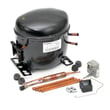
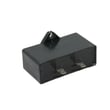
A bad start device/overload can make a good compressor act “bad” by preventing it from starting. If the overload is weak, it can trip quickly and cause the classic clicking symptom. For this model, the compressor itself is available as refrigerator compressor W10160407, and compressor start protection is commonly tied to the overload device.
What the symptoms usually mean
| Symptom | Most likely cause | What we do next |
|---|---|---|
| Clicks every few minutes, no steady run | Start device/overload or compressor locked | Check overload, then compressor testing |
| Runs but won’t cool | Sealed system issue or weak compressor | Professional sealed-system diagnosis |
| Loud buzzing then click | Compressor struggling to start | Start device/overload check |
| Completely silent, no fans | Control/power issue | Verify power, controls, wiring |
When to stop and get service
- You smell burning insulation, see melted wiring, or the outlet trips
- The compressor is too hot to touch for more than a second
- You need electrical or sealed-system testing (meter checks, amp draw, refrigerant work)
Why it matters
The compressor is the heart of the cooling system; misdiagnosing it can lead to unnecessary parts. Ruling out airflow, door sealing, and start/overload problems first saves time and helps you decide whether a repair is worthwhile.
Last updated: February 2026
How to tell what model Kenmore refrigerator?
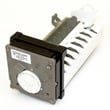
Your Kenmore refrigerator’s model number is printed on the appliance ID tag; on most Kenmore bottom-mount units (including model 59667942600), you’ll find it inside the fresh food compartment on a side wall or ceiling, or on a label behind the crisper drawers. Once you have it, use it to match the correct parts list, such as the refrigerator ice maker D7824706Q.
Where to look for the model number tag
Check these common locations first (in order):
- Inside the refrigerator section on the left or right interior wall
- On the ceiling of the fresh food compartment near the light housing
- Behind or under the crisper drawers (remove drawers and look on the liner)
- Along the door frame area (open the door and inspect the frame edges)
- Near the bottom front kick plate area (some models place the tag lower)
What the model number looks like (and why it matters)
Kenmore model numbers are typically all numbers (sometimes with dots in other Kenmore families). For your parts page, the model format is:
- Model number: 59667942600
Why it matters
The model number is the fastest way to get the right fit and avoid returns. Kenmore used multiple manufacturers over the years, so two refrigerators that look similar can use different door gaskets, control modules, or ice makers.
Quick checklist before you write it down
- Copy the full model number exactly as shown (all digits)
- Also record the serial number (helps with production variations)
- Take a clear photo of the tag for reference
Examples of parts that depend on the exact model
Even small differences in model can change which parts fit. Here are common examples for Kenmore bottom-mount refrigerators:
| Part type | What it affects | Example from this model’s parts list |
|---|---|---|
| Ice maker | Ice production and harvesting | Refrigerator ice maker D7824706Q |
| Door gasket | Sealing, frost, temperature stability | Door gasket options vary by color and door |
| Evaporator fan parts | Airflow and cooling balance | Evaporator motor and fan blade selections |
If the tag is missing or unreadable
- Look for a second label behind the crisper drawers or on the cabinet liner
- Check any purchase paperwork or service stickers (often list the model)
- If you can only find a partial number, match it against the parts list by major assemblies (ice maker, door gasket, control module) to narrow it down
Last updated: February 2026
What is the bottom part of a refrigerator called?
The “bottom part” of a refrigerator is most often called the base grille (also called the toe grille or kick plate). On a Kenmore bottom-mount refrigerator like model 59667942600, it’s the vented panel at the very bottom front that helps protect components and allow airflow.
What people mean by “the bottom part”
Depending on where you’re looking, customers use “bottom part” to describe a few different areas:
- Base grille / toe grille: the removable front panel at floor level
- Machine compartment: the area behind the base grille where airflow and some components are located
- Freezer drawer area: the lower compartment on a bottom-mount refrigerator
- Lower basket: the bin inside the freezer drawer (a common “bottom” item that breaks)
- Drip pan area: the pan underneath that catches defrost water
Quick ID guide (what you see vs. what it’s called)
| What you notice | Common name | What it does |
|---|---|---|
| Vented panel at the very bottom front | Base grille (toe grille, kick plate) | Protects the lower area and supports airflow |
| Drawer at the bottom | Freezer drawer | Holds frozen food in a bottom-mount design |
| Plastic bin inside the freezer | Lower basket | Organizes food and slides in/out |
| Water under the fridge | Drip pan (drain pan) | Collects defrost water so it can evaporate |
Why it matters
Using the right name helps you get the right replacement part and the right repair steps. For example, a broken freezer bin is a different fix than an airflow issue behind the base grille.
Parts that are commonly confused with “the bottom part”
If you meant a broken bin or drawer component in the lower section of your 59667942600, these are common replacements:
- Refrigerator lower basket WP12754803 (freezer basket/bin)
- Tray, drip e W11337775 (drip tray/drain pan area component)
- Refrigerator condenser 67006133 (cooling system component located in the lower/rear area)
Last updated: February 2026