Owner’s manual
 Error Codes




What is the life expectancy of a bottom freezer refrigerator?
A bottom freezer refrigerator typically lasts 13 to 17 years. For your GE CWE23SP4MDW2 bottom-mount refrigerator, regular maintenance (especially keeping airflow clear and cleaning) and fixing cooling issues early are what most often determine whether you land closer to 13 years or push past 17.
What affects lifespan the most
- Condenser coil cleanliness (dust buildup makes the compressor work harder)
- Door seal condition (warm air leaks increase run time)
- Room temperature and ventilation (tight enclosures shorten component life)
- Defrost system health (frost buildup strains the evaporator fan and cooling)
- Water and ice system upkeep (filter changes help protect flow and taste)
Maintenance schedule we recommend
Use your CWE23SP4MDW2 owner’s manual for model-specific care steps and locations.
| Task | How often | Why it matters |
|---|---|---|
| Clean condenser coils and grille area | Every 6 to 12 months | Reduces compressor stress and heat buildup |
| Check and clean door gaskets | Every 3 months | Prevents air leaks and temperature swings |
| Replace water filter (if used) | About every 6 months | Maintains flow and helps reduce odors/taste issues |
| Verify temps (fresh food and freezer) | Monthly | Catches cooling drift early |
Parts that commonly impact longevity (when symptoms show up)
If you notice warm temps, heavy frost, or unusual fan noise, these model-matched parts are common suspects:
- Refrigerator temperature sensor WR55X10025 (temperature feedback to controls)
- Refrigerator evaporator fan motor and blade WR60X10352 (moves cold air through compartments)
- Refrigerator defrost heater WR51X10131 and refrigerator defrost bi-metal thermostat WR50X10108 (prevents ice buildup on the evaporator)
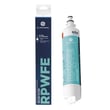
- GE refrigerator water filter RPWFE (water quality and dispenser flow)
Why it matters
A refrigerator usually does not “wear out” all at once; efficiency drops first. Keeping coils clean, seals tight, and the defrost system working reduces run time and heat, which are the biggest drivers of compressor and control-board stress.
Last updated: February 2026
What is the most common problem with GE profile refrigerators?
The most common issues we see with GE Profile refrigerators like model CWE23SP4MDW2 are ice maker and water dispensing complaints (slow ice, low water flow) and temperature control problems (warm fresh food or freezer). These symptoms often trace back to the water filter, sensors, airflow, or the defrost system; use the CWE23SP4MDW2 owner's manual to match symptoms to the right checks.
Most common symptoms customers report
- Ice maker not making ice or making small/hollow cubes
- Water dispenser flow is slow
- Fresh food section too warm while freezer seems OK
- Frost buildup on the freezer back wall (defrost issue)
- Fan noise changes, or no airflow from vents
Quick checks that solve many “common problems”
- Confirm temperatures: set fresh food around 37°F and freezer around 0°F, then allow 24 hours to stabilize.
- Replace the water filter on schedule: GE’s guidance is every 6 months or 170 gallons, or sooner if flow drops. A restricted filter can reduce dispenser flow and ice production.
- Check door sealing and loading: overpacked shelves and blocked vents reduce airflow and cause warm spots.
- Listen for the evaporator fan: if airflow is weak, cooling performance drops quickly.
- Look for frost patterns: heavy frost often points to a defrost heater, thermostat, or wiring issue.
Parts that commonly relate to these symptoms (this model)
| Symptom | Common area | Example part for CWE23SP4MDW2 |
|---|---|---|
| Low water flow, slow ice | Filtration | GE refrigerator water filter RPWFE |
| Warm temps, erratic temps | Temperature sensing | Refrigerator temperature sensor WR55X10025 |
| Frost buildup, warm fridge | Defrost system | Refrigerator defrost bi-metal thermostat WR50X10108 |
| Warm temps, poor airflow | Evaporator fan | Refrigerator evaporator fan motor WR60X25858 |
Why it matters
Ice and cooling problems can look the same from the outside, but the fix is very different. A simple maintenance item (like a clogged filter) can mimic a more serious failure (like a fan or defrost problem). Starting with the basic checks prevents unnecessary part replacement.
If you’re seeing an error code or a repeating alarm, use GE refrigerator error codes to narrow the troubleshooting to the exact system.
Last updated: February 2026
How do I find the model number on my CWE23SP4MDW2?
On the GE CWE23SP4MDW2 bottom-mount refrigerator, the model number is printed on a label inside the fresh food (refrigerator) compartment on the left side, near the middle. We recommend writing down both the model and serial number for parts matching.
Where to look (quick steps)
- Open the fresh food (upper) refrigerator door.
- Look on the left interior wall.
- Check near the middle height of the compartment.
- Find the label that lists Model # and Serial #.
- Copy the numbers exactly as shown (letters and numbers).
What the label typically includes
| Label item | What it’s used for | Example (format) |
|---|---|---|
| Model number | Ensures correct diagrams and parts fit | CWE23SP4MDW2 |
| Serial number | Helps identify production details | Letters and numbers |
Why it matters
GE bottom-mount refrigerators can have similar-looking doors, shelves, and electronic controls across model families. Using the exact model number helps us match the correct parts list, diagrams, and documentation so you order the right component the first time.
If the label is hard to read
- Wipe the label gently with a damp cloth and dry it.
- Use your phone camera zoom or flashlight to improve visibility.
- Double-check characters that look similar (0 vs O, 1 vs I).
For a diagram-style reference and more model identification details, use the CWE23SP4MDW2 owner's manual.
Last updated: March 2026