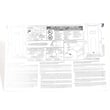
Installation guide
 Owner’s manual
 Error Codes


What model is my Kenmore gas range?
For Kenmore gas range model 79071152700, the model number is printed on the appliance identification plate (serial plate). On this range, that plate is located on the right side of the oven front frame, inside the storage drawer or lower panel compartment area; confirm the exact spot in the 79071152700 owner's manual.
Where to look on model 79071152700
We recommend checking these common label locations in this order:
- Pull out the storage drawer and look on the right side of the oven front frame
- Look inside the lower panel compartment area (same general area as the storage drawer opening)
- Check the oven door frame area (door jamb) if the drawer area label is hard to see
- Use a flashlight and look for a silver or white identification plate with “Model No.” and “Serial No.”
What the model number looks like
On the serial plate, you will typically see fields similar to the ones below:
| Label field | What it tells you | Example format |
|---|---|---|
| Model No. | Exact model used to match parts and diagrams | 790.XXXXXXX |
| Serial No. | Production identifier for your specific unit | Letters and numbers |
| Date of purchase | Your record (not always printed on the plate) | Month/Year |
Why it matters (parts and troubleshooting)
We use the exact model number to match the correct Kenmore parts list, wiring diagram references, and gas range components like the oven igniter, oven light bulb, and temperature sensor. Even one digit off can point to a different series with different burners, control boards, or trim.
Tips if the label is dirty or hard to read
- Wipe the plate gently with a damp cloth and mild dish soap; dry it right away
- Take a phone photo and zoom in to read small print
- Write down both the model and serial number for future service
- If the drawer is stuck, avoid forcing it; check the drawer stops and alignment first
Last updated: January 2026
How do you light the pilot light on a Kenmore gas stove?
On the Kenmore gas range model 79071152700, pilot lighting depends on whether your range uses standing pilots or electric ignition. If you have standing pilots, you light them once initially following the steps in the installation guide, and they stay lit; during a power outage, surface burners can also be lit manually with a match.
Before you start (safety first)
- Turn on the kitchen vent and keep the area well ventilated.
- Remove flammables (paper towels, aerosol cans, curtains) from the cooktop area.
- Use a long match or long-reach lighter; keep your face and hands back.
- If you smell strong gas, do not light anything; turn burner knobs to OFF and air out the room.
- Make sure the gas supply shutoff valve is fully ON.
How to light a surface burner manually (power outage)
If your model has electric ignition and the power is out, you can light a surface burner this way:
- Hold a lit match to the burner head.
- Slowly turn the surface control knob to LITE.
- After the burner lights, adjust the flame to the desired setting.
Standing pilot vs. electric ignition: what to expect
| Feature | Standing pilot models | Electric ignition models |
|---|---|---|
| Normal lighting | Pilot stays lit; burner lights from pilot | Ignitor sparks when knob is turned to LITE |
| First-time setup | Pilot must be lit initially | No pilot lighting needed |
| Power outage | Burners still work (pilot already lit) | Surface burners can be lit with a match |
If the burner will not light after you try
- Confirm the burner cap is seated correctly and ports are not clogged.
- Try a different burner to rule out a single burner issue.
- Check for a weak or delayed ignition; that often points to an igniter problem.
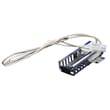
- For oven bake ignition problems (no heat or slow ignition), a common fix is replacing the range oven burner igniter 5304509706.
Why it matters
Correct pilot or manual-lighting steps prevent delayed ignition, flare-ups, and uneven flames. They also help you quickly separate a normal power-outage situation from a part failure (igniter, gas valve, or regulator).
Last updated: January 2026
Why is my Kenmore oven not igniting?
If your Kenmore gas range model 79071152700 is not igniting, the most common causes are a weak or failed oven igniter, a gas supply or regulator issue, or an oven control setting problem. Start by confirming power and gas are on, then focus on the igniter because it is the most frequent failure point.
Quick checks we recommend first
- Make sure the range has power; electric ignition models need electricity to light the oven.
- Confirm the gas supply is turned ON.
- Verify the gas regulator valve is ON (the manual notes the oven will not operate if the regulator is off). See the 79071152700 owner's manual.
- Confirm the clock is set; on many ranges the oven will not operate until time-of-day is set.
- Recheck the bake or broil settings to ensure the controls are set for the function you want.
What to look for (symptom-based)
| What you see | What it usually means | What to do next |
|---|---|---|
| No glow from the igniter | No power to igniter or failed igniter | Check power, then inspect wiring and igniter |
| Igniter glows but burner never lights | Igniter is weak (not drawing enough current) or gas valve issue | Replace igniter first; then consider gas valve |
| Burner lights sometimes, sometimes not | Weak igniter, loose connection, or control issue | Inspect connections; igniter is still the top suspect |
Parts that commonly fix “won’t ignite”
- Oven igniter: A cracked or weak igniter is the most common reason the bake burner will not light. Consider the range oven burner igniter 5304509706.
- Gas regulator: If gas flow is restricted or the regulator is off, the oven will not operate; the model uses a range pressure regulator 316091711.
- Oven control: If the control is not sending voltage to the igniter, ignition will not start (less common than igniter failure).
Why it matters
A gas oven that does not ignite is usually failing to open the gas valve because the igniter is not heating properly. Fixing the root cause restores normal bake and broil performance and helps prevent repeated ignition attempts that can create strong gas odors.
Last updated: January 2026
What are the parts of a gas oven?
A Kenmore gas range like model 79071152700 uses a gas burner system to create heat for baking and broiling, plus safety and control parts to regulate temperature. Key oven parts include the burner, igniter, gas valve/regulator, temperature sensor, door seal, racks, and oven light. See the 79071152700 owner's manual for your exact component names and locations.
Main parts you will find in the oven section
- Oven burner (bake burner tube and orifice/spud) that produces the bake flame
- Igniter that lights the gas at the burner
- Gas valve and pressure regulator that control gas flow and manifold pressure
- Oven temperature sensor (probe) that tells the control how hot the oven is
- Oven bottom and baffle that protect the burner area and help distribute heat
- Oven door glass and door seal (gasket) that retain heat in the cavity
- Oven light system (bulb and socket) for visibility
Parts on this model that commonly come up in repairs
If the oven will not heat, heats slowly, or the temperature is unstable, these model-matched parts are frequent suspects:
| Symptom | Common part to check | What it affects |
|---|---|---|
| No bake ignition or delayed ignition | Range oven burner igniter 5304509706 | Lights the bake burner flame |
| Oven temperature inaccurate | Oven probe 316233903 | Senses oven temperature |
| Oven light out | Range oven light bulb 316538904 | Interior lighting |
| Gas pressure or conversion issues | Range pressure regulator 316091711 | Manifold pressure regulation |
Why it matters
Knowing the oven parts helps you troubleshoot safely and avoid replacing the wrong component. For example, a weak igniter can prevent proper burner ignition even when the control and sensor are working normally.
Safety notes for gas oven components
- Turn off gas and electrical power before servicing internal parts.
- Do not use a flame to check for gas leaks.
- Keep the oven cavity clear of foil on walls, bottom, or racks; it disrupts heat distribution.
- If you use oven cleaner, keep it off electrical controls and wipe the temperature sensor area carefully.
Last updated: January 2026