 Installation guide
 Owner’s manual
 Error Codes




What model is the Whirlpool quiet partner 3?
Whirlpool “Quiet Partner III” is a series name, not a single dishwasher model. The most common Quiet Partner III model identification you’ll see is GU2200XTSS3; for parts and installation details on your specific dishwasher, match the model number on the rating label to the WDF518SAFM0 owner's manual.
Use the model number from the dishwasher’s rating label (not the series name) to ensure you get the right parts, wiring method, and installation dimensions.
- Look for a sticker or plate on the tub frame (often along the door opening) or on the side of the inner door.
- Write down the full model number and any revision digits.
- Use the model number to match the correct parts list and diagrams.
- If you are installing or reinstalling, follow the electrical and drain routing requirements in the WDF518SAFM0 installation guide.
“Quiet Partner III” describes a Whirlpool dishwasher family; WDF518SAFM0 is a specific Whirlpool dishwasher model with its own parts and installation requirements.
| What you have | What it means | What to use for parts/repair |
|---|---|---|
| Quiet Partner III | Series/family name | Use the actual model number from the rating label |
| GU2200XTSS3 | A specific Quiet Partner III model | Use GU2200XTSS3 parts and manual |
| WDF518SAFM0 | A specific Whirlpool dishwasher model | Use WDF518SAFM0 parts and documentation |
Ordering by “Quiet Partner 3” can lead to the wrong spray arm, drain pump, or control parts because multiple Whirlpool dishwashers share that branding. Matching the exact model number keeps fit, wiring, and drain hose routing correct.
Last updated: January 2026
What is the average lifespan of a Whirlpool dishwasher?
A Whirlpool dishwasher like model WDF518SAFM0 typically lasts 10 to 12 years with normal household use. You can often reach the high end of that range by keeping the filter and spray arms clean, using the right detergent, and avoiding installation issues that cause leaks or poor draining.
- Water hardness and mineral buildup (can reduce cleaning performance and strain the pump)
- How often you run it (daily use wears moving parts faster than occasional use)
- Maintenance habits (filter cleaning, checking spray arms, cleaning the tub)
- Drain setup and airflow (a poor drain connection can cause standing water and odors)
- Door and rack condition (rusted racks and worn hinges can shorten practical life)
Use these habits for the Whirlpool WDF518SAFM0:
- Clean the filter regularly; replace it if it is damaged or won’t come clean (see filter W10717669).
- Inspect and rinse spray arm holes; replace a cracked or warped arm if it stops spinning freely.
- Run a monthly dishwasher cleaner cycle to reduce grease and mineral buildup.
- Use rinse aid to improve drying and reduce spotting (especially with hard water).
- Keep the door seal area clean and dry to prevent leaks and odor.
| Situation | Typical fix | When replacement makes sense |
|---|---|---|
| Not draining, water left in tub | Clear drain path; check drain pump | If the drain pump is noisy or seized |
| Poor cleaning | Clean filter and spray arms | If wash motor is weak or spray arms are damaged |
| Rusting racks | Touch up coating | If rack is heavily rusted and shedding |
Dishwashers usually fail from avoidable stress: restricted filtration, clogged spray arms, and poor draining force the pump and motor to work harder every cycle. A few minutes of routine care protects expensive components and keeps cycle times and cleaning performance consistent.
For model-specific care and cleaning intervals, follow the WDF518SAFM0 owner's manual.
Last updated: January 2026
What's the most common problem with a Whirlpool dishwasher?
For the Whirlpool WDF518SAFM0 dishwasher, the most common problems we see are poor cleaning and draining issues. In many homes, the root cause is simple maintenance (a dirty filter or blocked spray arm), but a worn pump or drain component can also be the culprit.
- Dishes still dirty or gritty: clogged filter, blocked spray arm holes, or low water temperature
- Water left in the bottom: drain path restriction, drain pump issue, or sink/disposer connection problem
- Won’t start: door not fully latched, power issue, or cycle not set correctly
- Leaks: door seal area, loose hose connections, or over-sudsing from wrong detergent
- Poor drying: rinse aid low, heater-related issue, or plastic items holding water
Start with these before replacing parts:
- Confirm the door is closed tightly and latched
- Check the breaker or fuse, then restore power if tripped
- Verify the water supply valve is turned on
- Clean the filter and remove debris from the sump area
- Inspect spray arms for clogs and free rotation
If you’re troubleshooting a no-start or power symptom, follow the checks in the WDF518SAFM0 installation guide.
If cleaning or draining problems keep coming back after basic maintenance, these parts are frequent suspects:
| Problem | Common part to inspect | What it does |
|---|---|---|
| Poor cleaning | Spray arm W10567664 | Spins and distributes wash water through spray jets |
| Gritty residue | Filter W10717669 | Traps food soil to keep it from recirculating |
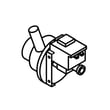
| Not draining | Dishwasher drain pump W11677711 | Pumps water out through the drain hose |
A clogged filter or spray arm reduces water flow and wash pressure, so detergent cannot do its job. Drain restrictions can also leave dirty water in the tub, which leads to odors and redeposits soil on dishes.
Last updated: January 2026
What to do when your Whirlpool dishwasher won't drain?
If your Whirlpool WDF518SAFM0 dishwasher won’t drain, start by clearing the filter area and checking for a blocked drain path (hose, air gap, disposer inlet). A poor drain-hose routing (missing high loop) can also cause water to stay in the tub. Use the steps in the WDF518SAFM0 installation guide to confirm the drain connection is set up correctly.
- Cancel the cycle and run a drain function (if your control panel has Cancel/Drain).
- Remove standing water as needed so you can inspect the sump and filter area.
- Clean the dishwasher filter and check the sump for labels, glass, or food debris.
- Inspect the drain hose for kinks, crushing, or a clog where it passes through the cabinet.
- If connected to a garbage disposer, make sure the disposer knockout plug was removed.
Your installation setup matters as much as the pump. The drain connection must be before the drain trap and the drain hose should be routed up high under the counter (high loop) to help prevent backflow. The installation instructions also call out not cutting the corrugated section of the hose and keeping the molded end sized correctly for the connection.
| What to check | What “good” looks like | What it prevents |
|---|---|---|
| High loop under counter | Hose is looped up and secured | Sink water backing into the tub |
| Connection location | Ties in before the drain trap | Slow drain and backflow |
| Hose condition | No kinks, no crushed spots | Restricted flow |
| Hose end trimming | Cut only on marked lines, not corrugated | Leaks and clogs |
If the hose and filter area are clear but the dishwasher still won’t drain, the drain pump is a frequent failure point.
- Dishwasher drain pump W11677711: pushes water out through the drain hose during drain portions of the cycle.
- Drain hose and air gap (if used): clogs here can mimic a bad pump.
- Wiring connections: a loose connection can stop the pump from running.
A dishwasher that can’t drain often leaves dirty water in the sump, causes odors, and can trigger cycle interruptions. Correct drain-hose routing and a clean filter reduce repeat clogs and help the drain pump last longer.
Last updated: January 2026





