Installation guide
 Owner’s manual
 Error Codes


How do I find the size of my Kenmore refrigerator?
To find the size of your Kenmore refrigerator model 10653582300, we measure the outside dimensions (height, width, depth) for fit, and we use cubic feet (interior volume) for storage capacity. Your exact measurements and capacity are listed in the 10653582300 owner's manual.
Measure the outside dimensions (fit in your kitchen)
Use a tape measure and record in inches:
- Height: floor to top of cabinet (measure with and without hinges if possible)
- Width: left to right across the cabinet (not the doors)
- Depth: front of cabinet to back (measure with and without handles)
- Clearances: leave space for airflow and door swing
The installation guidance for this model calls for ventilation space around the refrigerator; see the 10653582300 installation guide.
Estimate storage capacity (cubic feet)
If you need a quick estimate, cubic feet is calculated from interior measurements:
- Measure interior height, interior width, and interior depth (in inches)
- Multiply them to get cubic inches
- Divide by 1,728 to convert to cubic feet
Quick formula
| What you want | Formula |
|---|---|
| Cubic feet | (H × W × D in inches) ÷ 1,728 |
| Cubic inches | H × W × D |
Why it matters
- Outside dimensions help you confirm the refrigerator fits your opening and allows proper ventilation.
- Cubic feet helps you compare storage capacity across Kenmore side-by-side refrigerator models.
- Clearance space helps prevent poor cooling and overheating from restricted airflow.
Last updated: January 2026
What is the ER if code on a Kenmore Elite?
On Kenmore refrigerator model 10653582300, an ER IF display points to an ice compartment airflow problem, most often involving the freezer evaporator fan area, air ducts to the ice maker, or frost buildup restricting airflow. Use the troubleshooting section in the 10653582300 owner's manual to follow the model-correct checks and reset steps.
What ER IF usually means on Kenmore 106 side-by-side refrigerators
ER IF is commonly associated with the refrigerator not detecting the expected airflow to the ice maker area.
Common causes to check
- Freezer evaporator fan not running, noisy, or obstructed
- Heavy frost on the freezer back wall (airflow blocked)
- Freezer vents blocked by food packages
- Door not sealing, letting warm air in and creating frost
- Ice chute door not closing fully (warm air leak)
Quick troubleshooting steps (in order)
- Power reset: unplug or turn off the breaker for 5 minutes, then restore power.
- Check airflow: confirm freezer vents are not blocked.
- Listen for the fan: with the freezer door switch pressed, listen for the evaporator fan.
- Look for frost: heavy frost suggests a defrost problem that can choke airflow.
- Confirm door seal: inspect gaskets for gaps, tears, or sticking.
Parts that are commonly involved (when diagnosis confirms failure)
| Symptom | Likely area | Model-matched part example |
|---|---|---|
| No airflow sound, warm freezer | Evaporator fan system | Refrigerator evaporator fan blade WP2169142 (blade damage or rubbing) |
| Heavy frost, weak airflow | Defrost system | Refrigerator defrost bi-metal WPW10225581 or refrigerator heater WP2323198 |
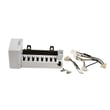
| Ice maker not producing after airflow is restored | Ice maker assembly | Ice maker assembly 4317943 |
Why it matters
The ice maker depends on steady freezer airflow to stay cold enough to harvest and refill. When airflow drops, temperatures rise in the ice area, ice production slows, and the control can trigger ER IF.
For broader Kenmore 106-series code patterns and what to check next, use the Kenmore 106 model refrigerator error codes guide.
Last updated: January 2026
What is the average lifespan of 10653582300?
The average lifespan of a Kenmore side-by-side refrigerator like model 10653582300 is about 14 years. Regular maintenance (cleaning coils, keeping door seals tight, and fixing ice and water issues early) helps you reach or beat that average.
What affects lifespan most
- Condenser coil cleanliness (dirty coils make the compressor run longer)
- Door gasket condition (air leaks increase run time and frost)
- Ice maker and water system health (leaks and clogs strain components)
- Room temperature and ventilation around the cabinet
- How often doors are opened and how full the compartments stay
Quick maintenance checklist (high impact)
- Vacuum condenser coils and the grille area every 6 to 12 months.
- Confirm doors close on their own and seals fully contact the cabinet.
- Keep vents inside the fresh food and freezer sections unblocked.
- Replace a failing dispenser light promptly to avoid heat and socket damage.
- Address slow ice production or no water early to prevent valve and line issues.
Common “wear” items vs. major repairs
| Item type | Examples on this model | Why it matters |
|---|---|---|
| Wear and convenience parts | Refrigerator inlet valve W10408179, ice maker assembly 4317943 | Water and ice problems are common and usually fixable without replacing the refrigerator |
| Cooling system components | Compressor, evaporator, fan motor | These repairs are higher cost; good airflow and clean coils reduce stress |
Why it matters
A refrigerator that runs “too much” often is usually working harder due to heat load, airflow restrictions, or door seal leaks. The manual notes that run time increases with warm room temperatures, frequent door openings, and adding large amounts of food; reducing those loads helps extend service life.
For model-specific care and operating tips, follow the 10653582300 owner's manual.
Last updated: March 2026