Installation guide
 Owner’s manual
 Error Codes


What is the average lifespan of a KitchenAid dishwasher?
KitchenAid dishwashers typically last 10 to 12 years on average. For your KitchenAid KDTM504EPA0, lifespan depends most on water quality, how often you run cycles, and routine care like cleaning filters and keeping the door seals in good shape (see the KDTM504EPA0 owner's manual).
Typical lifespan and what changes it
Most KitchenAid dishwashers land in this range, but these factors move the number up or down:
- Hard water: mineral buildup can reduce cleaning and drying performance over time
- Heavy daily use: more cycles means more wear on the pump, motor, and heater
- Maintenance habits: regular cleaning helps prevent drain and wash issues
- Leaks: even small leaks can damage components and shorten service life
- Detergent and rinse aid use: correct products reduce residue and improve drying
Maintenance that helps you reach the full lifespan
These steps reduce common wear issues (leaks, poor cleaning, poor drying):
- Use rinse aid consistently; energy-efficient models rely on it for drying and to control hard-water deposits
- Run a monthly cleaning cycle (dishwasher cleaner or a citrus-based cleaner)
- Keep spray arms clear of labels, seeds, and broken glass
- Load so items do not block spray arms or the detergent dispenser
- Inspect the door sealing surfaces and wipe them clean
Quick parts check if you see leaks
If you notice water at the front or sides of the door, these parts are common culprits:
| Symptom | Common area to inspect | Example part for KDTM504EPA0 |
|---|---|---|
| Drips at bottom of door | Lower door seal | Dishwasher door seal, lower WPW10497235 |
| Moisture along door edge | Perimeter door seal | Dishwasher door seal W11177741 |
Why it matters
A dishwasher that is maintained tends to clean better, dry better, and avoid early failures in high-wear systems like the wash pump, drain path, and heating circuit. Your manual also notes that newer, energy-efficient dishwashers often run 2 to 3 hours per load, which is normal and not a sign of a failing unit.
Last updated: February 2026
Which dishwasher to stay away from?
We recommend staying away from any dishwasher model line that shows a consistent pattern of leaks, poor cleaning even with correct loading, chronic drain/fill failures, or repeated control problems. For KitchenAid model KDTM504EPA0, following the use and care steps in the KDTM504EPA0 owner's manual prevents many issues that make a dishwasher feel “bad.”
Practical red flags (what to avoid)
When you are comparing models or deciding whether to keep repairing one, these are the biggest warning signs:
- Repeated leaks at the door, tub seam, or hose connections
- Ongoing “not cleaning” complaints after basic maintenance
- Frequent no-drain or no-fill symptoms (standing water, canceled cycles)
- Control failures (dead panel, random stopping, won’t start)
- Early failure of high-cost parts (pump and motor, electronic control)
Quick decision guide
Use this to connect the complaint to the most likely system involved.
| Common complaint | Usually points to | Typical next step |
|---|---|---|
| Leaks at the front/door | Door seal or alignment | Inspect sealing surfaces; replace worn seal |
| Not cleaning well | Loading, filter, spray arm blockage | Re-load, clean filter, clear spray arm holes |
| Won’t drain | Drain path restriction or pump issue | Check hose routing and sink/disposal connection |
| Won’t start/blank panel | Door closure sensing, power, control | Confirm door closes fully; check breaker |
If you already own KDTM504EPA0: prevent the “bad dishwasher” problems
These steps match common KitchenAid dishwasher trouble patterns and the manual’s loading and safety guidance.
- Load so items do not block the upper or lower spray arms
- Keep the filter seated and locked after cleaning
- Use automatic dishwasher detergent; add it right before starting a cycle
- Avoid running a cycle if you see active leaking; fix the source first
- If leaking shows up at the door, inspect the dishwasher door seal W11177741
Why it matters
Avoiding a problem-prone model reduces repeat service calls. Leaks can damage cabinets and flooring; chronic wash or drain issues usually mean longer cycles, higher detergent use, and more part replacements.
Last updated: February 2026
What is the most common problem with a KitchenAid dishwasher?
The most common KitchenAid dishwasher problems are poor cleaning, not draining, and not starting. On the KitchenAid KDTM504EPA0, these symptoms are usually tied to wash-system issues (spray arm or pump performance), a door that is not fully closed and latched, or water flow problems into or out of the tub. See the KDTM504EPA0 owner's manual for model-specific troubleshooting steps.
Most common symptoms and what they usually mean
- Dirty dishes or grit left behind: restricted spray, clogged filtration, or weak circulation.
- Standing water in the bottom: drain path restriction or a drain component issue.
- Won’t start or stops right away: door not latched, Start/Resume sequence not completed, or control input issue.
- Leaks at the door: worn door sealing surfaces.
- Fills slowly or not at all: water supply restriction or inlet valve problem.
Quick checks we recommend first (fast, no parts)
- Confirm the door is fully closed and latched; if Start/Resume is blinking, close the door and press Start/Resume.
- Make sure large items are not blocking the wash system at the back of the tub.
- Clean the filter area and check spray-arm holes for debris.
- Verify the sink drain and disposer inlet are clear (new disposer plugs are a common cause of no-drain).
- Run hot water at the sink before starting a cycle to improve wash performance.
Parts that commonly solve these problems on KDTM504EPA0
| Symptom | Common part to inspect/replace | What it affects |
|---|---|---|
| Leaks at the door | Dishwasher door seal W11177741 | Seals the door perimeter to prevent drips |
| Won’t fill or fills slowly | Dishwasher water inlet valve W11175771 | Controls water entering the dishwasher |
| Not draining | Dishwasher drain hose 8269144A | Carries drain water to the sink/disposer |
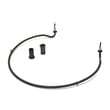
| Poor drying | Element assembly W10703867 | Heats water and supports drying performance |
Why it matters
These “common problems” often share the same root causes: restricted water movement (cleaning), restricted water exit (draining), or a door that is not latched (starting). Fixing the underlying cause prevents repeat cycles, standing water odors, and leaks that can damage cabinets.
Last updated: February 2026