Installation guide
 Owner’s manual
 Error Codes



What is the most common problem with KitchenAid dishwashers?
The most common problems we see on KitchenAid dishwashers like model KUDC10FXSS4 are poor cleaning (food left on dishes) and drainage trouble (standing water). These usually trace back to restricted water flow (spray arm or filter issues), a drain path restriction, or a failing pump or motor.
Most common symptoms and what they usually mean
- Dishes still dirty: spray arm holes blocked, filter/sump area dirty, low water temperature, or weak wash circulation.
- Standing water in the tub: drain hose restriction, disposer/air gap blockage, or a weak drain pump.
- Not filling with enough water: water supply valve not fully open, inlet restriction, or a failing inlet valve.
- Leaks at the door: door seal wear, tub gasket issues, or the dishwasher not centered/leveled.
- Won’t start or stops mid-cycle: door not latching, power supply issue, or control-related fault.
Quick checks we recommend first (KUDC10FXSS4)
Use these checks before replacing parts; they match the basic “does not operate” and “check operation” guidance in the installation instructions.
- Confirm the door is fully closed and latched.
- Verify water supply is turned on.
- Check the circuit breaker or house fuse.
- Start a short cycle; after about 2 minutes, open the door and confirm there is water in the bottom of the tub.
- If the unit is newly installed, confirm the dishwasher is centered and level so the door does not rub or bind.
Parts that commonly solve these problems
If your symptoms match, these are common repair paths for KUDC10FXSS4:
| Symptom | Most likely area | Example part for this model |
|---|---|---|
| Standing water | Drain system | Dishwasher drain pump WPW10348269 |
| Poor wash action | Wash/circulation system | Dishwasher sump and motor assembly (common fix) |
| No/low fill | Water supply | Dishwasher water inlet valve (common fix) |
| Door leak | Sealing/leveling | Lower door seal or tub gasket (inspect for tears) |
Why it matters
Poor cleaning and standing water are usually early signs of restricted flow or a weakening pump. Fixing the root cause helps prevent repeat clogs, odor, and longer cycle times that still do not deliver clean dishes.
Where to confirm the exact procedure
For model-specific steps, safety notes, and installation checks, use the KUDC10FXSS4 installation guide.
Last updated: February 2026
What is the life span of a KitchenAid dishwasher?
A KitchenAid undercounter dishwasher like model KUDC10FXSS4 typically lasts 10 years with normal household use. Consistent cleaning, correct installation, and fixing small issues early (drain, heating, or door problems) are what most often determine whether it reaches that full service life.
Typical lifespan and what affects it
Most dishwashers land in a similar range, but these factors move the needle the most:
- Water quality (hard water speeds up mineral buildup on the heater and inside the sump)
- How often you run it (daily use wears pumps and rack parts faster)
- Loading habits (overloading can strain the wash system and racks)
- Maintenance (keeping the filter area clean helps prevent drain issues)
- Installation quality (leveling, centering, and door alignment reduce leaks and wear)
For model-specific care and operating guidance, follow the KUDC10FXSS4 owner’s manual.
Quick “what wears out first” guide
| Component area | Common symptom | Example part for KUDC10FXSS4 |
|---|---|---|
| Draining | Water left in tub | Dishwasher drain pump WPW10348269 |
| Heating and drying | Poor drying, cool water | Dishwasher heater W10703867 |
| Door balance | Door drops or won’t stay up | Dishwasher door balance link 8194001 |
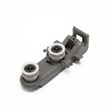
| Racks and rails | Rack won’t roll smoothly | Whirlpool dishwasher dishrack wheel W10195416V |
Why it matters
Knowing the typical 10-year lifespan helps you decide whether to maintain, repair, or replace. If your KUDC10FXSS4 is near that age and you are seeing multiple symptoms (drain problems plus poor drying, for example), addressing the root cause early can prevent secondary damage to the motor and controls.
Tips to help your dishwasher reach its full lifespan
- Use rinse aid to improve drying and reduce hard-water deposits.
- Run hot water at the sink before starting a cycle for better wash performance.
- Keep the bottom area clear of debris so water can drain freely.
- Make sure the unit stays level and centered so the door seals evenly.
- If cycles seem unusually long, remember many energy-efficient models average 2 to 3 hours per load.
Installation alignment and leveling details are covered in the KUDC10FXSS4 installation guide.
Last updated: February 2026
How to fix rubber seal on KitchenAid dishwasher?
On the KitchenAid KUDC10FXSS4 dishwasher, a “rubber seal” issue is usually a door gasket that slipped out of its channel or a lower door seal that is not sealing evenly. We fix it by cleaning the sealing surfaces, reseating the seal evenly, then latching the door so it conforms.
Before you start
- Turn off power at the breaker.
- If you pull the dishwasher out, shut off the water supply.
- Clean the tub lip and seal channel with mild soap and water; dry completely.
- Avoid harsh cleaners; they can swell or deform rubber.
Reseat the seal (most common fix)
- Open the door and inspect the gasket area for twists, gaps, or sections popped out.
- Starting at a corner, press the seal straight into the channel using your fingers.
- Work in small sections until it sits fully and evenly end-to-end.
- Close and latch the door; keep it closed for several hours (overnight works best).
If it still leaks: check door alignment
A good seal still leaks if the dishwasher is not centered or level. Use the checks in the KUDC10FXSS4 installation guide:
- Top of door does not contact screws, brackets, or countertop
- Space between tub and cabinet opening is equal on both sides
- Door sides do not rub screw heads; re-center the unit if they do
Quick leak clues
| Leak location | Most likely cause | Best next step |
|---|---|---|
| One corner | Seal not fully seated | Press that section deeper, re-latch |
| Bottom center | Lower seal or alignment | Level and re-center dishwasher |
| Random drips | Dirty sealing surface | Clean and dry tub lip and seal |
When replacement makes sense
Replace the seal if it is torn, permanently flattened, or will not stay in the channel. For this model, the lower door seal is the seal WPW10497235.
Why it matters
A properly seated door seal prevents cabinet and floor damage and helps maintain wash temperature for better cleaning and drying.
Last updated: February 2026