Owner’s manual
 Error Codes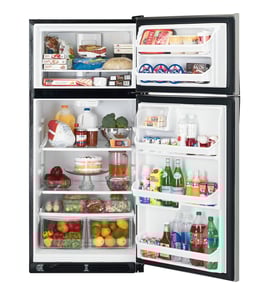


Is GE Cafe considered high end?
Yes. GE Café is considered a high-end (premium) line within the GE brand, positioned above standard GE models with upgraded design, finishes, and feature sets. It is separate from your GE GTS18DCPWRBB top-mount refrigerator, which is a more traditional, value-focused style.
GE premium lines at a glance
GE generally groups its premium offerings into a few tiers. Here is a simple way to think about it:
| GE line | Market position | Typical focus |
|---|---|---|
| GE (standard) | Mainstream | Practical features, value |
| GE Profile | Upper-mainstream | More features, more styling |
| GE Café | Premium | Design-forward, pro-style options |
| Monogram | Luxury | Built-in, high-end customization |
What “high end” usually means with GE Café
When customers call a line “high end,” they usually mean a mix of performance, appearance, and options.
- More premium styling (often pro-style handles and coordinated finishes)
- More feature options (depending on the appliance type)
- Higher price point than standard GE and many GE Profile models
- More emphasis on matching suites and design consistency
Why it matters when buying parts or planning repairs
For parts and repairs, the most important detail is always the exact model number, not the product line name. GE Café models use different components than many standard GE models, even when they look similar.
- Use the model tag to confirm the exact model number
- Match parts by model, then by part number/part ID
- Use diagrams and part lists to avoid ordering look-alike parts
For model-specific identification and documentation, use the GTS18DCPWRBB owner's manual.
Last updated: February 2026
What is the most common problem with a GE refrigerator?
The most common issue we see with GE refrigerators like model GTS18DCPWRBB is poor cooling (fresh food too warm, freezer not staying cold). In many cases, the fix is basic: restore airflow and heat removal by cleaning condenser coils, confirming fans run, and making sure vents are not blocked; see the GTS18DCPWRBB owner's manual.
Quick checks that fix many cooling complaints
- Make sure air vents inside the refrigerator are not blocked by food (overcrowding can cause warm spots).
- Verify the refrigerator control is not set too warm; adjust one step at a time.
- Confirm the unit has proper airflow around it; typical clearances are about 1/8 inch at the sides and 1 inch at the top and back.
- Clean dust from condenser coils and the condenser fan area (dust buildup is a top cause of weak cooling).
- Listen for the evaporator fan and condenser fan; a failed fan can stop cold air circulation.
Common causes and what you usually notice
| Symptom | Likely cause | What to do first |
|---|---|---|
| Fresh food warm, freezer OK | Blocked vents or airflow issue | Move food away from vents; recheck temps |
| Freezer warm, little/no airflow | Evaporator fan issue or frost buildup | Check fan noise; inspect for heavy frost |
| Warm cabinet but compressor runs a lot | Dirty coils or poor ventilation | Clean coils; confirm clearances |
| No ice or slow ice (if equipped) | Water supply/valve issue | Check shutoff valve; inspect fill tube |
Parts that often relate to cooling or airflow
If you confirm a fan is running poorly or making noise, these model-matched parts are commonly involved:
- Refrigerator condenser fan motor WR60X10170 (moves heat off the condenser)
- Refrigerator condenser fan blade WR60X10207 (damaged blades reduce airflow)
- Refrigerator evaporator fan blade WR60X10205 (helps circulate cold air)
Why it matters
Poor cooling is usually an airflow or heat-transfer problem. Fixing it early helps prevent food spoilage and reduces compressor run time, which lowers wear on major sealed-system components.
Last updated: February 2026
What size is an 18 cubic foot refrigerator?
An 18 cu. ft. top-mount refrigerator like GE model GTS18DCPWRBB is typically about 65 to 68 inches tall, 28 to 30 inches wide, and 30 to 32 inches deep. For the exact cabinet dimensions and door-swing needs, use the GTS18DCPWRBB owner's manual.
Typical dimensions and what affects them
Even at the same capacity, exterior size varies based on insulation thickness, door style, and handle depth.
- Height: usually 65 to 68 inches (to the top of the cabinet or hinge cover)
- Width: usually 28 to 30 inches
- Depth: usually 30 to 32 inches (often more with handles)
- Style impact: top-freezer models are often narrower than side-by-side units at similar capacity
- Fit tip: measure your opening in 3 places (top, middle, bottom)
Installation clearances you should plan for
GE’s guidance for 18 and 19 cu. ft. refrigerator installations calls for these minimum clearances for airflow and easier hookup.
| Location | Typical minimum clearance |
|---|---|
| Sides | 1/8 inch |
| Top | 1 inch |
| Back | 1 inch |
| Hinge-side wall clearance | 5/16 inch |
How to measure your space (quick checklist)
- Measure opening width (wall to wall) and compare to refrigerator width.
- Measure opening height (floor to cabinet/soffit) and allow for leveling.
- Measure depth to the front edge of counters; decide if you need a flush look.
- Confirm door swing clearance on the hinge side (especially next to a wall).
- Leave room behind for the power cord and, if equipped, water line.
Why it matters
Capacity (18 cu. ft.) tells you storage volume, not whether the refrigerator will physically fit. The right measurements plus proper clearances help prevent poor cooling from restricted airflow and avoid door clearance problems.
Last updated: February 2026