Owner’s manual
 Error Codes



How to remove bottom grille on GE refrigerator?
On the GE GDE20ESEBRSS bottom-mount refrigerator, we remove the bottom base grille by taking out the two Phillips-head screws, then pulling the grille away from the cabinet. This gives access to the leveling legs for leveling and service.
Steps to remove the bottom (base) grille
- Unplug the refrigerator or switch off power at the breaker (recommended for safety).
- Locate the base grille at the very bottom front of the refrigerator.
- Remove the two Phillips-head screws securing the grille.
- Pull the grille straight off and set it aside.
What to check while the grille is off
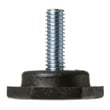
- Leveling legs: Turn clockwise to raise the refrigerator; counterclockwise to lower it.
- Stability: Make sure the leveling legs are firmly touching the floor so the unit does not wobble.
- Airflow area: Clear dust and debris around the lower front area so the refrigerator can breathe.
- Door alignment symptoms: If doors do not close well, leveling often helps.
Reinstalling the grille
Align the grille in position and reinstall the two Phillips-head screws.
| Task | Tool | What you will do |
|---|---|---|
| Remove base grille | Phillips screwdriver | Remove 2 screws, pull grille off |
| Level refrigerator | By hand (leveling legs) | Turn legs to raise or lower |
| Reinstall base grille | Phillips screwdriver | Reinstall 2 screws |
Why it matters
Removing the base grille is a normal step for leveling and basic access. Proper leveling helps prevent door closing issues, reduces vibration, and keeps the refrigerator stable during operation and cleaning.
For model-specific illustrations and notes, follow the GDE20ESEBRSS owner's manual.
Last updated: January 2026
What is the average lifespan of a GE refrigerator?
A GE refrigerator typically lasts about 13 years on average. For your GE GDE20ESEBRSS bottom-mount refrigerator, regular maintenance (clean airflow, good door sealing, stable temperatures) is what most directly determines whether you reach or exceed that typical lifespan; see the GDE20ESEBRSS owner's manual for model-specific care and operating guidance.
Typical lifespan and what affects it
Most refrigerators fail early because of heat buildup, airflow restrictions, or temperature control issues. These factors have the biggest impact:
- Condenser cleanliness and airflow (dust and pet hair make the system run hotter)
- Door gasket sealing (warm air leaks increase run time and frost)
- Stable cabinet temperatures (avoid frequent warm-ups from propped doors)
- Ice maker and water system health (leaks and low flow can create secondary problems)
- Electrical stability (power surges and repeated breaker trips stress controls)
Quick maintenance checklist (best ROI)
Use this short routine to extend life and reduce breakdowns:
- Vacuum the condenser area and vents every 3 to 6 months
- Keep doors closed and confirm the door alarm behavior; use how to reset the door alarm on a GE refrigerator if needed
- Set typical temps: 37°F fresh food, 0°F freezer
- Leave space around the cabinet for ventilation (especially at the back)
- Replace failed temperature-sensing parts promptly if temps swing
Common “end-of-life” symptoms vs fixable issues
| Symptom | Often fixable? | Common area to check |
|---|---|---|
| Warm fridge, freezer OK | Yes | Airflow and damper, evaporator fan |
| Frost buildup, warm temps | Yes | Defrost system, door sealing |
| Temps fluctuate, food freezing | Yes | Sensors and control logic |
| Loud humming, won’t cool | Sometimes | Compressor start components, sealed system |
If you are seeing temperature swings, a failed sensor can cause long run times and poor cooling; the refrigerator temperature sensor WR55X10025 is one model-matched example of a temperature-sensing part used on this platform.
Why it matters
A refrigerator that runs hot or runs constantly can shorten the life of the compressor and electronic control board, and it also increases energy use. Simple airflow and sealing checks are the most effective way to protect the sealed cooling system.
Last updated: January 2026
What is the most common problem with a GE refrigerator?
The most common issue we see with GE refrigerators like model GDE20ESEBRSS is not cooling properly (fresh food warm, freezer warming, or temperatures swinging). Cooling problems usually trace back to airflow, frost buildup, or a failed temperature-sensing or fan component.
Most common symptoms and what they usually point to
- Refrigerator not cooling or freezer not freezing: evaporator fan, condenser fan, dirty condenser, control or sensor issue
- Warm fresh food but freezer OK: airflow restriction, damper issue, frost on evaporator, door not sealing
- Strange noises (buzzing, clicking, rattling): fan blade hitting ice, failing fan motor, compressor start components
- Water leaking or puddles: clogged/iced drain, water line connection issue, water inlet valve seep
- Ice maker or dispenser problems: low water pressure, kinked line, clogged filter, inlet valve issue
- Door not closing: misalignment, overloaded bins/shelves, gasket not sealing
- Light not working: bulb or socket issue
Quick checks we recommend first (before replacing parts)
- Confirm temperature settings and allow 24 hours after any adjustment.
- Check door seal and door closing (paper test, look for gaps, remove obstructions).
- Listen for fans: evaporator fan (freezer area) and condenser fan (rear/bottom area).
- Look for frost buildup on the freezer back wall (a sign of defrost or airflow trouble).
- Clean condenser coils and make sure airflow around the cabinet is not blocked.
- If you have water/ice issues, verify house water pressure is 20 to 120 psi and inspect the supply line connections per the GDE20ESEBRSS owner's manual.
Common parts that relate to “not cooling” on this model
| Symptom | Likely system | Example part for GDE20ESEBRSS |
|---|---|---|
| Temps swing, food freezing or warming | Temperature sensing/control | Refrigerator temperature sensor WR55X10025 |
| Frost buildup, warm fridge | Defrost system | Refrigerator defrost thermostat WR50X10068 |
| Warm temps, weak airflow | Evaporator airflow | Refrigerator evaporator fan motor WR60X10277 |
Why it matters
A refrigerator that is not cooling can spoil food quickly, and airflow or defrost problems can snowball into heavier frost, louder fan noise, and longer run times. Catching the symptom early helps you avoid repeat failures and unnecessary part swaps.
Last updated: January 2026