Owner’s manual
 Error Codes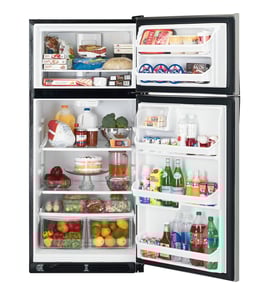


What are the disadvantages of a top mount fridge?
A top-mount (top-freezer) refrigerator like the GE GTS16DTHBRWW typically makes fresh-food access less convenient because the refrigerator section sits lower, and it usually offers fewer premium organization and dispenser features than many bottom-freezer designs. For model-specific features and layout, use the owner's manual.
Common disadvantages you may notice
- More bending for daily use: fresh foods are below waist level, so you bend more often.
- Less “eye-level” organization: shelves and drawers can feel less accessible than bottom-mount layouts.
- Fewer built-in convenience features: many top-mount models do not include exterior water or ice dispensing.
- Smaller freezer usability for some households: the top freezer can feel tighter for bulky frozen items.
- More temperature variation risk: frequent freezer-door openings can affect overall airflow and temps in some kitchens.
What this means for GE GTS16DTHBRWW owners
The GTS16DTHBRWW is designed around a traditional top-freezer layout with adjustable shelving and drawers. If you want to improve day-to-day usability, we focus on organization and keeping airflow clear.
| Concern | Practical workaround | Parts that often help |
|---|---|---|
| Bending to reach produce | Keep high-use items on upper shelves | Refrigerator glass shelf WR32X21260 |
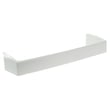
| Door storage feels limited | Rebuild door bins and rails as needed | Refrigerator door shelf rail WR17X30024 |
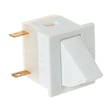
| Light is dim or out | Replace the bulb so you can see items quickly | GE appliance light bulb, 40-watt 40A15 |
Why it matters
Most “disadvantages” are really usability tradeoffs. If your kitchen habits center on fresh food, a top-mount design can feel less convenient; if you use the freezer more, having it at eye level can be a plus.
Last updated: February 2026
What is the most common problem with GE GTS16DTHBRWW refrigerators?
The most common issues we see with the GE GTS16DTHBRWW top-mount refrigerator are “not cooling well” complaints and ice maker problems (no ice or slow ice). Cooling problems are often tied to airflow restrictions or a failed fan motor; ice maker problems are commonly caused by the unit not being connected to water or the freezer not being cold enough. See the troubleshooting section in the owner's manual for model-specific checks.
Most common symptoms and what they usually point to
- Refrigerator warm, freezer cold: evaporator airflow problem (fan not running, vents blocked)
- Both sections warm: condenser airflow issue, sealed-system/compressor problem, or control issue
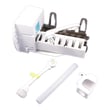
- Ice maker not making ice: water line not connected/turned on, ice maker switched off, or freezer temperature too warm
- Frost buildup: door left ajar, poor door seal, or airflow blocked by packages
- Unusual fan noise: worn fan motor or mounting grommet
Quick checks we recommend first (no parts swapping)
- Confirm the freezer is set cold enough; the freezer must be 15°F or colder before the ice maker will produce ice.
- Make sure the refrigerator is actually connected to a cold water supply (on models with an ice maker) and the ice maker is turned on only after water is connected.
- Check that food packages are not blocking freezer vents; good circulation reduces frost load.
- Listen for the evaporator fan when the doors are closed; if it is silent, cooling performance drops fast.
- Inspect door gaskets for gaps and tears.
Common parts related to these problems
| Symptom | Likely area | Example part for this model |
|---|---|---|
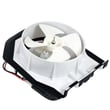
| Warm temps, weak airflow | Evaporator fan system | Refrigerator evaporator fan WR60X31522 |
| Ice maker not filling | Water supply/valve | Refrigerator water inlet valve WR57X39965 |
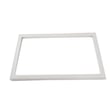
| Frost, moisture, warm spots | Door sealing | Refrigerator door gasket WR14X27232 and refrigerator freezer door gasket WR14X27230 |
Why it matters
Cooling and ice maker complaints often share the same root cause: temperature and airflow. If airflow is restricted or a fan is failing, the freezer may not stay cold enough to support steady ice production, and food temperatures can drift into unsafe ranges.
Last updated: February 2026
How do I find the model number on my GTS16DTHBRWW?
On the GE GTS16DTHBRWW top-mount refrigerator, the model number is printed on the rating label inside the fresh food (refrigerator) compartment. Look on the left interior wall, near the middle of the compartment, and copy the model and serial numbers exactly.
Where to look (fast checklist)
- Open the refrigerator (fresh food) door
- Check the left side wall inside the compartment
- Look near the middle height of the compartment
- Find the label that lists both Model # and Serial #
- Write the numbers down exactly as shown (including letters)
What the label typically includes
| Label item | What it’s used for | Example |
|---|---|---|
| Model number | Matching parts and diagrams | GTS16DTHBRWW |
| Serial number | Identifying production details | Varies |
| Electrical info | Verifying power specs | Varies |
Why it matters
Using the exact model number helps us match the correct GE refrigerator parts for your specific configuration (shelves, door parts, controls, and ice maker components). Even small model-number differences can change which parts fit.
Helpful tip
If the label is hard to read, take a clear photo with the door open and the compartment light on. The location is also shown in the GTS16DTHBRWW owner’s manual.
Last updated: March 2026