Owner’s manual
 Error Codes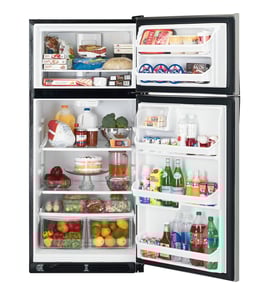


How to tell cubic feet of Kenmore refrigerator by model number?
For Kenmore model 79579293902, the most reliable way to get the exact cubic-foot capacity is to look it up by the full model number in the product specifications section of the 79579293902 owner's manual. If you only have the model number and no spec sheet, you can still estimate capacity by measuring the interior.
Best ways to find the exact cubic feet
- Check the manual/specifications: Capacity is typically listed as “total capacity” (and sometimes split into refrigerator and freezer). Use the 79579293902 owner's manual.
- Look at the model tag: Confirm the model number matches 79579293902 exactly; one digit off can change the capacity.
- Search by full model number: Use the complete number, not just “795” or “7929”.
How to estimate cubic feet by measuring (works for any refrigerator)
- Empty the compartment you are measuring (fresh food and freezer are usually measured separately).
- Measure interior dimensions in inches: width × depth × height.
- Multiply to get cubic inches.
- Divide by 1,728 to convert to cubic feet.
Quick conversion table
| What you have | What to do | Result |
|---|---|---|
| Interior inches (W × D × H) | Multiply | Cubic inches |
| Cubic inches | Divide by 1,728 | Cubic feet (approx.) |
Why model numbers do not reliably “encode” cubic feet
Kenmore model numbers can hint at platform/series (for example, “795” often indicates an LG-built Kenmore), but the digits do not consistently translate into a specific capacity across all years and designs. Using the manual/spec sheet gives the correct number for your exact configuration.
Why it matters
Cubic-foot capacity affects how you shop for replacement shelves, bins, and drawers, and it helps you compare storage space when replacing a refrigerator. It also helps set realistic expectations for airflow and loading so food stays at safe temperatures.
Last updated: January 2026
Where is the temperature control on the Kenmore 79579293902?
On the Kenmore 79579293902 top-mount refrigerator, the temperature controls are typically located inside the fresh food (refrigerator) compartment, often at the top front or on the side wall near the air damper area. Use the control panel or dial shown in the 79579293902 owner's manual to confirm the exact location and settings.
How to find it quickly
- Open the refrigerator door and look along the top front “ceiling” area.
- Check the left or right interior side wall near the upper shelves.
- Look for a small control housing with a slider, dial, or buttons labeled “Refrigerator” and “Freezer.”
- If your unit has a display, check for a small user interface inside the refrigerator section.
- If you see vents between compartments, the control is often close to that airflow path.
What you should see (common layouts)
| Control style | Where it’s usually located | What it adjusts |
|---|---|---|
| Dial or slider | Inside refrigerator section | Overall cooling level |
| Buttons/display | Inside refrigerator section (sometimes top front) | Separate fridge/freezer setpoints |
| Damper-based control | Near the air outlet between sections | How much cold air enters fridge |
Why it matters
Finding the correct temperature control helps you avoid over-freezing food in the refrigerator section or warming the freezer. It also helps when diagnosing airflow issues (for example, a stuck damper can cause warm fridge and cold freezer symptoms).
If temperatures still won’t hold
- Set freezer to about 0°F and refrigerator to about 37°F.
- Make sure vents are not blocked by food packages.
- Check door sealing and closing; a worn gasket can cause temperature swings.
- If you suspect airflow problems, review how to fix your evaporator cooling fan.
Last updated: January 2026
What causes a Kenmore 79579293902 to stop cooling?
A Kenmore 79579293902 top-mount refrigerator usually stops cooling because cold air is not being moved correctly (airflow problem) or the sealed system is not running correctly (compressor/start issue). We focus first on simple airflow and frost checks, then move to fans, controls, and the compressor.
Quick checks that solve many “not cooling” calls
- Confirm the refrigerator is getting power and the interior lights work.
- Make sure the temperature controls were not set too warm.
- Check for blocked vents (packages pushed against the air outlets).
- Listen for the evaporator fan in the freezer; it should run when the compressor is running.
- Look for heavy frost on the freezer back wall (often points to a defrost problem).
- Clean dust from the condenser area (restricted heat release can reduce cooling).
Most common causes (and what you’ll notice)
| Likely cause | Typical symptom | What to check next |
|---|---|---|
| Evaporator airflow problem (fan/ice blockage) | Freezer cold but fresh food warm, weak airflow | Frost pattern, fan noise, vent blockage |
| Defrost system issue | Thick frost on freezer back panel, temps rise over days | Frost buildup, door left ajar, gasket sealing |
| Condenser fan problem | Warm cabinet sides, compressor hot, poor cooling | Fan running near compressor area |
| Start device or compressor issue | Clicking, humming, then stops; no steady run | Start relay, compressor operation |
| Control or damper issue | Temps inconsistent, airflow not matching settings | Damper movement, control response |
Parts that commonly relate to “no cooling” on this model
If your symptoms match, these model-specific parts are often involved:
- Refrigerator electronic control board EBR41531306
- Refrigerator air damper motor 4681JB1027N
- Refrigerator condenser fan motor EAU61644105
- Refrigerator compressor TCA35931726
Why it matters
Cooling failures are often caused by airflow restrictions (frost, blocked vents, failed fan) that can be corrected before food spoils. If the compressor is not starting or not running steadily, the repair path changes quickly and may require sealed-system service.
For model-specific access steps, panel locations, and diagnostic notes, use the 79579293902 owner's manual.
Last updated: January 2026