Installation guide
 Owner’s manual
 Error Codes


How to hard reset kenmore washer?
To hard reset your Kenmore washer model 11027542600, unplug it for 1 minute, then plug it back in and start a new cycle. This clears many temporary control issues and is the fastest first step before deeper troubleshooting; see the 11027542600 owner's manual.
Hard reset steps (power reset)
- Press the Cycle Control knob in to stop the washer (if it is running).
- Unplug the washer from the wall outlet.
- Wait 60 seconds.
- Plug the washer back in.
- Select a cycle and settings (water level, temperature, options).
- Pull the Cycle Control knob out to start.
If the washer still will not start or finish
These checks solve the most common “looks dead” or “won’t spin/drain” complaints on this style of Kenmore top-load washer.
- Confirm the lid is fully closed; a failed lid switch can stop agitation or spin.
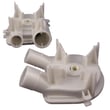
- If the tub will not drain, check for a clog at the pump and hoses; consider the washer drain pump WP3363394 if the pump is jammed or leaking.
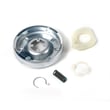
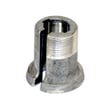
- If the motor runs but the washer will not agitate or spin, inspect the drive system; a worn coupler is common (see washer motor coupling 285753A).
- If agitation is weak or the top of the agitator “ratchets,” replace worn agitator dogs (see agitator dog 80040).
- If the washer shakes or walks, level it and tighten the leveling-foot locknuts; use the installation guide for the leveling procedure.
What a reset does (and does not do)
| Action | What it helps | What it will not fix |
|---|---|---|
| Unplug 1 minute | Glitches, stuck cycle, unresponsive controls | Broken lid switch, clogged drain, worn coupler/clutch |
| Restart cycle | Clears a paused/stopped state | Leaks, vibration from poor leveling |
Why it matters
A power reset is a safe, no-parts step that often restores normal operation after a brief power interruption or a control “hang.” If symptoms return immediately, the issue is usually mechanical (drain pump, motor coupling, agitator parts) or installation-related (leveling).
Last updated: February 2026
How to identify a Kenmore washer model?
Your Kenmore washer model number is printed on the appliance ID label; for Kenmore washers it often starts with 110 (like 11027542600). On most top-load Kenmore washers, we find it under the lid near the tub opening or on the rear panel. Confirm the exact format in the 11027542600 owner’s manual.
Where to look on a Kenmore washer
Check these common model-number label locations:
- Under the lid, around the tub rim (top-load washers)
- On the back of the cabinet near the power cord entry
- Along the rear edge of the control console (some designs)
- Inside the lid area near the hinge (some designs)
- On the lower rear panel near the base (occasionally)
What the model number looks like
Kenmore model numbers are usually 10 to 12 digits. Many Kenmore washers use a prefix that identifies the manufacturer series; 110 is very common.
| What you see on the label | What it means | Why you need it |
|---|---|---|
| Model number (example: 11027542600) | Identifies the exact washer design | Ensures parts diagrams match your washer |
| Serial number | Production identifier | Helps with service history and age |
| Type or code | Internal manufacturing info | Sometimes used in service documentation |
Why it matters
We use the model number to match the correct parts and instructions for your exact Kenmore washer. Even small model changes can affect fit for items like a lid switch, drain pump, or agitator components.
Quick tip for ordering the right part
When you search parts for Kenmore 11027542600, match by both the part name and the ID used on the parts list. For example, common wear items include the agitator dog 80040 and the washer lid switch assembly WP8318084.
Last updated: February 2026
How to unclog drain hose on Kenmore washer?
To unclog the drain hose on your Kenmore washer model 11027542600, we disconnect and clear the hose end-to-end, then reinstall it with the correct height and an air gap so the washer drains without backing up. Use the steps in the 11027542600 installation guide to reconnect the hose correctly afterward.
Safety first
- Unplug the washer before servicing.
- Turn off both water taps.
- Keep a shallow pan and towels ready for spillover.
- If the washer is full of water, bail out water first to reduce mess.
Step-by-step: clear the drain hose
- Pull the washer forward enough to access the drain hose.
- Remove the drain hose from the standpipe or laundry tub.
- Check the hose end for lint, coins, socks, or sludge; remove debris by hand.
- Flush the hose with hot water; for buildup, soak the hose end in hot water mixed with vinegar, then flush again.
- If the washer still will not drain, check the pump inlet for blockage; a common replacement is the washer drain pump WP3363394.
Reinstall it the right way (prevents repeat clogs)
The drain setup matters as much as the clog removal.
- Keep the hose secure but not sealed in the standpipe; it needs an air gap.
- Do not force excess hose down into the standpipe.
- Make sure the top of the drain hose is at least 39 in. (99 cm) above the floor.
- Make sure the drain outlet is not higher than 96 in. (244 cm) above the floor.
Quick drain setup checklist
| Item to verify | Target for model 11027542600 | What happens if wrong |
|---|---|---|
| Standpipe/laundry tub air gap | Hose loose but secure | Slow drain, siphoning, overflow |
| Hose height (minimum) | 39 in. above floor | Cycle can seem stuck filling/draining |
| Drain height (maximum) | 96 in. above floor | Won’t drain, water remains |
Why it matters
A partially clogged hose or an incorrectly installed hose can make the washer “hang” during drain, leave water in the tub, or cause backflow. Correct hose height and an air gap protect floors from leaks and help the drain pump move water efficiently.
Last updated: February 2026
What is the average lifespan of a Kenmore washer?
A Kenmore washer typically lasts 10 to 15 years with normal household use. For Kenmore model 11027542600, routine care (proper loading, correct detergent use, and addressing leaks or draining issues early) is what most directly determines whether you land closer to 10 or 15 years.
Typical lifespan and what changes it
Most washers reach the end of their service life because of wear in the drive and drain systems, not because the cabinet “wears out.” These factors have the biggest impact:
- Load size and balance: frequent overloading or unbalanced loads shorten tub, clutch, and suspension life
- Drain performance: slow draining strains the pump and can leave water behind
- Water quality: hard water increases residue and component wear
- Installation conditions: an unlevel floor increases vibration and stress
- Temperature exposure: freezing conditions can damage internal components
For model-specific care and maintenance intervals, follow the 11027542600 owner's manual.
Signs it may be near end-of-life
If you see several of these together, repairs often become more frequent:
- Loud grinding, squealing, or repeated burning-rubber smells during agitation or spin
- Tub not spinning up to speed, or clothes coming out very wet
- Repeated leaks from the tub area or persistent oil/grease marks under the washer
- Frequent “no drain” symptoms (standing water after the cycle)
- Excessive shaking even after leveling and load balancing
Common wear items vs. major repairs
Here is a practical way we look at it when deciding whether to repair or replace.
| Issue type | Examples | Typical outcome |
|---|---|---|
| Wear item repair | Lid switch, drain pump, coupling | Usually worth repairing |
| Drive system wear | Clutch, drive block, motor issues | Depends on age and overall condition |
| Structural/major | Basket, drive tube, gear case problems | Often higher cost; evaluate carefully |
If the washer will not drain, a common fix is replacing the washer drain pump WP3363394.
Why it matters
Knowing the 10 to 15 year lifespan range helps you plan: if your 11027542600 is already in that window, investing in preventive maintenance and smaller repairs can extend service life, while repeated major-drive repairs can quickly exceed the washer’s remaining value.
Last updated: February 2026
What is the capacity of a Kenmore 110 series washer?
Washer capacity depends on the exact Kenmore 110 model number. For Kenmore model 11027542600, the installation information we have does not list a cubic-foot capacity; most Kenmore 110 top-load washers of this design typically fall in the 3.2 to 3.6 cu. ft. range. Check the 11027542600 owner's manual for the exact spec.
How to confirm the exact capacity for model 11027542600
We recommend verifying capacity using the model-specific literature because “Kenmore 110 series” covers many different washer platforms.
- Look for a “Specifications” or “Features” section in the manual
- Check for wording like “Washer capacity”, “Basket volume”, or “Tub capacity”
- If the manual lists basket dimensions instead of cu. ft., use those to compare with similar Kenmore top-load models
- If you are shopping for replacement parts, match by model number 11027542600 (not just “110 series”)
Why capacity matters
Capacity affects how much laundry you can wash per load and helps prevent issues like poor cleaning, out-of-balance spinning, and “walking” from chronic overloading.
Quick guidance: what “3.2 to 3.6 cu. ft.” means in real use
| Capacity range | Typical load size | Best for |
|---|---|---|
| 3.2 cu. ft. | Medium loads | Everyday mixed laundry |
| 3.5 to 3.6 cu. ft. | Medium-large loads | Towels, jeans, larger family loads |
Related setup details that impact usable capacity
Even with the right tub size, installation and water supply affect performance. The installation guidance for this washer calls for:
- Hot and cold water pressure typically 5 to 100 psi (some dispenser setups need higher minimum pressure)
- A level floor (max slope about 1 inch under the washer)
- Proper drain setup (standpipe or tub height typically 39 to 96 inches from the bottom of the washer)
For those requirements and diagrams, use the 11027542600 installation guide.
Last updated: February 2026