Owner’s manual
 Error Codes



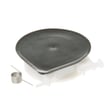
How do you put the bottom grill on a GE refrigerator?
On the GE GYE22GYNDFS bottom-mount refrigerator, the bottom grill (base grille) typically snaps into place along the lower front edge. We align the grill tabs with the slots, press it in evenly until it seats, then reinstall any retaining screws (if your version uses them). For the exact attachment points, use the GYE22GYNDFS owner's manual.
Before you reinstall the bottom grill
- Unplug the refrigerator or switch off power at the breaker if you will be working near wiring.
- If you pulled the refrigerator out, raise the front leveling legs first so it rolls without scraping.
- Keep the water supply line and power cord clear so they do not get pinched.
- Confirm the grill is not warped and that all mounting tabs are intact.
Steps to install the bottom grill (base grille)
- Position the grill: Hold it centered at the bottom front of the cabinet.
- Engage the tabs: Line up the grill’s tabs/clips with the matching slots along the frame.
- Snap it in: Press along the length of the grill (left, center, right) until it sits flush.
- Reinstall screws (if equipped): Tighten snugly with a Phillips screwdriver; do not overtighten.
- Verify clearance: Open and close both fresh food doors and the freezer drawer to confirm nothing rubs.
Quick checks if it will not stay on
| What you see | Most likely cause | What to do |
|---|---|---|
| One side pops out | Tabs not fully engaged | Remove and reinstall, pressing evenly across the grill |
| Grill sits crooked | Leveling legs or cabinet not level | Re-level the refrigerator, then reinstall the grill |
| Screws will not start | Misalignment or cross-threading | Start screws by hand first, then tighten |
Why it matters
The bottom grill helps protect components at the base of the refrigerator and supports proper airflow around the lower front area. A loose or misaligned grill can rattle, snag during cleaning, or interfere with door and drawer operation.
Last updated: February 2026
What is the most common problem with a GE refrigerator?
The most common issue we see with GE refrigerators like model GYE22GYNDFS is poor cooling (fresh food too warm, freezer not holding temp). In many cases, the cause is restricted airflow or heat not being released properly, so the compressor runs longer and temperatures drift.
Most common causes of poor cooling
- Dirty condenser coils (heat cannot dissipate well)
- Evaporator fan problem (cold air is not circulated through the compartments)
- Blocked vents or overpacked shelves (airflow restriction)
- Defrost system issue (frost buildup blocks airflow across the evaporator)
- Door not sealing (warm air leaks in, causing longer run times)
Quick checks you can do first
- Confirm the controls are set to normal temps (typical targets: 37°F fresh food, 0°F freezer).
- Make sure interior vents are not blocked by food containers.
- Check door closing and gasket contact all the way around.
- Clean dust from the condenser area (unplug first).
- Listen for the evaporator fan when the doors are closed (it often runs during cooling).
Symptoms and what they usually point to
| Symptom | Most likely area to check | What you may notice |
|---|---|---|
| Fresh food warm, freezer OK | Airflow from freezer to fridge | Weak airflow at fridge vents |
| Freezer warm too | Condenser coils, compressor run time | Unit runs a lot, cabinet feels warm |
| Frost on back freezer panel | Defrost system | Snowy or icy buildup returns quickly |
| Temps swing, odd behavior | Sensors or control | Intermittent cooling, inconsistent cycling |
Why it matters
Cooling problems are often progressive: restricted airflow and dirty coils increase run time, which can lead to food spoilage and added wear on the sealed system. Catching the simple causes early usually prevents bigger repairs.
Helpful model-specific resources
- Use the troubleshooting and temperature guidance in the owner's manual.
- If the refrigerator is showing a code, match it using GE refrigerator error codes.
Last updated: February 2026
What are the disadvantages of a bottom freezer refrigerator?
Bottom-freezer refrigerators like the GE GYE22GYNDFS keep fresh food at eye level, but the tradeoffs are mostly cost and ergonomics: the freezer is lower (more bending), drawers can hide items, and the bottom compartment can be more prone to drain and defrost-related messes if maintenance is skipped. See the GYE22GYNDFS owner's manual for model-specific use and care details.
Common disadvantages (what you will notice day to day)
- More bending and lifting: you reach down for frozen foods, and heavy items (meat, bulk bags) often sit in the lower basket.
- Deep drawer organization: stacked items can get buried, so it is easier to forget what is in the back.
- Less convenient for frequent freezer access: if you use the freezer many times a day, the lower position can feel slower.
- Higher purchase price in many lineups: bottom-mount designs often cost more than comparable top-freezer models.
- Potential for water/ice at the bottom if drainage is neglected: clogged or iced drain paths can lead to puddles or ice buildup.
Bottom freezer vs. top freezer: quick comparison
| Feature | Bottom freezer | Top freezer |
|---|---|---|
| Fresh food access | Best (eye level) | Requires bending |
| Freezer access | Requires bending | Best (eye level) |
| Organization | Drawer-based; can hide items | Shelf-based; easier to see |
| Typical cost | Often higher | Often lower |
Why it matters
Choosing the right layout affects comfort and food waste. If your household uses fresh food most, bottom-mount can feel more efficient. If you rely heavily on frozen foods, the extra bending and drawer digging can become a daily frustration.
Tips to reduce the downsides
- Put heaviest frozen items in the upper basket area when possible.
- Use bins or labeled bags to prevent “lost” items in deep drawers.
- Keep door openings shorter to reduce frost and moisture.
- If you ever get nuisance beeping from a door left ajar, use how to reset the door alarm on a GE refrigerator.
Last updated: February 2026