Error Codes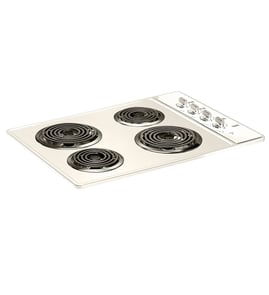
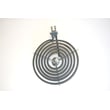


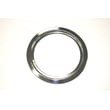
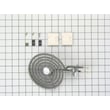

What are the disadvantages of electric cooktops?
Electric cooktops like the GE JP651 typically heat and cool more slowly than gas, so temperature changes are less immediate. They can also be harder to use for high-heat techniques, and spills can bake onto the surface area around the burner, increasing cleanup time.
- Slower response: turning the knob up or down does not change pan temperature as quickly as gas.
- Residual heat: the burner stays hot after you turn it off, which can overcook food if you do not move the pan.
- Less precise “instant” control: simmering and quick heat drops take more practice.
- Cookware sensitivity: warped pans can heat unevenly on electric elements.
- Cleanup can be tougher: boil-overs can burn onto drip pans or around the element.
If heat is uneven, slow, or inconsistent, these are common wear items on coil-style electric cooktops:
| Symptom | Common cause | Example part for JP651 |
|---|---|---|
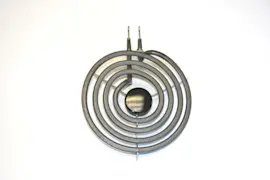
| Burner will not heat | Failed surface element | Range coil surface element, 6-in WB30X359 |
| Burner heats unevenly | Warped/aging element or poor contact | Range coil surface element, 8-in WB30X348 |
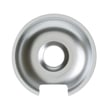
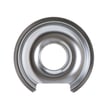
| Messy, hard-to-clean burner area | Damaged or stained drip pan | Range drip pan, 6-in WB32X10012 |
Knowing these disadvantages helps you set expectations and troubleshoot correctly. For example, “slow to cool down” is normal residual heat, but “won’t reach temperature” often points to a worn surface element, a bad infinite switch, or poor electrical contact.
- Preheat pans a little longer than you would on gas.
- Use flat-bottom cookware for better contact and more even heating.
- Move the pan off the burner when you turn it off to avoid overcooking.
- Clean spills promptly so they do not bake on.
- If a burner cycles oddly or will not regulate, consider testing the switch and element (a multimeter helps); see how to use a multimeter to test electrical parts video.
Last updated: January 2026
Do electric cooktops use 110 or 220?
Most built-in electric cooktops like the GE JP651 are wired for 208/240 volts (often called 220V) on a dedicated circuit; they do not plug into a standard 120V (110V) outlet. Some small portable cooktops can use 120V, but full-size cooking elements typically require the higher voltage.
- Voltage: Most are 208/240V for the surface elements.
- Circuit: Typically a dedicated breaker and properly sized wiring.
- Connection: Usually hardwired or connected in a junction box, not a standard wall plug.
- Controls: Some internal components may use lower voltage, but the cooktop supply is still 208/240V.
| Cooktop type | Typical supply | What it means in a kitchen |
|---|---|---|
| Portable countertop unit | 120V | Plugs into a standard outlet; lower total heating power |
| Built-in electric cooktop (like JP651) | 208/240V | Requires a dedicated circuit; supports higher heat output |
- Check the electrical panel for a 2-pole breaker labeled “cooktop” or “range.”
- Look for a dedicated circuit serving only the cooktop.
- If you are replacing a cooktop, match the new unit’s electrical requirements to the existing circuit.
- If a burner is not heating correctly, inspect the heating components and controls (for example, a failed surface element or infinite switch can mimic a power issue).
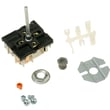
If you are troubleshooting a no-heat or weak-heat burner on this model, common replacement parts include the range coil surface element, 8-in WB30X348 and the inf ht swi WB21X36771.
Using the correct voltage and circuit protects the cooktop wiring, prevents nuisance breaker trips, and ensures the surface elements reach full temperature for normal cooking performance.
Last updated: January 2026
What is the difference between electric cooktop and induction cooktop?
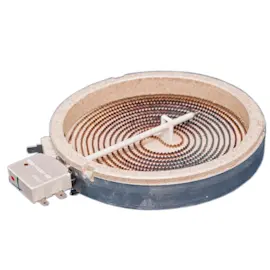
A GE electric cooktop like model JP651 heats by running electricity through a surface element (or radiant element) that then transfers heat to the pan. An induction cooktop heats the cookware directly using electromagnetic energy, so it typically heats faster and wastes less heat.
- Electric cooktop: An element gets hot first, then the glass/coil area heats the pan.
- Induction cooktop: A magnetic field induces heat in compatible cookware; the cooktop surface mainly warms from the hot pan.
- Result: Induction usually responds faster to temperature changes than standard electric.
- Speed: Induction often boils water faster; electric is usually slower to ramp up and cool down.
- Efficiency: Induction generally uses less energy because less heat is lost to the air.
- Surface temperature: Electric surfaces stay hot longer; induction surfaces cool sooner (but can still be hot from the pan).
- Cookware: Induction requires magnetic cookware (many stainless steels and cast iron); electric works with almost any flat-bottom pan.
| Feature | Electric cooktop (JP651 type) | Induction cooktop |
|---|---|---|
| Heat source | Hot element under/at the surface | Magnetic field heats the pan |
| Pan compatibility | Most cookware | Magnetic cookware only |
| Heat response | Moderate | Fast |
| Cleaning | Spills can bake on a hot surface | Surface is cooler, often easier |
Choosing between electric and induction affects cooking performance, cookware cost, and how quickly the cooktop cools after use. If you are maintaining an electric cooktop, keeping the surface components in good shape also helps heating stay consistent.
If your electric burner area is damaged or not sitting correctly, these common JP651-RELATED parts can matter:
- Range coil surface element, 8-in WB30X348 (heating element)
- Range drip pan, 6-in WB32X10012 (catches spills under the element)
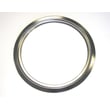
- Range burner trim ring WB31X5013 (helps finish and support the burner opening)
Last updated: January 2026
How much is it to replace an electric stove top?
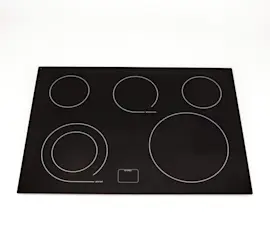
Replacing the cooktop on a GE JP651 electric cooktop typically runs $300 to $1,100 total, depending on the cooktop style (coil vs. smooth-top), whether you replace the full cooktop assembly or just failed parts, and local labor rates.
- Cooktop (part/assembly): about $200 to $800+
- Labor (if hired): about $100 to $300
- Service call/diagnosis (common): about $75 to $150
- Small parts and supplies: about $10 to $50
| What you replace | Typical parts cost | Typical labor | Best when |
|---|---|---|---|
| One surface element or drip pan | $6 to $100 | $0 to $150 | Only one burner is failing or damaged |
| Infinite switch or control knob | $50 to $75 | $0 to $200 | Burner won’t regulate heat or knob is stripped |
| Full cooktop (complete top) | $200 to $800+ | $100 to $300 | Multiple burners, wiring, or top surface are damaged |
If the cooktop surface is in good shape and only one burner area is acting up, replacing a single part is usually the most cost-effective fix.
Common JP651-RELATED parts customers replace:
- Range coil surface element, 8-in WB30X348 (burner not heating or heats unevenly)
- Inf ht swi WB21X36771 (burner stuck on high, won’t cycle, or won’t adjust)
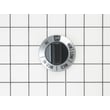
- Knob surface unit WB3X464 (knob cracked, loose, or won’t turn the shaft)
- Range drip pan, 6-in WB32X10012 (rusted, warped, or hard-to-clean pan)
A full cooktop replacement makes sense when the top is physically damaged or multiple circuits are failing. If the issue is isolated to one burner, switch, or knob, a targeted repair usually restores safe, consistent heating for far less money.
Last updated: January 2026