Installation guide
 Error Codes




Can you put a cooktop over a wall oven?
Yes, you can install a cooktop over a wall oven in many kitchens, but it must be done using the exact cabinet cutout and clearance requirements for your Whirlpool RBD245PDS14 and the specific cooktop. Use the installation guide dimensions and follow all electrical and enclosure requirements.
- Confirm the oven is approved for the installation type you want (wall cabinet vs undercounter).
- Use the cabinet opening dimensions shown in the installation guide; those dimensions provide minimum clearances.
- Make sure the recessed installation area provides a complete enclosure around the recessed portion of the oven.
- Verify the oven support surface is solid, level, and flush with the bottom of the cabinet cutout.
- Plan the electrical junction box location so the oven cable can reach without pinching or strain.
The installation guide for this model calls out specific cutout sizing and minimum clearances. Here are the most common dimensions customers compare when planning a cooktop-over-oven layout.
| Installation scenario | Cabinet width (typical) | Cutout width (typical) | Cutout depth (typical) |
|---|---|---|---|
| Wall cabinet installation | 24 in | 22-1/2 in | 23-1/4 in |
| Undercounter single oven (no cooktop above) | 24 in | 22-1/2 in | 23-1/4 in |
A cooktop-over-oven setup only works when the cabinet cutout, enclosure, and wiring layout match the oven’s installation requirements. If the opening is too tight or the junction box is in the wrong spot, the oven can sit out of level, overheat surrounding cabinetry, or pinch the power cable.
Last updated: February 2026
Does a wall oven need its own circuit?
Yes. The Whirlpool RBD245PDS14 electric built-in oven must be on its own dedicated circuit; the installation requirements specify a separate 30-amp or 40-amp circuit depending on the oven’s kW rating shown on the model/serial rating plate. See the wiring and breaker guidance in the installation guide.
A dedicated circuit means the oven is the only appliance powered by that breaker.
- Use a separate 30A or 40A branch circuit (based on the rating plate kW)
- Use a time-delay fuse or circuit breaker
- Do not put a fuse in the neutral or grounding circuit
- Connect through a junction box using a U.L.-listed conduit connector
- Use copper conductors sized to the circuit (the guide calls out 8 gauge solid copper wire for the connection)
The installation instructions tie circuit size to the oven’s power rating.
| Rating plate power (at 240V) | Required circuit | Typical use case |
|---|---|---|
| 7.2 kW and below | 30 amp | Lower-wattage single ovens |
| 7.3 to 9.6 kW | 40 amp | Higher-wattage ovens |
A wall oven draws high current during preheat and baking. A dedicated, correctly sized circuit prevents nuisance trips, overheating at the junction box, and wiring damage; it also ensures the oven heats properly and safely.
- Turn power off before any wiring work
- Confirm the home wiring type (aluminum wiring needs special handling)
- Place the electrical supply junction box in the recommended location (typically within a few inches below the support surface for wall-cabinet installs)
- If you are not fully comfortable working with 240V circuits, have a qualified technician handle the electrical connection
Last updated: February 2026
Are electric wall ovens 110 or 220?
Whirlpool electric wall ovens like model RBD245PDS14 are wired for a dedicated 208/240-volt circuit (commonly called 220V). They connect hardwired to a junction box, not a standard 120-volt (110V) outlet.
Most built-in electric wall ovens use 2 hot legs (L1 and L2) for 208V or 240V operation. The RBD245PDS14 installation requirements call for a dedicated circuit sized to the oven’s kW rating on the model/serial rating plate.
- Uses 208/240 VAC supply (typical for electric wall ovens)
- Requires a dedicated circuit (30A or 40A depending on kW rating)
- Connects directly to a junction box using approved conduit connector
- Uses copper conductors and proper grounding
- A time-delay fuse or circuit breaker is recommended
The installation guide ties breaker size to the oven’s power rating (kW) listed on the rating plate.
| Oven rating on rating plate | Typical required circuit |
|---|---|
| 7.2 kW and below (at 240V) | 30-amp dedicated circuit |
| 7.3 to 9.6 kW (at 240V) | 40-amp dedicated circuit |
Check the rating plate on the oven door or frame, then follow the wiring and breaker guidance in the installation guide.
Using a 120V (110V) circuit will not power the heating elements correctly and can cause nuisance tripping or no-heat conditions. Correct 208/240V supply and proper grounding also reduce the risk of electrical shock and overheating at the junction box.
Because this is a hardwired, high-voltage appliance, we recommend these basics before any work:
- Turn power off at the breaker before opening the junction box
- Do not place a fuse in the neutral or grounding circuit
- Do not ground to a gas pipe
- Use the correct wire gauge specified for the installation
- If your home has aluminum wiring, follow the special instructions in the install documentation
Last updated: February 2026
Why did my Whirlpool wall oven stop working?
Your Whirlpool RBD245PDS14 electric built-in oven usually stops working because it lost power (tripped breaker or blown fuse), has a wiring/connection problem, or a failed heating or safety component. Start by confirming the oven is getting the correct supply voltage and the display powers on.
- Reset the oven by turning the circuit breaker OFF for 1 minute, then back ON.
- Check the home electrical panel for a tripped breaker or blown fuse.
- If the display shows “PF”, that indicates a recent power interruption; re-set the clock and try Bake or Broil.
- Start a Bake or Broil cycle and confirm the ON indicator appears.
- After about 2 minutes, crack the door and feel for heat (use caution).
- If an “F” code followed by a number appears, use the troubleshooting section in the installation guide.
If the oven has power but will not heat, these parts are common suspects for this model:
| Symptom | Likely cause | Part to check on this model |
|---|---|---|
| Oven runs but temperature is wrong or heats inconsistently | Bad temperature feedback | Wall oven temperature sensor WPW10131825 |
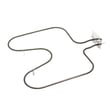
| Broil does not heat but bake may work | Failed broil heater | Broiler element WP9760771 |
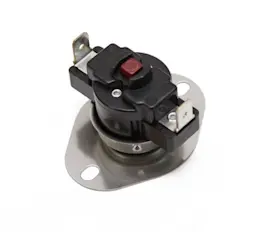
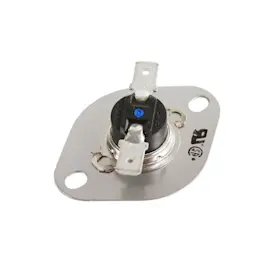
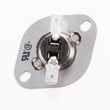
| Oven shuts down or will not heat after it starts | Overheat protection opening | Range high-limit thermostat WP9759243 or oven safety thermostat WP4451354 |
A wall oven that “stops working” is often a power-supply or safety issue. Confirming the breaker, correct electrical connection, and basic heat test helps you avoid replacing parts unnecessarily and points you to the right repair (sensor, element, thermostat, or wiring).
Last updated: February 2026