Owner’s manual
 Error Codes
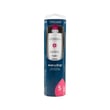


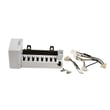
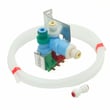
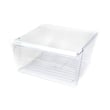
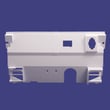
How to remove drip pan from Kenmore side-by-side refrigerator?
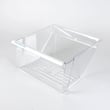
On Kenmore side-by-side refrigerator model 10650562991, the drip pan (defrost pan) is accessed from the bottom front. We remove the base grille first, then slide the pan out so it can be emptied, cleaned, and reinstalled.
Steps to remove the drip pan (defrost pan)
- Turn the temperature control to OFF, then unplug the refrigerator.
- Open both doors.
- Remove the base grille: place your hands at both ends, push in with your thumbs along the top, and pull up on the bottom.
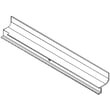
- Locate the drip pan underneath the cabinet (behind the grille area).
- Carefully slide the pan straight out; keep it level to avoid spills.
- Wear gloves; the pan can have dirty water and residue.
- Use a towel or shallow tray under the front edge in case of drips.
- Wash with warm water and mild dish soap; dry completely.
- Slide the pan back in fully so it sits flat.
- Reinstall the base grille by lining up the tabs with the metal clips and snapping it into place.
Quick safety and handling notes
The manual recommends disconnecting power before cleaning or servicing. That prevents shock risk and also keeps the evaporator fan and compressor from running while you are working. See the owner's manual.
What to expect (normal vs. problem)
| What you see in the pan | Usually means | What to do |
|---|---|---|
| Small amount of water | Normal defrost drainage | Clean and reinstall |
| Slime or odor | Old standing water, food residue | Clean pan; check drain opening for clogs |
| Pan overflowing | Drain tube restriction or heavy frost melt | Clear drain path; monitor for repeat overflow |
Why it matters
Keeping the drip pan clean helps prevent odors and reduces the chance of water puddles under the refrigerator. It also makes it easier to spot a defrost drain issue early.
Last updated: February 2026
How much freezer space is in a side-by-side?
Most side-by-side refrigerators have about 7.5 to 10 cubic feet of freezer space (with total capacity often around 22.5 to 31 cubic feet). For your Kenmore 10650562991, the exact freezer capacity is listed in the owner's manual.
Typical freezer capacity ranges (what to expect)
Side-by-side designs split the cabinet vertically, so the freezer is usually narrower but tall. In real use, shelves, the ice bin, and airflow space reduce usable room.
- Typical freezer capacity: 7.5 to 10 cu. ft.
- Typical total capacity: 22.5 to 31 cu. ft.
- Usable space is less once you account for:
- Ice maker and ice bin
- Shelving and door bins
- Air channels and vents
- Bulky packaging
How to estimate your usable freezer space
We recommend using the freezer storage guidance in the manual and planning for airflow.
- Keep packages from blocking vents so cold air can circulate
- Avoid overpacking; it can cause warm spots and slow freezing
- Use baskets and bins to prevent items from sliding off shelves
- Leave enough room for the door to close tightly
Quick planning guide
| What you are storing | Space planning tip | Why it helps |
|---|---|---|
| Bulk meat, meal prep | Use flat stacks on shelves | Freezes faster, easier airflow |
| Bags of frozen fruit/veg | Use a basket/bin | Prevents spills and lost items |
| Ice storage | Keep the bin seated correctly | Helps the dispenser and door seal |
Why it matters
Freezer capacity affects how quickly food freezes and how well it stays frozen. The manual also notes a practical loading limit: no more than 2 to 3 lb of unfrozen food per cubic foot of freezer space in 24 hours, which helps prevent temperature swings.
Last updated: February 2026
Where is the model number on a Kenmore side by side refrigerator?
On Kenmore side-by-side refrigerator model 10650562991, the model number is printed on the model and serial number label located on the inside wall of the refrigerator compartment. Open the fresh food door and look along the interior side walls for a sticker-style label. See the 10650562991 owner's manual for the exact label description and recording fields.
How to find the label fast
- Open the refrigerator (fresh food) door, not the freezer door.
- Look on the inside wall of the refrigerator compartment.
- Check the upper side walls first, then scan downward.
- Move food bins forward if they block your view.
- Use a flashlight; the print can be small or lightly faded.
What you will see on the label
Most Kenmore 106-series labels include both identifiers:
| Item on label | What it’s used for |
|---|---|
| Model number (example format: 106.xxxxxxxx) | Matching the correct parts diagrams and parts list |
| Serial number | Identifying production details for service history |
Why it matters
We use the model number to match your refrigerator to the correct parts for fit and function, such as the ice maker assembly - refrigerator ice maker by whirlpool 4317943 or the refrigerator inlet valve W10408179. Using the full model number helps avoid ordering the wrong ice maker, water valve, thermostat, or door gasket.
Tips when writing the model number down
- Copy it exactly as printed, including all digits.
- If it starts with 106, keep the full number after it.
- Take a clear photo of the label for reference.
Last updated: February 2026
Why is the ice maker not working on my Kenmore side by side refrigerator?
If the ice maker isn’t working on your Kenmore 10650562991 side-by-side refrigerator, the most common causes are the ice maker being turned off, the freezer not cold enough yet, the water supply valve being closed, or an ice jam in the ejector area. We recommend checking those items first.
Quick checks that fix most “no ice” problems
- Confirm the ice maker is ON (wire shut-off arm down, or the ON/OFF switch set to ON depending on style).
- Make sure the freezer is cold enough; after hookup, allow 24 hours for ice production.
- Verify the household water shut-off valve to the refrigerator is fully open.
- Look for a cube jammed in the ejector area; clear it with a plastic utensil.
- Reseat the ice bin or bucket fully; if it is not pushed in all the way, dispensing and sensing can act up.
Step-by-step troubleshooting (in order)
- Check the shut-off arm or switch
- Some versions use a wire shut-off arm; it must be down in the ON position.
- Other versions use an ON/OFF switch in the freezer compartment.
- Confirm temperature and timing
- If the refrigerator was just installed, moved, or reconnected to water, give it time to cool and cycle.
- Check for an ice jam
- Remove the bin or bucket and inspect the ejector area; clear any stuck cubes.
- Confirm water can reach the ice maker
- If the mold is dry, focus on water supply and the inlet valve.
Parts that commonly solve “no ice” (when checks above don’t)
| Symptom | Most likely part | What it affects |
|---|---|---|
| Ice maker cycles but no water fills | Refrigerator inlet valve W10408179 | Opens to send water to the ice maker |
| Ice maker won’t cycle or won’t harvest | Ice maker assembly 4317943 | Motor/module, mold, and ejector functions |
Why it matters
An ice maker depends on three things working together: freezer temperature, water supply, and ice maker controls/sensors. A simple OFF setting, warm freezer, or a small ice jam can stop production even when the water dispenser still works.
For model-specific ice maker ON/OFF locations, bin removal steps, and expected production rates, use the owner's manual.
Last updated: February 2026
Why is my Kenmore side by side refrigerator leaking water?
Water leaking from your Kenmore side-by-side refrigerator model 10650562991 is usually caused by a defrost drain that is clogged with ice or debris, or by a water supply issue at the filter, tubing, or inlet valve. We recommend checking the drain path first, then the dispenser and water line connections using the owner's manual.
Most common leak sources (and what to check)
- Defrost drain clogged or frozen: Water backs up during defrost and spills into the fresh food section.
- Water filter area: A loose filter or air in the lines can cause dripping at the dispenser.
- Water line or tubing: Look for kinks, cracks, or a loose push-in connection.
- Water inlet valve: A valve that does not fully close can seep and create intermittent leaks.
- Ice chute or dispenser drip: Holding the glass too briefly can leave residual drips.
Quick troubleshooting steps
- Unplug the refrigerator and protect the floor with towels.
- Check where the water starts:
- Under crisper drawers or inside the fridge: suspect defrost drain.
- Under the freezer door/dispenser area: suspect dispenser drip, filter, or water line.
- Behind the unit: suspect water supply line or inlet valve.
- Inspect the filter and dispenser behavior:
- Hold the cup under the dispenser 2 to 3 seconds after releasing the lever to reduce drips.
- If water flow is weak, remove the filter and test flow; a restricted filter often points to replacement.
Parts that commonly solve water leaks
| Leak symptom | Likely area | Part to consider (if failed) |
|---|---|---|
| Puddle near back/bottom, slow seep | Water supply connection/valve | Refrigerator inlet valve W10408179 |
| Drips or leaks around filter housing | Filter mount/housing | Refrigerator water filter housing WP2186443 |
| Leaks tied to defrost cycles, water inside fridge | Defrost drain system | (Clear drain; inspect defrost components if icing persists) |
Why it matters
A small leak can turn into floor damage, ice buildup, and poor cooling if the evaporator area starts frosting over. Fixing the root cause also helps prevent repeat ice maker and water dispenser problems.
Last updated: February 2026