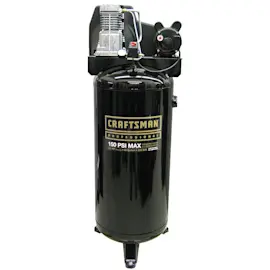
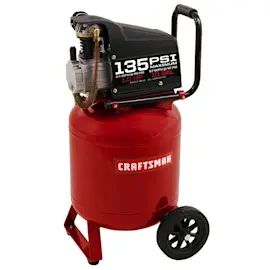
Owner’s manual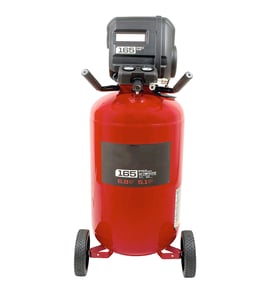

What is the lifespan of an air compressor?
A typical homeowner-grade air compressor lasts 10 to 15 years with normal use and basic maintenance. For your Craftsman 919166441 air compressor, lifespan depends most on run time, heat, moisture control, and leak prevention; keeping a moderate duty cycle extends pump and motor life.
Typical lifespan ranges (what we see most often)
- DIY/garage piston compressors: 10 to 15 years
- Light commercial use: 7 to 12 years
- Heavy daily use: 5 to 10 years
- Tank life: commonly 10 to 20 years when kept dry inside (draining moisture is the big factor)
| Use pattern | What shortens life fastest | What extends life most |
|---|---|---|
| Occasional (weekends) | Storing with water in tank | Draining tank after use |
| Regular (several days/week) | Long continuous run time | Keeping a moderate duty cycle |
| Heavy (daily) | Heat, dirty intake air, leaks | Clean airflow, quick leak repairs |
Model-specific guidance for Craftsman 919166441
Your manual notes the pump can run continuously, but recommends maintaining a 50% to 75% average duty cycle (about 30 to 45 minutes of run time per hour) to prolong compressor life. Use the maintenance and operating guidance in the owner's manual to keep temperatures down and reduce wear.
Maintenance that adds years (high impact)
- Drain the tank after each use to reduce internal corrosion.
- Fix air leaks promptly (fittings, regulator, drain valve, check valve).
- Keep ventilation clear; place the unit in a clean, dry, well-ventilated area.
- Avoid long extension cords and low voltage; they overheat motors.
- Bleed pressure before servicing hoses, tools, or accessories.
Why it matters
Lifespan is mostly about controlling heat and moisture. Heat accelerates pump and motor wear; moisture accelerates tank corrosion and can cause pressure control parts (like the pressure switch and regulator) to work harder.
Helpful DIY troubleshooting
If you are trying to judge whether your compressor is nearing end-of-life, these guides help you pinpoint the real failure point:
For parts lookup by model number, we recommend starting with the model parts list and using Sears PartsDirect if you need to search more broadly.
Last updated: February 2026
What does 4.0 scfm at 90 PSI mean?
It means the compressor can deliver about 4 standard cubic feet of air per minute while maintaining 90 PSI at the outlet. For the Craftsman 919166441 specifically, the rating is 3.5 SCFM at 90 PSIG, which is the airflow you can count on for running air tools at that pressure (see the owner's manual).
How to use SCFM and PSI to pick the right air tool
SCFM is the amount of air available; PSI is the pressure available. Your tool needs both.
- Match the tool’s required SCFM at a stated PSI (often 90 PSI)
- If the tool’s SCFM requirement is higher than the compressor’s SCFM rating, the tool will run weakly or the compressor will run constantly
- Higher PSI does not replace missing SCFM; airflow is what keeps the tool running
- Plan extra capacity for continuous-use tools (sandblasters, DA sanders, die grinders)
- Short-burst tools (brad nailers, staplers) usually work with lower SCFM
What “standard” in SCFM means
SCFM is measured under standardized conditions so you can compare compressors more fairly. In the Craftsman 919166441 glossary, SCFM is defined as a unit of measure of air delivery, and PSIG is pressure measured on a gauge.
Craftsman 919166441 airflow ratings (from the manual)
| Rating point | Air delivery | What it’s used for |
|---|---|---|
| 40 PSIG | 4.9 SCFM | Higher airflow at lower pressure (some blow guns, inflators) |
| 90 PSIG | 3.5 SCFM | Common reference point for many pneumatic tools |
Why it matters
If your tool needs more air than the compressor can supply at 90 PSI, you will see pressure drop at the regulated gauge during use. That is the practical sign that the compressor is undersized for the accessory.
For parts and model lookups beyond this list, we recommend searching by model number on Sears PartsDirect.
Last updated: February 2026
What is the most common cause of air compressor failure?
The most common cause of failure on a Craftsman air compressor like model 919166441 is poor maintenance that leads to overheating and accelerated wear (restricted ventilation, dirty components, and leaks). Electrical issues and pressure-control problems (pressure switch or safety valve) are also frequent failure triggers.
Most common failure causes we see
- Overheating from restricted airflow: blocked vents, operating too close to a wall, or running with covers removed or damaged
- Air leaks: loose fittings, leaking seals, or leaks between the head and valve plate
- Pressure control problems: pressure switch not shutting off at cut-out, or a safety valve that leaks or pops open
- Electrical problems: incorrect grounding, wrong voltage, inadequate fuse protection, or unsafe wiring/repairs
- Unsafe operating habits: running unattended, operating in wet conditions, or using the compressor in poorly ventilated areas
Quick checks that prevent most breakdowns
Before you troubleshoot, follow the safety steps in the 919166441 owner's manual.
- Unplug the compressor, bleed tank pressure, and let the unit cool before servicing
- Keep the compressor in an open area with at least 12 inches of clearance from walls/obstructions for ventilation
- Check fittings with a soapy water solution; tighten where bubbles form (do not overtighten)
- If the safety valve pops or the unit will not shut off at cut-out, switch the lever to Off and stop using it until corrected
- Never drill, weld, or modify a leaking tank; replace the tank if it leaks
Symptom-to-cause cheat sheet
| Symptom | Most likely cause | What to do first |
|---|---|---|
| Safety valve pops off | Pressure switch not shutting off, cut-out set too high | Turn Off; do not run until pressure control is corrected |
| Hissing at fittings | Loose tube fittings | Soap-test and snug fittings |
| Tank will not hold air | Defective tank or weld leak | Stop using; replace tank |
| Runs hot or trips | Ventilation restricted | Clear vents; ensure 12-inch clearance |
Why it matters
Overheating, leaks, and pressure-control faults do more than reduce performance; they can create unsafe operating conditions. Good airflow, leak checks, and proper shutoff control protect the motor, pump, and tank.
For model-specific diagrams and maintenance guidance, use the parts list for model 919166441 or search by model on Sears PartsDirect.
Last updated: February 2026
Is it worth it to repair a compressor?
Yes; repairing your Craftsman air compressor model 919166441 is worth it when the failure is limited to common service parts (pressure switch, check valve, regulator, gauge, fittings) and the tank and pump are in good condition. If the tank integrity is questionable, replacement is the right choice.
Quick repair vs. replace checklist
Use these factors to decide:
- Tank condition: rust-through, pinhole leaks, or damaged welds means replace the unit.
- Problem type: pressure-control and no-start issues are usually repairable.
- Scope: one or two parts is a good repair; multiple major components favors replacement.
- Electrical symptoms: breaker trips, burning smell, or damaged wiring means stop and use a qualified technician.
- Downtime: frequent repeat failures make replacement the better value.
Problems that are usually worth repairing
On many portable compressors, these are straightforward fixes:
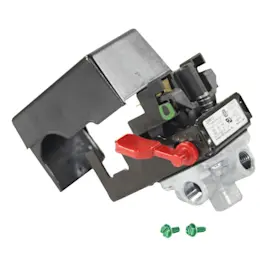
- Won’t start due to a failing pressure switch
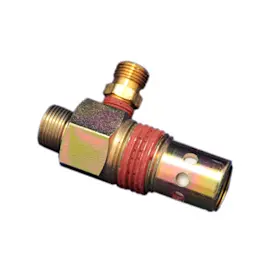
- Won’t restart with a full tank due to a check valve or unloader issue
- Can’t adjust outlet pressure because the regulator is sticking
- Gauge reads incorrectly because a pressure gauge is failing
- Air leaks at fittings, drain valve, or quick-connect coupler
For step-by-step troubleshooting, use air compressor won't start or air compressor won't build tank pressure.
When replacement is the better value
Replace the compressor when any of these apply:
- The tank won’t hold air or shows heavy corrosion
- The pump has low output plus repeated seal or valve problems
- The unit has recurring electrical faults (handled by a qualified technician)
Cost and outcome guide
| Situation | Typical cost level | Best choice |
|---|---|---|
| Air leak, gauge, regulator issue | Low | Repair |
| Pressure switch or check valve issue | Medium | Repair |
| Pump rebuild plus other problems | High | Compare closely |
| Tank integrity concern | Not repairable safely | Replace |
Why it matters
Air compressors store high-pressure air and use electricity. Our owner's manual for model 919166441 emphasizes shutting the unit off and bleeding pressure from the hose and tank before maintenance. For parts shopping by model number, start with Sears PartsDirect.
Last updated: February 2026