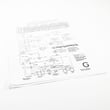
Owner’s manual
 Error Codes


How to tell cubic feet of Kenmore refrigerator by model number?
For Kenmore model 25351399104, the model number alone usually does not state the exact cubic-foot capacity. The most reliable way is to use the capacity listed in the specifications section of the owner's manual, or calculate it from the interior compartment measurements.
- Check the specs in the manual: Look for “capacity” or “product dimensions/specifications” in the owner's manual.
- Look for the serial plate: The manual notes the model and serial information is on the serial plate inside the refrigerator compartment; that label can help confirm you are matching the right documentation.
- Measure and calculate (good when specs are not handy): Measure the usable interior space and convert to cubic feet.
- Use the right measurement: Measure the inside of the food compartment and freezer separately, then add them.
- Measure usable space: Exclude door bins, thick insulation areas, and non-usable voids.
- Empty the section you are measuring (fresh food, then freezer).
- Measure interior height, width, and depth in inches.
- Multiply:
H x W x D = cubic inches. - Convert:
cubic inches ÷ 1728 = cubic feet.
| What you measure | What you get | Notes |
|---|---|---|
| Interior H x W x D (inches) | Cubic inches | Measure each compartment separately |
| Cubic inches ÷ 1728 | Cubic feet | Add fresh food + freezer totals |
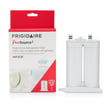
Capacity helps us match the right refrigerator parts and maintenance items (like a water filter, shelves, or bins) and helps you compare storage space when planning food storage, ice maker use, and temperature settings.
Last updated: February 2026
Where is the model number on a Kenmore side by side refrigerator?
On Kenmore side-by-side refrigerator model 25351399104, the model number is on the serial plate located inside the refrigerator compartment. Open the fresh food door and look along the interior walls near the top or side areas for the label.
The serial plate typically includes both the model and serial information. When you find it, we recommend writing it down exactly as shown.
- Model number: starts with 253 for this Kenmore platform
- Serial number: a longer code used for production tracking
- Electrical ratings: voltage and amperage information
- Manufacturer details: brand and compliance markings
For the exact wording and where the manufacturer expects you to record it, check the owner's manual.
If you do not see it immediately, check these common spots inside the fresh food section:
- Left interior wall near the top hinge area
- Right interior wall near the top shelf area
- Side wall behind or beside the crisper drawers
- Ceiling area near the light housing
We use the full model number to match the correct Kenmore parts and diagrams for your refrigerator, including items like the refrigerator filter WF2CB and the refrigerator water valve 242252702. Even small model-number differences can change fit and compatibility.
| Item | What it’s used for | Example format |
|---|---|---|
| Model number | Identifies the exact refrigerator design and parts | 25351399104 |
| Serial number | Identifies the specific unit and production run | Longer mixed code |
Last updated: February 2026
Why is my Kenmore refrigerator not getting cold enough?
If your Kenmore 25351399104 side-by-side refrigerator is not cold enough, the most common causes are incorrect temperature control settings, blocked air vents, dirty condenser coils, or a door that is not sealing. Start by adjusting the controls and allowing 24 hours for temperatures to stabilize (see the owner's manual).
- Make sure the freezer and fresh food controls are not set to 0 (Off).
- Turn the controls slightly toward Colder, then wait 24 hours for stabilization.
- Keep food packages from blocking cold air vents; airflow is required for even cooling.
- Limit door openings; warm air entering the cabinet quickly raises temperatures.
- Check that doors close fully and the refrigerator is level.
- Condenser coils: If they are dusty, the refrigerator cannot shed heat well and cooling suffers.
- Door gasket: A dirty, warped, or torn seal leaks warm air and forces long run times.
- Evaporator airflow: The manual notes a fan circulates air between compartments; if airflow is weak, cooling becomes uneven.
- Temperature control components: If settings do not respond, the control can be the issue.
| Symptom you notice | Likely area | Example part on this model page |
|---|---|---|
| Warm temps plus long run time | Heat removal, airflow | Refrigerator condenser motor 5303918774 |
| Temps drift, hard to regulate | Temperature control | Refrigerator temperature control 5304496561 |
| Frost buildup, warming over time | Defrost system | Refrigerator defrost heater 5303918255 and refrigerator defrost bi-metal thermostat 5303918214 |
A side-by-side refrigerator depends on steady airflow and correct control settings to keep both compartments at safe temperatures. Small issues like blocked vents or a leaking gasket can look like a major cooling failure.
Last updated: February 2026
What does er if mean on a Kenmore refrigerator?
On Kenmore model 25351399104, the ER IF code indicates a problem with the ice fan circuit (the fan that moves cold air through the ice maker area). The most common causes are ice buildup blocking the fan, a failed fan motor, or a wiring/control issue; use the owner's manual for model-specific checks.
- Power reset: unplug the refrigerator (or switch off the breaker) for 5 minutes, then restore power.
- Make sure the freezer door closes fully and the door gasket seals all the way around.
- Listen for a small fan running near the ice maker area when the freezer is running.
- Look for frost or ice around the ice maker housing or air passages.
- Confirm freezer temperature is set correctly (typical target is 0°F).
Ice around the ice fan is a top trigger for ER IF.
- Move food away from vents and the ice maker area.
- If you see heavy frost, a controlled defrost can help: turn the unit off and leave doors open until ice melts; protect floors with towels.
- If frost returns quickly, the defrost system is the next place to check.
| Symptom | What it points to | Example part for this model |
|---|---|---|
| Frost keeps coming back, fan area re-freezes | Defrost control components not stopping ice buildup | Refrigerator defrost bi-metal thermostat 5303918214 |
| Thick frost sheet on freezer back panel | Defrost heater not warming evaporator | Refrigerator defrost heater 5303918255 |
If the fan is clear but ER IF returns, inspect the ice maker compartment for broken pieces, ice jams, or airflow restrictions.
- Check the ice bucket and chute for packed ice.
- If the ice maker is overfilling or leaking into the compartment, inspect the fill system.
- If you suspect a water supply issue contributing to freezing or odd ice production, the inlet valve is a common failure point: refrigerator water valve 242252702.
The ice fan helps keep the ice maker area cold and stable. When it is blocked or not running, temperatures swing, ice can melt and refreeze, and the refrigerator may stop making ice or show repeated error codes.
Last updated: February 2026
Why is the ice maker not working on my Kenmore side by side refrigerator?
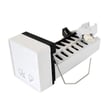
If the ice maker on your Kenmore 25351399104 side-by-side refrigerator isn’t making ice, the most common causes are the wire signal arm being in the OFF (up) position, the household water supply valve being closed or restricted, or the freezer not being cold enough to cycle ice production. See the owner's manual for the exact checks and control settings for your unit.
- Make sure the ice maker wire signal arm is down (ON) and not blocked by packages.
- Confirm the household water line valve is fully open.
- Verify the freezer is cold enough; warm freezer temps stop ice production.
- Check for a slow water dispenser; slow flow often points to a clogged filter.
- Remove the ice bin and shake loose clumped cubes after a power outage or long periods of non-use.
- Clear any ice chips around the bin shelf and chute; reinstall the bin fully.
If water flow is restricted or inconsistent, these parts are the most common fixes for this model:
| Symptom | Most likely part | What it affects |
|---|---|---|
| Water dispenses slowly; ice production drops | Refrigerator filter WF2CB | Reduces water flow to the ice maker and dispenser when clogged |
| No water to ice maker (but supply is on) or intermittent fill | Refrigerator water valve 242252702 | Controls water entering the refrigerator for ice and water |
| Ice maker cycles but cubes don’t form correctly | Ice maker mold 241798231 | The mold area where cubes freeze and release |
| Ice won’t dispense; bin jams easily | Ice container 241860803 | Stores ice and interfaces with the dispenser mechanism |
The ice maker depends on two things working together: cold freezer temperature and steady water flow. A slightly warm freezer or a restricted water supply (often from a clogged filter or a restricted valve) stops the fill and freeze cycle, so ice production never starts.
When clearing a jammed bin, we never recommend using sharp tools to break ice; that can crack the bin or damage the dispenser mechanism. Empty the bin and let clumps loosen, then shake to separate.
Last updated: February 2026