Owner’s manual
 Error Codes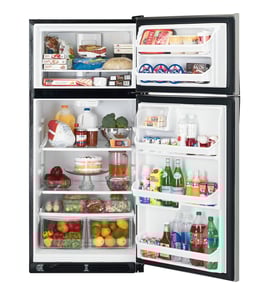



How to tell what model Kenmore refrigerator?
Your Kenmore refrigerator’s model number is printed on the model and serial number label inside the fresh food (refrigerator) compartment. For Kenmore model 10674962400, the label is on an inside wall of the refrigerator compartment; match the full number exactly to get the right parts and instructions in the owner's manual.
- Open the refrigerator door and check the inside side walls first
- Look near the ceiling/control area inside the refrigerator compartment
- Check behind or above the crisper drawers (some labels are easier to see with drawers removed)
- Write down both the model number and serial number
- Keep the purchase date with your records for future service and parts matching
Kenmore model numbers are the key to matching the correct diagrams and replacement parts (water filter, ice maker, door gaskets, switches). For this refrigerator, the manual’s product record section specifically calls out recording the model and serial number from the label inside the refrigerator compartment.
| Label item | What it’s used for | Example for this page |
|---|---|---|
| Model number | Parts lookup and correct manual | 10674962400 |
| Serial number | Production tracking and service history | Varies by unit |
| Purchase date | Warranty documentation and records | Your receipt date |
Using the exact model number prevents ordering the wrong part and helps you follow the correct troubleshooting and maintenance steps (for example, water filter replacement intervals and ice maker setup).
Last updated: February 2026
What are the disadvantages of a top mount fridge?
Top-mount refrigerators like the Kenmore 10674962400 are reliable and efficient, but the main disadvantages are convenience and organization: fresh-food items sit lower (more bending), freezer access is higher, and many models have fewer built-in storage and dispenser features than newer layouts.
- Less convenient fresh-food access: the refrigerator compartment is below the freezer, so you bend more for everyday items.
- Freezer at eye level can be awkward: heavier frozen items may be harder to lift down safely.
- Fewer organization features: many top-mount designs have simpler bins, shelves, and drawer layouts.
- Limited dispenser options: some top-mount models do not include an external water or ice dispenser.
- Airflow sensitivity: blocking vents can cause temperature and moisture problems in either section.
If the “disadvantage” feels like uneven cooling, odors, or slow ice production, we treat that as a setup or maintenance issue first.
- Keep packages from blocking freezer and refrigerator vents (air must circulate between sections).
- Start with mid-settings on the controls; adjust one setting at a time.
- Wait 24 hours between temperature adjustments.
- Leave proper clearance around the cabinet for ventilation (typical guidance is about 1/2 inch at the sides and top, and more near walls for door swing).
| Symptom | Likely cause | First adjustment |
|---|---|---|
| Refrigerator too warm | Door opened often, warm room, vents blocked | Raise refrigerator setting 1 step |
| Freezer too warm or ice slow | Heavy use, door opened often | Raise freezer setting 1 step |
| Sections too cold | Controls set too cold | Lower the appropriate setting 1 step |
For model-specific control and airflow details, follow the owner's manual.
Top-mount fridges depend on shared airflow between the freezer and fresh-food sections; when vents are blocked or settings are changed too quickly, the layout can feel “worse” because temperatures and humidity swing more noticeably.
Last updated: February 2026
What are the most common problems with Kenmore refrigerators?
The most common problems we see on Kenmore refrigerators like model 10674962400 are warm temperatures (often from blocked air vents or frequent door opening), moisture buildup, doors that won’t close or are hard to open (gasket issues), lights not working, and ice maker or water system troubles. Use the owner's manual troubleshooting steps first.
- Refrigerator too warm: blocked vents, doors opened often, controls set incorrectly
- Interior moisture buildup: high room humidity, blocked vents, unwrapped food, normal after defrost
- Doors won’t close: food packages blocking, bins or shelves out of position, dirty or sticking gaskets
- Doors hard to open: dirty or sticky gaskets (often fixed by cleaning and conditioning)
- Lights not working: loose or burned-out bulb, or a failed door switch
- Ice maker not making ice: water supply issue, inlet valve problem, or ice maker assembly failure
- Confirm power: outlet works, breaker is not tripped, controls are not set to OFF.
- Check airflow: keep packages away from return vents and supply vents.
- Reduce door-open time: organize food so the door closes quickly.
- Inspect door seals: clean sticky gaskets and the mating surface; make sure shelves and bins are seated.
- If water or ice is affected: verify the household water supply is on and the line is not kinked.
| Symptom | Part to consider | What it affects |
|---|---|---|
| No interior light | Refrigerator light switch W11384469 | Turns the light on when the door opens |
| No ice production | Ice maker assembly 4317943 | Ice harvesting and fill cycle |
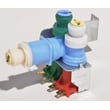
| Weak/no water to ice maker | Refrigerator inlet valve WP2188808 | Water flow into the refrigerator |
| Bad taste/slow water flow | Genuine Kenmore refrigerator water filter EDR6D1 | Filtration and flow restriction when clogged |
Warm temps, poor airflow, and leaky door seals force longer run times and can lead to food spoilage, frost buildup, and water leaks. Catching simple issues like blocked vents or sticky gaskets prevents bigger cooling-system strain.
Last updated: February 2026