Installation guide
 Owner’s manual
 Error Codes


Who makes Kenmore 11028632700?
Kenmore is a brand name, and different manufacturers have built Kenmore washers over the years. For Kenmore model 11028632700, the 110 model prefix identifies it as a Whirlpool-built washer.
How to confirm the manufacturer from the model tag
We recommend checking the model and serial label under the washer lid and matching the prefix.
- Open the lid and locate the model/serial label under the lid
- Confirm the model number is 11028632700
- Use the first three digits (110) as the manufacturer prefix
- Keep the model and serial number handy for parts lookup and service
For more details on where to find the label and how Sears uses the model number for service records, see the 11028632700 owner's manual.
What the 110 prefix means (quick reference)
| Kenmore model prefix | Typical manufacturer | What it helps with |
|---|---|---|
| 110 | Whirlpool | Parts compatibility, repair procedures |
| Other prefixes | Varies by series | Use the exact model number to match parts |
Why it matters
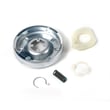
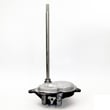
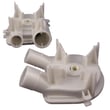
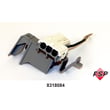
Knowing who built the washer helps us match the correct parts and repair approach (for example, Whirlpool-style direct-drive components such as a motor coupling, lid switch, or drain pump are common on many 110-series top-load designs).
If you are troubleshooting a symptom (won’t spin, won’t drain, won’t agitate), using the correct manufacturer family also helps narrow likely causes and the right replacement parts.
Last updated: January 2026
How to reset a Kenmore 11028632700 washer top loader?
To reset your Kenmore 11028632700 top-load washer, we recommend stopping the cycle with the Cycle Control knob, unplugging the washer for 1 to 5 minutes, then restoring power and restarting the cycle. This clears many “stuck” control states and restarts the lid-safety logic.
Quick reset steps (most common)
- Push in the Cycle Control knob to stop the washer.
- Unplug the washer (or switch the breaker off).
- Wait 1 to 5 minutes.
- Restore power.
- Close the lid and pull out the Cycle Control knob to restart.
For model-specific control details, follow the stop/restart instructions in the 11028632700 owner's manual.
If the washer still will not start after a reset
These checks solve the most common “no start” complaints on a mechanical-timer top loader:
- Confirm the lid is fully closed; the washer will not run if the lid switch is not made.
- Make sure the Cycle Control knob is pulled out firmly (some knobs feel “in between”).
- Verify the outlet has power (test with a lamp) and reset the home breaker if needed.
- If the washer fills but will not agitate or spin, inspect the drive system components.
Parts that commonly affect starting and running
| Symptom | Common suspect | Example part for this model |
|---|---|---|
| Won’t run with lid closed | Lid switch | Washer lid switch assembly WP8318084 |
| Motor runs but won’t agitate/spin | Motor coupling | Coupling 285753A |
| Won’t drain or stalls at drain | Drain pump | Washer drain pump WP3363394 |
Why it matters
A proper reset helps you avoid unnecessary part replacement by clearing a paused timer state and ensuring the lid-safety circuit is satisfied. If the washer restarts but stops again at the same point, that repeatable symptom usually points to a specific component (like the lid switch or drain pump).
Last updated: January 2026
How to unclog drain hose on Kenmore washer?
On Kenmore washer model 11028632700, we unclog the drain hose by safely draining any standing water, checking for kinks or a tight standpipe fit, then removing the hose and flushing or clearing the blockage. Finish by reinstalling the hose with a proper air gap per the 11028632700 installation guide.
Safety first
- Unplug the washer before servicing.
- Turn off both water taps.
- Keep towels and a shallow pan nearby; water will spill when hoses are removed.
- If the washer is full of water, bail out water first to reduce mess.
Step-by-step: unclog the drain hose
- Confirm the drain setup is correct: the top of the drain hose should be at least 39 in. (99 cm) above the floor, and the hose should not be sealed or taped into the standpipe (it needs an air gap).
- Inspect for simple restrictions: pull the washer forward and check for a kinked, crushed, or pinched corrugated hose.
- Remove the hose and clear it:
- Detach the drain hose from the home drain (standpipe or laundry tub).
- If you can access the washer end, remove the hose from the washer outlet.
- Flush the hose with hot water; use a flexible brush or a small drain snake to push out lint, coins, or sock debris.
- Reinstall correctly: route the hose without sharp bends and secure it so it is stable but still has an air gap.
Quick checks that prevent repeat clogs
- Avoid excessive detergent; heavy suds can slow draining.
- Do not force extra hose down into the standpipe.
- Keep the drain height within the typical range; the hose end should not be more than 96 in. (244 cm) above the floor.
Common symptoms and what they usually mean
| Symptom | Most common cause | What to do |
|---|---|---|
| Water remains in tub | Clogged hose or restricted drain | Clear hose and verify standpipe air gap |
| Washer drains then refills | Hose shoved too far into standpipe (no air gap) | Reposition hose so it is loose but secure |
| Won’t drain or spin | Lid not closed or drain restriction | Close lid, then clear drain path |
Why it matters
A properly routed, unclogged drain hose helps the 11028632700 drain fast, prevents siphoning (drain water flowing back), and reduces the chance of leaks and floor damage.
Last updated: January 2026